Saturday, April 17, 2-4pm at the International Hotel, 838 Kearny Street, San Francisco:
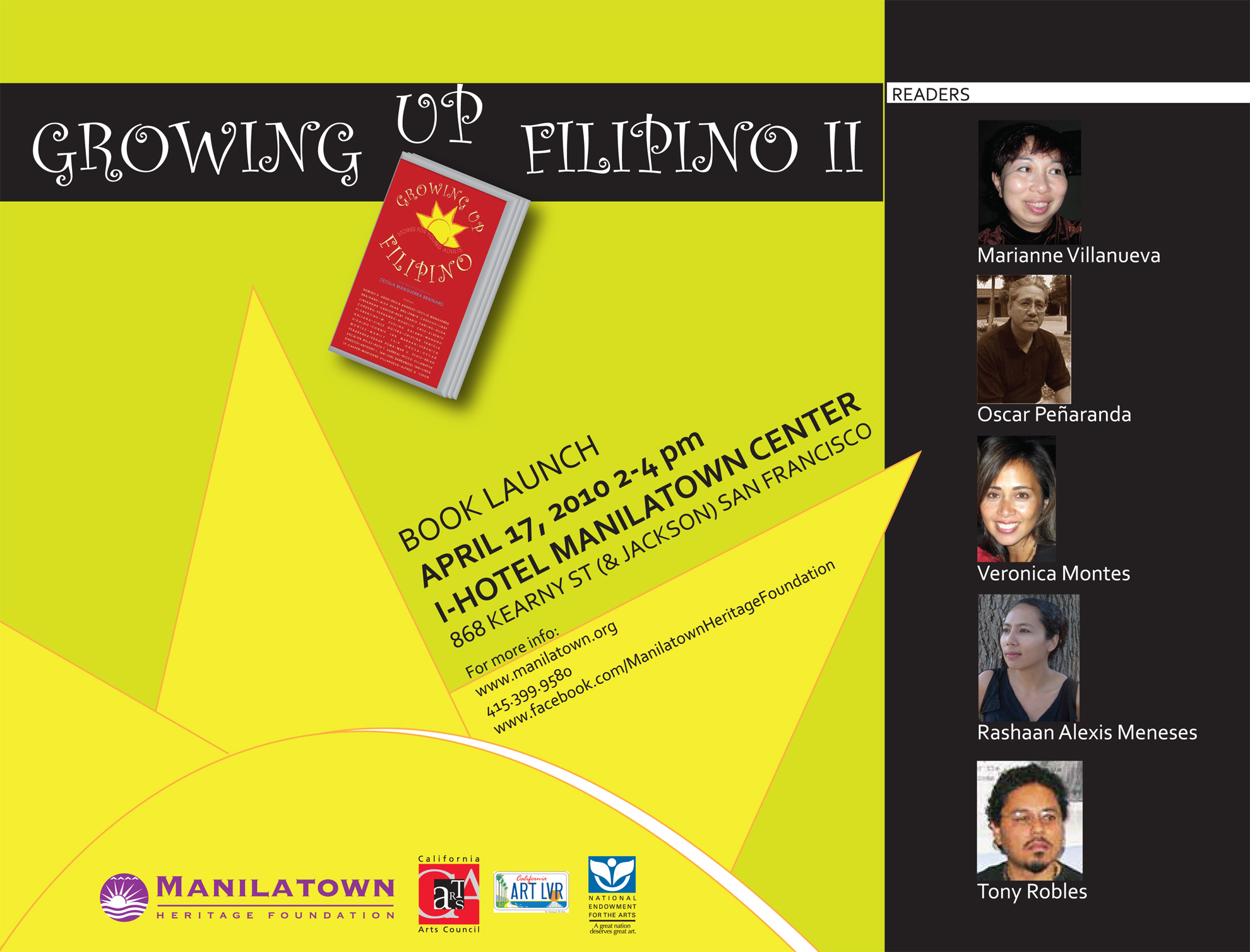
Saturday, April 17, 2-4pm at the International Hotel, 838 Kearny Street, San Francisco:
Poet and Professor Barbara Jane Reyes covers the University of San Francisco fiction talk and workshop for her class “Filipino American Arts” in her post “Random: Culture, Commodity, Performance, Production”
…I am also thinking about erasure and invisibility (so, what’s new?). Last week in class, we discussed Lysley Tenorio’s story, “Save the I-Hotel,” which moves back and forth between the 1930’s and 1977, specifically the day of the final evictions of the I-Hotel. The story follows two men, laborers named Fortunado and Vicente, who are I-Hotel residents during that entire time period. We get the kind of care they exhibit toward one another, one helping the other find employment, sharing space however cramped, protecting each other from white male violence, keeping each other company when loneliness and homesickness are consuming, lending a coat to keep the other warm. It’s very tender. How do these things not amount to love, and how is this love never romantic? So that’s that, about erasure and silence; we simply cannot know that 100% of the Manongs were hetero, though we never ever hear about Manongs who were not.
I am also thinking of Rashaan Alexis Meneses’s visit to my class, also last week. She discussed how she came to her story, “Here in the States,” from the anthology Growing Up Filipino II, and her series of stories about immigrant workers in our urban areas (specifically, Los Angeles), what things about their American lives we never know because even though they’re omnipresent, we never ask them to tell us their life stories. She talked about the process of writing these stories and considering an audience who may not have the same cultural knowledge, how much to explain and translate, and how to explain and translate, while balancing what the story needs, at what pace it needs to move, from whose point of view it must be told.
She also conducted a writing workshop for my students, based upon memories, items that always occupy a special or significant place in our memories, and how to go about writing about these things. We started with a list of seven items and from there, did a freewrite engaging all the senses. I like this, the practice of keeping a written inventory of memories to which we can always return as artists. I like how this practice can bring to light the many ways in which our individual memories, histories, and stories may intersect with our cultural memories, histories, and stories. My students had some really great responses, and were, for the most part, quite open about why those items were so important to them, and where they are now in relation to these items. I later on told Rashaan about my mental inventory, and that I always go back to the same memory; all of th.e items on my list pertain to that memory of visiting Papa’s house in Gattaran when I was six…
Read the rest of the post here.
More coverage on the fiction workshop at the University of San Francisco will be forthcoming…
Scenes from the book launch for Growing Up Filipino II: More Stories for Young Adults published by PALH and edited by Cecilia Manguerra Brainard, at the San Francisco Bayanihan Community Center, January 16, 2010.
From Times Union: Serving New York’s Capital Region, Albany, NY
A book of note: Growing up Filipino 2
January 15, 2010 at 10:27 am by Michael Janairo, Arts & Entertainment EditorHere’s an interesting book that probably deserves a wider audience: “Growing up Filipino 2.” Among the literature of the United States, a recognition of writers telling stories from a Filipino or Filipino-American point of view is often sorely lacking. So here’s one book that aims to expand the understanding of what it means to be American.
Community & Academic Writing Programs:
A Panel for Emerging Writers
When: 12/06/2009, 2 pm
Where: San Francisco Public Library, Latino Room B (lower level), 100 Larkin at Grove
Free and Open to the public, refreshments will be provided
The California Bay Area houses a diverse array of writing programs, both community-based and academic. For this event, an exciting panel of writers will provide information to emerging writers of color who are thinking of applying to various writing programs and need some guidance. We believe it’s so valuable for writers of color who have gone through community based writing programs and MFA (Masters of Fine Arts) programs to share their knowledge and experiences with others. A question and answer session will follow.
Some questions that will be discussed: Why did you decide to attend a community based writing workshop and/or an MFA program? How did you decide on where to apply? Why did you attend the program you attended? What was the structure of your program? What were the positive and negative aspects of your program?
Panelists include:
Rashaan Alexis Meneses (St Mary’s, Fiction MFA)
Claire Light (San Francisco State University, Fiction MFA)
Vickie Vertiz (VONA, KSW IWL)
Craig Santos Perez (University of San Francisco, Poetry MFA)
Oscar Bermeo (VONA, KSW IWL, louderArts)
Vanessa Huang (VONA, KSW, Kundiman)
“Words belong to each other.”
Reading The Moment and Other Essays, its so easy to forget all this technology we have at our fingertips. I’ve heard recordings of Eliot’s “The Lovesong of J. Alfred Prufrock,” so I wondered if Virginia had recordings of her own. What a thrill it might be to hear the sound of her voice, which is not quite what I thought she’d sound like but wonderful all the same.
 Rashaan Alexis Meneses