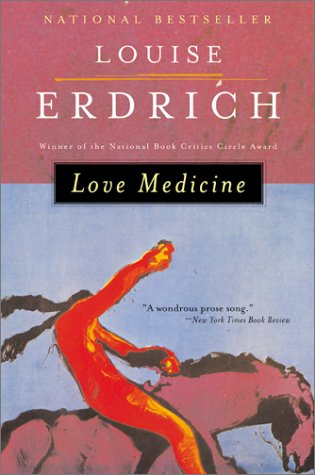
This winter’s schedule might not include teaching classes but that doesn’t mean there’s plenty of homework and reading to do. At the start of 2014, along with the ongoing and maybe some new creative writing projects, the research question rattling this mind is can post-colonial discourse(s) inspire, challenge, and inform the craft of fiction writing? Pictured below are just some of the authors who may or may not light the path with a little Djuna Barnes thrown in for fun.
Previous readings for those interested included John Tomlinson’s Cultural Imperialism (Continuum, 2001), Bill Ashcroft, Gareth Griffiths, Helen Tiffin‘s The Empire Writes Back (Routledge, 2002) and Graeme Harper’s Creative Writing Studies: Practice, Research and Pedagogy (New Writing Viewpoints, 2007). Not pictured but also to be tackled will be Gish Jen’s Tiger Writing: Art, Culture, and the Independent Self (Harvard University Press, 2013).
On Wednesday, November 20, 2:35-3:35 at Hagerty Lounge, Saint Mary’s College of California, yours truly will be part of an afternoon panel discussion on life after the MFA. Tapped to speak on residencies and colonies for 7-8 minutes, here’s some musings on what might be covered that afternoon, which we hope you can join.
Applying to Residencies
Why residencies? How does it sound to live, work, dine, and stroll with writers, artists, composers, dancers, choreographers for weeks or months? How about having food delivered to your door. Meeting for supper and a cocktail or two to talk shop about books, paintings, photography, and film? What of days and hours devoted solely to reading and reflecting on your work? Residencies in essence are a chance to hole away in some remote and often rural setting and remember what it means to read and create for the sake of reading and creating.
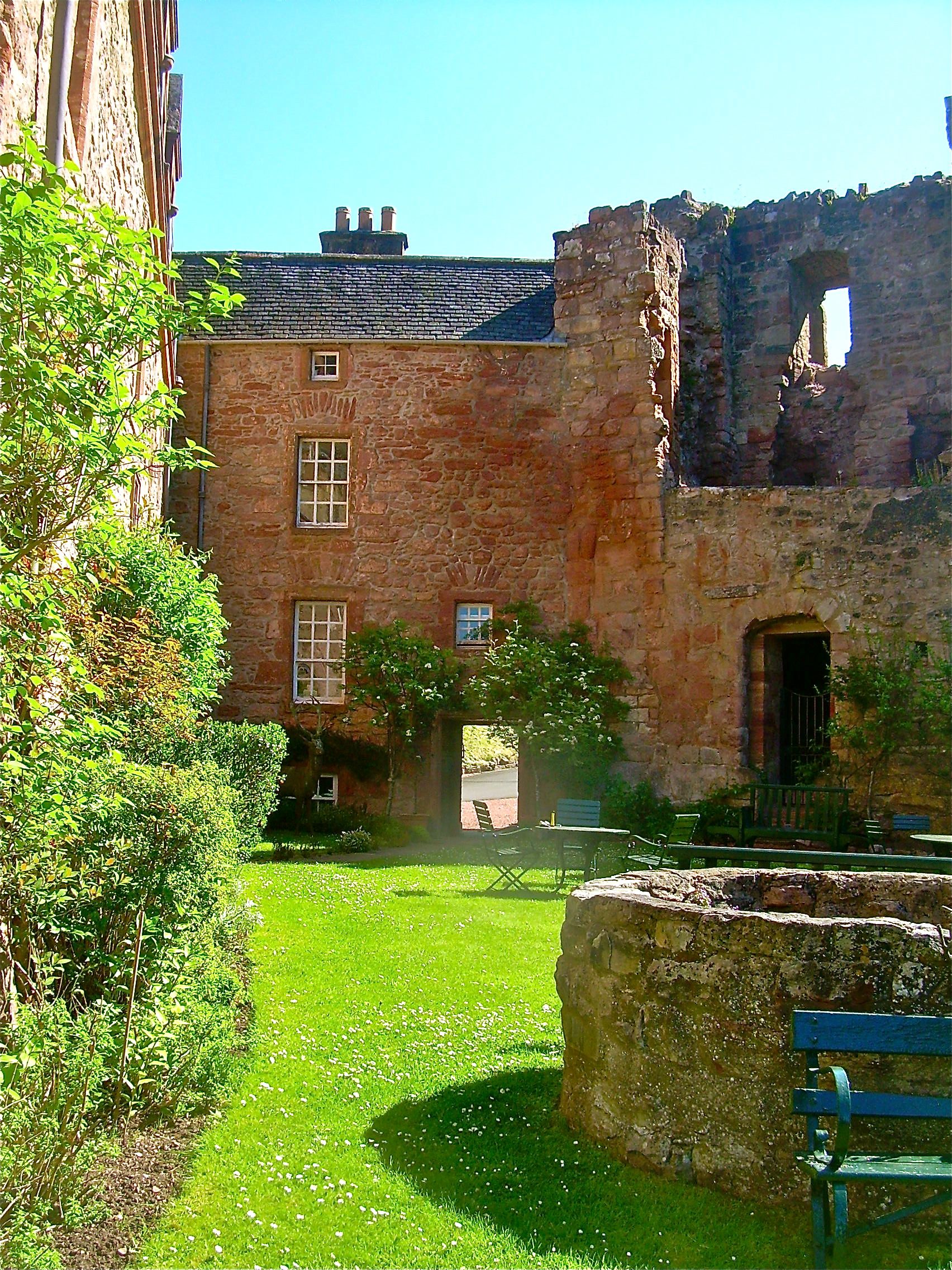
Retreat for Writers, Hawthornden Castle, Scotland, UK.
There’s no magic formula I know of but years of practice, revision, and navigating rejection. I’ve been applying to residencies and colonies since grad school, so I’ve had almost seven years honing my artistic statement and project description(s), which have seen many incarnations. I’ve been through countless drafts and am constantly revising every artifact I send out to apply.
Maintain contact with professors from graduate school since they are the community who will support you through this creative journey, and be sure to make the recommendation letter process as easy as possible by giving at least two months advance notice with all the supplies already stamped and addressed, ready to post. Keep a short sample, CV, and statement handy if they request it to refresh their memory about you and your work.
Keep refining both your artist statement/letter of intent and the writing sample. These are the two legs you’ll stand on when you face the faceless committee. Keep a list of questions and journal freewrites in response to keep the artist statement/letter of intent urgent and relevant. It should change as you evolve as a writer. I love this little gem of a book 344 Questions?: The Creative Person’s Do-It Yourself Guide to Insight, Survival, and Finding Artistic Fulfillment which I crack open every now and again just to exercise and play with portrayals of self. These musings come handy when piecing together and updating the artist statement.
Literature Summary Description (MacDowell Colony)
In two to five words, please describe the work you are proposing to do at the Colony. You will have an opportunity to describe the project in greater detail in the next step of the application. Examples: memoir, historical novel, short fiction, prose poetry.
In the space below, please provide a detailed description of the project you intend to work on at the Colony. If you have already begun the project, tell us where you are in the work process and what you hope to accomplish with your residency. The text field is limited to 2,500 characters including spaces.
Intended Project (MacDowell Colony)
Please provide a brief synopsis of the creative work you propose to write if offered a Residential Fellowship at Hawthornden. This may be work already in progress or work still in its infancy. You should be sure to mention any necessary research that you may need to undertake while in residence. Please limit your description to this sheet only.
While in Residence
Before I left for MacDowell, I got the best piece of advice from novelist and dear friend Mary Volmer who warned me not to place too much expectation or pressure on myself. “You’re not going to get everything you want done, but you will get what you need,” she urged, and she was right.
An hour feels like three in our studios. It’s amazing how much work you get done when you sit down to it, and let your mind settle with the tasks in front of you.
Some of the highlights are not just spending evenings talking with fellow artists but having a real
Mansfield Studio at MacDowell Colony in New Hampshire.
dialogue with your project. I found that once I was tucked into my cabin and allowed myself to reacquaint and essentially renew my vows to the craft and to the piece I’ve dedicated years of my life to, the project started speaking to me and telling me what needed to happen to it. I learned how to read and write all over again.
One of the many traditions practiced at the Colony is for fellows to give presentations of their work, whether it be a reading or an open studio, you’re encouraged to share your artistic endeavors. The idea wasn’t that appealing, really, until a fellow explained that its best to present earlier rather than later during residency so that other fellows will have much needed context in terms of why you’re here and what you’re doing. This context cements a substantive foundation to conversations at dinner, breakfast, random encounters on the hallway or on the way to the studio. The whole purpose of the colony is not just for individual, solitary work but to be a part of the community, and being a part of a community means sharing.
Mansfield Studio in the mist at MacDowell Colony
What to Bring
All your favorite creature comforts: chai tea, scented candles, warm socks, an eye mask, if you have trouble sleeping in strange places, blank pads of paper and post-its, permanent markers, push pins, chocolate, nice stationary and stamps to write to loved ones, a wall calendar to keep on task, a hard drive to back up regularly, a pocketknife, and gin, lots of gin or your personal choice of poison because you deserve it after a long day’s worth of reading and writing.
These websites are chock-a-block with listings of residencies and colonies:
Excited to be a part of this panel that includes Brenda Hillman, Joshua Mohr, and Colby Gillete where we talk about residencies, publishing, and doctorate programs at Saint Mary’s College, Wednesday, November 20, 2:35-3:35pm, Hagerty Lounge. Please share with interested parties and consider coming out.
With only hours away, the questions are being finalized, some of them reconsidered for audience and accessibility thanks to a heads up from Lysley Tenorio about audience.
Proving once again that a writer’s work is never done, below are the revised questions, which will probably be tweaked and re-tweaked a few more times before put to the panel which includes Luisa A. Igloria (poetry), Jon Pineda (poetry, memoir, fiction), and Lysley Tenorio (fiction).
Fil Am Book Fest II is going to be an impressive and inspiring literary love fest. Here’s hoping to do the writers justice!
How do you start? When do you know you’ve come to the end?
Luisa Igloria’s newest collection The Saints of Streets (UST Publishing house, 2013) are comprised mainly of narrative poems. Can we talk about genre and shuttling among forms since Pineda has written a memoir, poetry, and a novel, Lysley moving from short fiction to a novel and Luisa focusing most recently on narrative within poetry?
How has family shaped you as a writer? What memories or experiences in childhood and with family serve as foundational in terms of what inspires you to write and what you write about?
Currently reading Pineda’s Apology, so his novel is forefront in my mind and specifically this quote: “It was not a dream, though it felt like one. A beautiful piece of memory that could make him cry. Exequiel woke now, feverish. Out of his head. He summoned it from the faint scar woven in the bottom of his foot. A story hidden in the flesh.” So many of the tales interwoven in this novel are told through the body. I’m curious to know how does the flesh experience–since this is such a visceral and at times violent set of interlocked stories–how does flesh dictate the telling of the novel as opposed to chronology? I’d love to hear the panelists discuss how the body dictates their work.
In Tenorio’s story “Felix Starro” the narrator contemplates age, time, and space, “I had turned nineteen three weeks before, on the plane to America. But I didn’t know exactly when it happened–that whole time in the sky I wasn’t sure if it was today or tomorrow, which country was ahead or behind and by how many hours or days…” Can you talk about geography and place. Is there as the title of the panel and conference suggests, a way to write home?
In D.R.M. Irving’s book on musical history of the Philippines, Colonial Counterpoint: Music in Early Modern Manila, (Oxford University Press, 2010) he posits that Manila during the 16th and 17th centuries became the first truly cosmopolitan city, linking the East with the West, the old world of Spain with the new world of New Spain in Mexico. Since each of your works are arguably transnational, do you feel that you speak to a new cosmopolitanism or that you might be cosmopolitan yourself?
In the collection of essays Not Home But Here: Writing from the Filipino Diaspora, Luisa Igloria writes in her introduction of the “academic residence.” Might the panelists speak on multi-residences, be they academic, artistic, personal, familial, etc. and how they inform or influence your writing or shape the different self/selves as academic, writer, Filipino?
Who are you reading now?
What is the best dish or meal to sit down to after a day of writing?
Excited to be a part of this upcoming October weekend event. Yours truly will be moderating the panel “Writing Our Way Home: Shaping Tradition, History and Culture” with Luisa Igloria, Jon Pineda, Lysley Tenorio. Hope to see you there! For more info, click here.
Forty five minutes outside of Edinburgh, tucked in a hidden pocket of Midlothian, sits a 15th century castle where I spent my June at the Hawthornden International Retreat for Writers. Not even the bus drivers knew of the castle. Kept a secret, deep in a Scottish glen, the ruins, renovated in Victorian-era, were tipped on a crag overlooking the River Esk, and here I continued my ongoing education of reading and writing for a summer month.
But the story doesn’t start here.
If we were to go all the way back, it would have opened two years ago when at a faculty gathering poet and friend Raina León prodded me to apply. Get thee to a writing residency was her imperative, and she clued me in on this gem of a fellowship with a low profile at Hawthornden Castle. Thank you, Raina.
This fellowship is sponsored and run by the great patronage of Drue Heinz of the Heinz company. Publisher of The Paris Review, she established the Drue Heinz Literature Prize and the Drue Heinz Lectures in Pennsylvania. Deepest gratitude goes to Ms. Heinz and her staff.
There is no magic I know of that got me to Scotland for a month of committed writing. Persistence and focus is what I brought to the table. Applications to these residencies are something like gearing up for grad school. Long and involved forms that demand you know who you are, letters of recc to prove you are who you say you are, and a writing sample that speaks to enough people on the committees that matter. I’ve been applying to residencies off and on since grad school, which means I’ve lived in hope for over six years. Let me say again, persistence and focus.
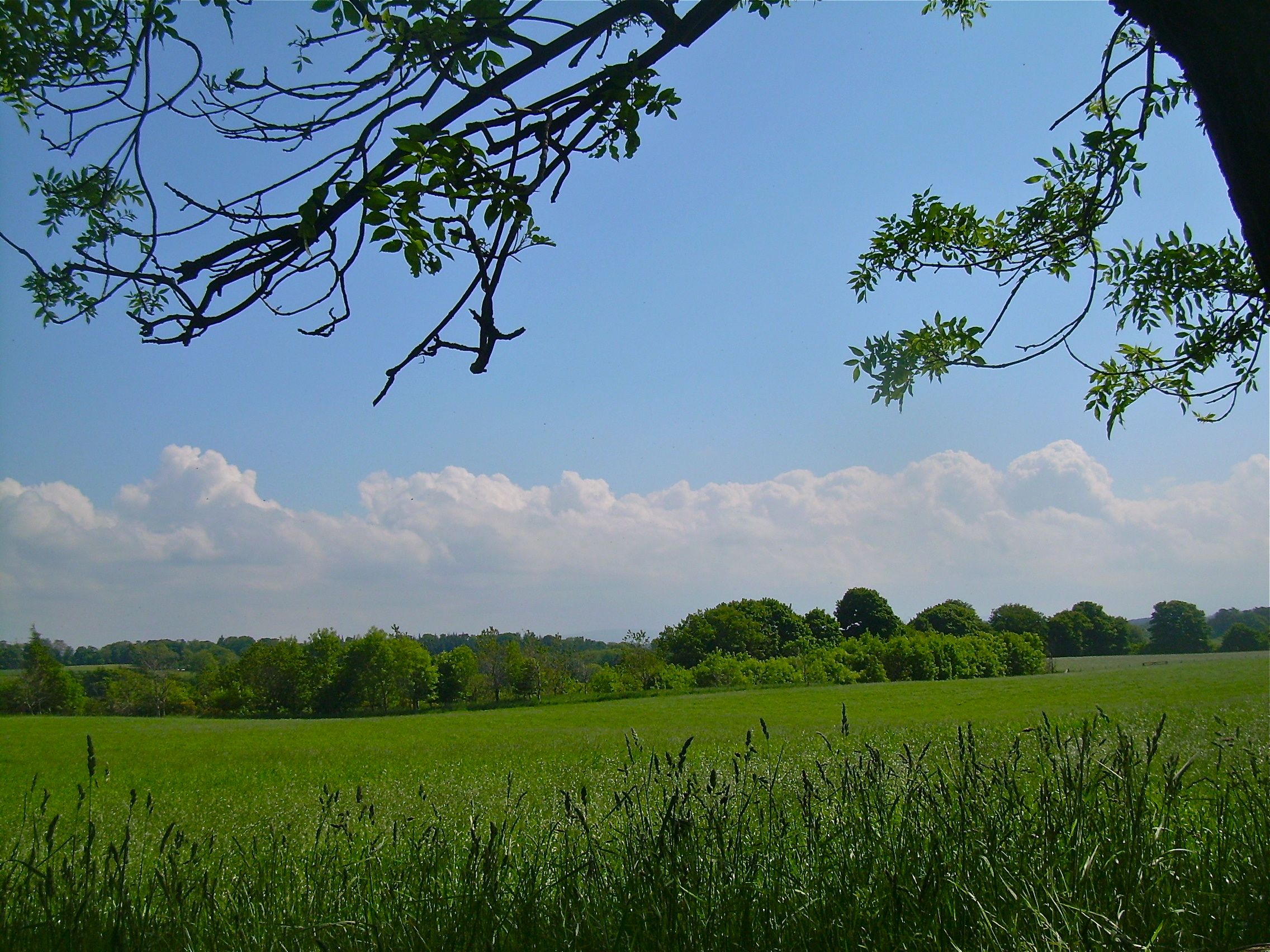
The Pentland Hills in the distance
The plane trip from San Francisco to Edinburgh was another test of patience: ten hours trying to sleep upright, a three hour layover in Charles de Gaulle, where splurging on Lauderée French macaroons was worth every euro, and a final two hours that seemed like forever before touching down in Scotland.
The sun still had a good hour to set when I finally arrived around 10pm, which I would later learn was the badgering hour. Jet-lagged and frazzled, I met two of the writers who I would live with for the next four weeks, one of whom was an East Coaster turned Bay Area based. She happened to know many of my colleagues and writer friends back in California and thankfully made me feel that much closer to home despite being a continent and ocean away.
***
The castle garden
Born to John Drummond, the first laird at Hawthornden Castle, William Drummond (1585-1649) turned laird of the castle himself at 24 when his father died. A poet and historian, William Drummond read well and widely, tackling the History of Scotland during the Reigns of the Five Jameses as one of his many literary works. Over 400 years later, in his study, a room where he was known to pace between tackling quill to paper, I stared out the window that overlooked the gravel driveway, pulled my hair out rearranging scenes and crossing out swathes of paragraphs, and dragged myself to bed, willing myself to sleep at midnight even as the last sun rays still poked their way through the west-facing window.
On the walk to the bus stop
On the first full day since my arrival, still adjusting to UK time, I woke at 5:30am to metallic squabbling and screeching of what I thought to be baby dinosaurs nesting right outside my western window. One bird would start up and then her siblings, would follow in discordant chorus. Almost every morning, afternoon, and early evening was graced with their shrill choir, and not only did I viscerally experience the scientific fact of how birds are cousin to pterodactyls and triceratops, but I understood how quickly and deeply I’d been thrust into nature. The castle was immersed in all things wondrous.
Evenings made the badgering hour when the lawn in front of the castle became a buffet table for a family of five hungry badgers. Stags, doe, and their fawns were frequently spotted on the road that led to the castle. Peregrines learned to fly just across the river, and we watched them from the castle garden at lunch time as they tested their wings. Spiders insisted rather persistently to claim the sinks and bathtubs as their resting spots. They were known to creep up cozy into our beds on more than one occasion.
***
I never knew I could be so jealous of poets.
The town of Roslin
These daily and nightly encounters with all things feathered, eight-legged, doe-eyed, antlered, and winged charged the poets, and they wrote with a sense of immediacy that doesn’t really jibe with long form fiction. One evening, a bat flew into the drawing room, circling over our heads for a good seven minutes. We tried to guide it out the window, but s/he seemed to enjoy our company more. Eventually, tiring of us, s/he took to an open casement and was gone. The next day, all three poets reported writing poems of our vespertine encounter. I hadn’t ever felt so keenly envious of poesie writers up until then. What I would have given to slip out of time for a day or two, to step away from my projekt and write in attendance to the here and now with such urgency? Fictions writers, particularly those noveling are stuck in another time zone and geography that rarely meshes with the present moment. We are caught in a loop of our own making.
***
We were there to write.
And we did. Everyday, at least six days a week, from eight in the morning to at least five in the evening. Oh, there were mid-day strolls along the castle grounds listening to the songbird soundtrack that ran from sun up to sun down, late afternoon jogs on the Old Railway to Dalkeith, and jaunts to Lasswade’s The Laird & Dog pub, which was the closest and easiest access to Wi-Fi. All sworn to an informal oath of silence while in the castle, Hawthornden’s motto was “Requiescat in Pace,” and from nine in the morning to six in the evening, we maintained relative quiet, so all writers could work in peace and decent ease.
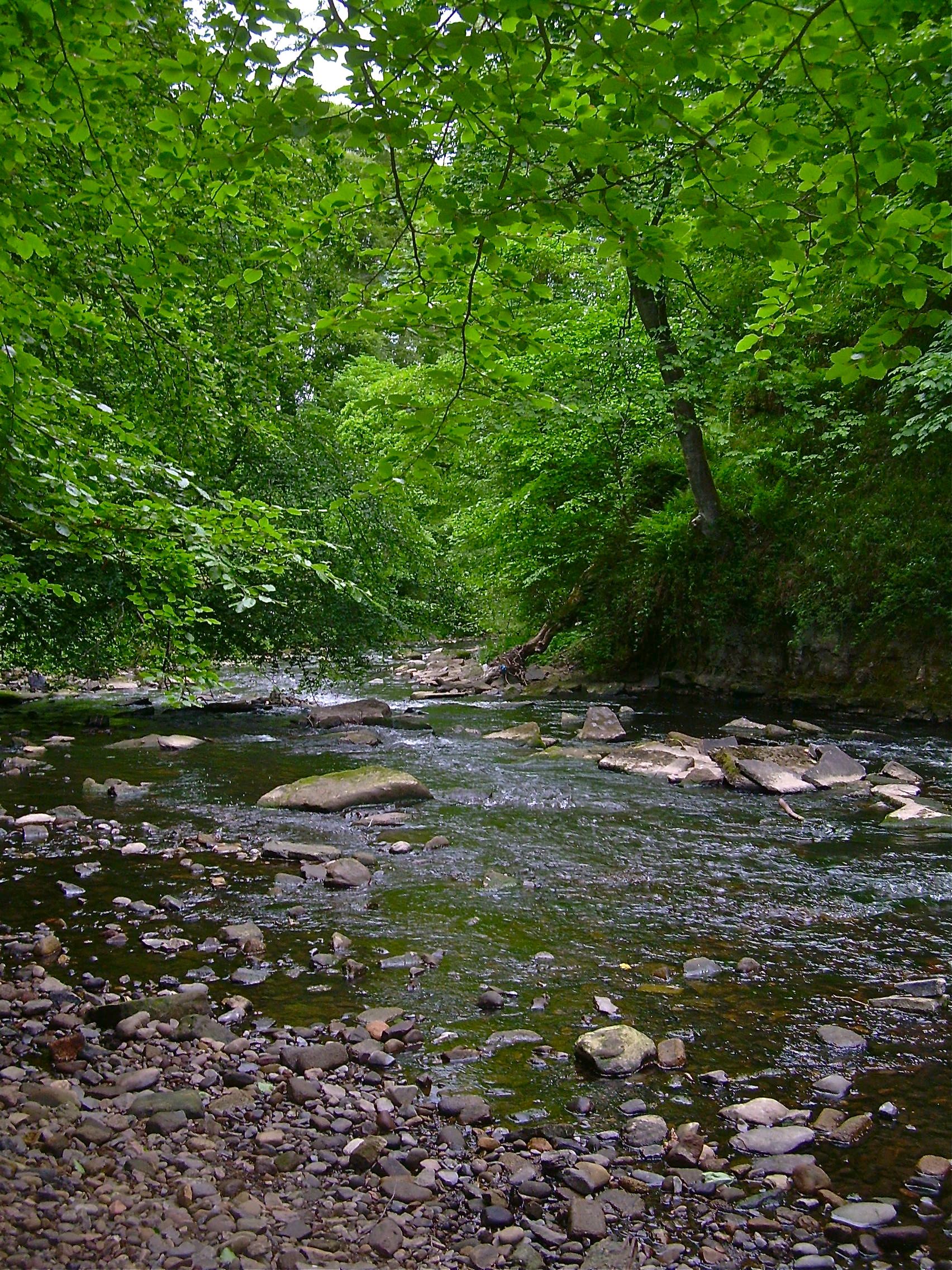
The River Esk
With no internet access, limited mobile service, and a vow to abstain from talking, the task of writing wasn’t necessarily easier but the setting secured focus and commitment to both the projekt at hand and the vital art in which all writing thrives, the act of reading. In a recent Guardian article “publicising a novel – the problems,” (Thursday 25 July 2013) Anakana Scholfield speaks to an issue close to this heart:
…why is there so much fuss in the media about how to write a novel – “everyone can become an author” – when the more important thing is how to read one?
There seems to have been a shift from a reading culture to a writing culture, a diminishment of critical space for the contemplation of literature. Writing needs to be discussed and interrogated through reading. If you wish to write well, you need to read well, or at least widely. You certainly need to contemplate reading a book in translation, unlikely to be widely reviewed in newspapers, many of which are too busy wasting space on “how to write” tips and asking about an author’s personal fripperies. It’s a great deal more fulfilling to read and think about a fine book than to attempt to write one.
Six years into the projekt, reading is the through line that keeps this writer grounded as the shape and meaning of the story collapses, condenses, and often over complicates itself, constantly morphing like land shifting under volatile forces. To write is to read. There’s no way around it. But how to keep up the art? How to maintain the necessary strength and focus for such a vital skill? You’d think that as one grows older, reading would become easier, but it doesn’t. Its just as much of a challenge as it ever was. Technology and the ten million distractions aren’t just to blame. The old adage the more I learn, the less I know seems to confound the reading eye. The mind skitters, won’t settle but jumps with expectations, preconceived notions, rather than sitting with words, images, sentences. Slowing down to savor syllables seems a fleeting wish. The reading mind must be taught and re-taught, and taught again. Its a muscle that can easily atrophy.
Reading at Hawthornden was s-l-o-w. As it should be.
Decades into becoming a “professional” reader, its hard to come to literature with an open mind. The more one reads, the more layered the lenses the reading eye gains and cannot shake away. So we must learn to read through prisms, knowing these prisms can be switched, combined, simplified, or complicated.
Prismatic. Requiring constant practice. The conjoined arts of reading and writing remained the main focus, but not the only activities at Hawthornden. There were encounters with Crusties, treks to the Pentland Peaks, and day trips to Edinburgh. But that’s all to come next…
For another a peek at the Hawthornden experience, check out poet and professor Gregory Leadbetter’s post “After Hawthornden” on his site.
Interested in writing fellowships and residencies? Yours truly has been booked in advance to talk about recent fellowships at The MacDowell Colony and the International Retreat for Writers at Hawthornden Castle in Scotland UK for Saint Mary’s College of California’s MFA Creative Writing Program Panel: “Life After the MFA”Wednesday, 20 November, 2:35pm, location on campus TBA.
Hope to see you there!
1928 Saint Mary’s Road, Moraga, CA 94556 (925) 631-4000
Fall calendering is well underway, in addition to speaking on artists’ residencies at Saint Mary’s College “Life After the MFA Panel” on 20 November this autumn, you can also catch some storytelling from yours truly at Babylon Salon’s LitCrawl 2013 event with the theme, “Razor’s Edge” on Saturday 13 October, 19, 6-9pm location TBD.
The Guardian UK loves lists, and they spend plenty of air time debating the purpose and usefulness of this form. Katie Kitamura waxes in her article “Literary Lists: Proof of our existence”:
Lists are used as a formally alienating device, a dehumanising agent, that is nonetheless entirely wrapped up in the question of human life.
How do we describe the fact of human existence? At a certain point, perhaps, style fails us. Language, even and in particular at its most evocative, becomes less of an aid and more of a difficulty. In these circumstances, a certain kind of writer has, again and again, reverted to the list – perhaps as the simplest proof of existence in the first place. It’s no accident that these lists often delineate material objects, the physical evidence of a life.
…[Umberto] Eco is talking about what I can only describe as a big feeling, and one that requires all the support of its formal and literary scaffolding. He is not, in the main, talking about grocery lists or lists of books read. But as long as we’re keeping lists, no matter what those lists are, we’re keeping faith with some idea of perpetuity. We are making the assumption that the list will endure even when we do not.
Furthering the idea that lists endure, The Guardian enumerated English literature’s 50 key moments from Marlowe to JK Rowling, registering historical moments and literary milestones. Here’s a taste:
Note: what follows is not merely a book list, but an attempt to identify some of the hinge moments in our literature – a composite of significant events, notable poems, plays, and novels, plus influential deaths, starting with the violent death of Shakespeare’s one serious rival …
1. The death of Christopher Marlowe (1593)
2. William Shakespeare: The Sonnets (1609)
3. The King James Bible (1611)
4. William Shakespeare: The First Folio (1623)78)
In the spirit of Eco’s perpetuity, here’s a personal record–certainly not exhaustive nor complete–noting moments of self discovery, influential people, places, films, musicians, mentors, trailblazers to follow, and other artifacts that have shaped this literary self. The below register doesn’t follow chronological order nor an order of importance but is a haphazard attempt to pin down the brightest constellations that wheel over my literary skies. Like any piece of writing, it’s been revised nth times over, and these fidgety fingers are still tempted to make further emendations. It will be interesting to revisit ten and twenty years from now and discover how the skyscape has shifted.
1. Central Station
2. The City of Angels
3. My soul mate, PJS.
4. Arundhati Roy’s The God of Small Things
33. Shakespeare’s Hamlet
34. Mr. Thurston’s Honors English class at Monte Vista High School and his extra credit reading list
35. Mr. Tato, Avocado Elementary School
36. Libraries at Highland Elementary, MVHS, Avocado, and Spring Valley Middle School
37. Elementary School Bookfairs (Scholastic Catalogs–does anyone remember these?)
38. Laura Ingalls Wilder Series
39. The Romantics: Shelley, Byron, Wordsworth, and the rest of the guys in the band
40. Charlotte Bronte
41. Emily Bronte & Wuthering Heights
Hopefully this inventory might give you pause to reflect over the personal and private moments that have shaped your art and passion. This could include lovers, would-be lovers, chance encounters, TV shows, songs, albums, poets, comediennes–whatever gets your engine revved. You’ll leave beloved people and places out that will make you cringe with regret, as I have, but that’s the nature of lists. As much as they stand as testament; they’re essentially ephemera like every other form we try and hold fast to. These watersheds don’t have to be explained but should mean everything to you.
& acclaimed author of West of Kabul, East of New YorkTamim Ansary
Also presenting transmedia artist Kate Durbin, novelist Renee Thompson, author of The Plume Hunter, and essayist and short story writer Rashaan Alexis Meneses.
Terry Bisson is an American science fiction and fantasy author best known for his short stories. Several of his works, including “Bears Discover Fire”, have won top awards in the science fiction community, such as the Hugo and the Nebula.
Tamim Ansary is the author of Destiny Disrupted: A History of the World through Islamic
Eyes and West of Kabul, East of New York, among other books. For ten years he wrote a monthly column for Encarta.com, and has published essays and commentary in the San Francisco Chronicle, Salon, Alternet, TomPaine.com, Edutopia, Parade, Los Angeles Times, and elsewhere. Born in Afghanistan in 1948, he moved to the U.S. in 1964. He lives in San Francisco, where he is director of the San Francisco Writers Workshop.


 Keep refining both your artist statement/letter of intent and the writing sample. These are the two legs you’ll stand on when you face the faceless committee. Keep a list of questions and journal freewrites in response to keep the artist statement/letter of intent urgent and relevant. It should change as you evolve as a writer. I love this little gem of a book 344 Questions?: The Creative Person’s Do-It Yourself Guide to Insight, Survival, and Finding Artistic Fulfillment which I crack open every now and again just to exercise and play with portrayals of self. These musings come handy when piecing together and updating the artist statement.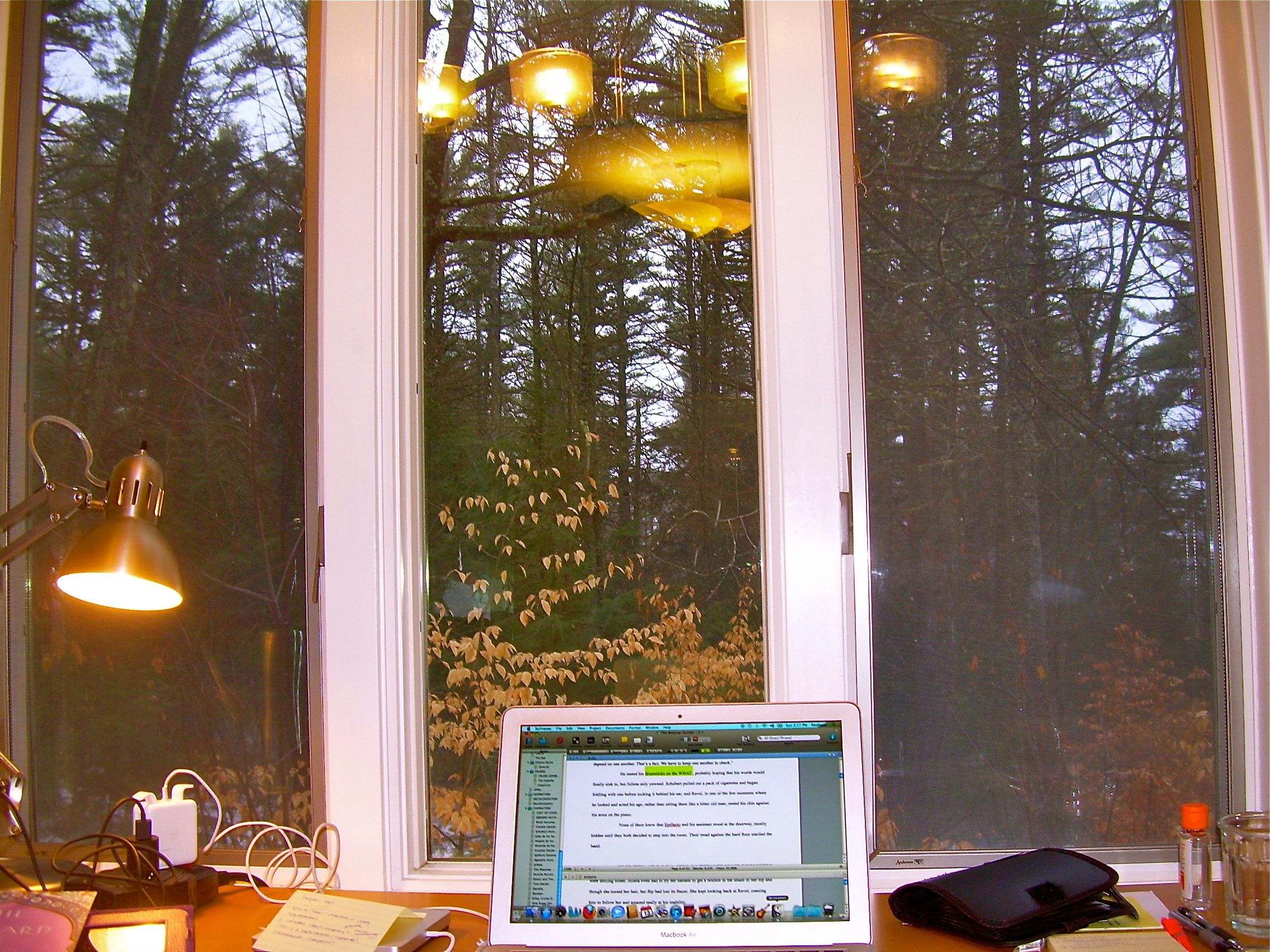








 Rashaan Alexis Meneses