Swinging into Spring with Upcoming Events

Paper presentation at Yale on “Engaging First Generation Students with Jean Jacques Rousseau’s Discourse on Inequality”

Paper Proposal: Clearly an outsider looking in, Jean-Jacques Rousseau exploits the adversity and hardships he’s faced as an exile, turning his experiences and observations into a source of empowerment and a means for enlightenment. In “A Discourse on Inequality” Rousseau’s rhetorical strategies, his critical view on hierarchy, and his refusal to accept the status quo, demonstrates for First Generation college students invaluable methods of critique and cognitive processes. First Generation students may often feel over-whelmed and estranged within institutions of higher learning, and a close reading and discussion of Rousseau provides a critical point of connection, shedding light on our own agency of power. While his contemporaries insist on entitlement, Rousseau reveals our own empowerment by illustrating how to engage critically within our community.


Frontispiece and title page of an edition of Rousseau’s Discourse on Inequality (1754), published by Marc-Michel Rey in 1755 in Holland.

***

Wednesday, April 27, 2011, 7:30pm
Reading with Rosemary Graham and Rashaan Alexis Meneses for Saint Mary’s College Creative Writing Series,

at Soda Center, Saint Mary’s College of California, 1928 Saint Mary’s Road, Moraga, CA.

Rosemary Graham
Rosemary Graham holds a Ph.D. in American Literature from the University of Virginia.  She is the author of Thou Shalt Not Dump the Skater Dude and My Not-So-Terrible Time at the Hippie Hotel. Her third novel, Stalker Girl, was published in August of 2010.  She is a professor of English at Saint Mary’s College of CA. 

rashaan meneses

Rashaan Alexis Meneses earned her MFA from Saint Mary’s College of CA, where she was named a 2005-2006 Jacob K. Javits Fellow and awarded the Sor Juana Indes de La Cruz Scholarship for Excellence in Fiction.  She has recently published in Pembroke Magazine and Growing up Filipino II: More Stories for Young Adults.

***

Keynote speech for  Saint Mary’s College of California’s Tenth Annual Asian Pacific American Graduate Celebration

Saturday, May 14, 2011

2:00 p.m. to 4:00 p.m.

Le Fevre Theater

Reception to follow in Delphine Lounge


Asian Pacific American Graduate Celebration

Tour of the San Francisco War Memorial Opera House

Inside the War Memorial Opera House

The San Francisco War Memorial Opera House gives monthly guided tours for a small fee of 25 clams per person. On these tours, visitors get a sneak peek at the current production as a work-in-progress, and, we’ve heard from several sources, that, depending on the docent, you get to see different parts of the house, meaning each tour is uniquely different. Here’s a quick rundown from our visit on October 2, 2010 when the house was preparing for Verdi’s Aida:

The Lobby

  • The light fixtures were made in Oakland.
  • The marble, on the walls, columns, and stairwell is from Tennessee.

The House

  • The stage extends 84 feet back.
  • Center stage, there was a small desk with a table light plugged into an extension cord where one of the staff. oversaw the crew. The desk was covered with binders full of paperwork.
  • 72 pipes hold the drapes (curtain).
  • A lot of the sets and scenery from past productions are housed in a separate warehouse.
  • The original design of the house was supposed to incorporate pipe organs though not a lot of operas require pipe organs.
  • Crew can run a bridge from orchestra to stage to move instruments and equipment.
  • There’s a catwalk to the chandelier to change lighting.
  • All the gold on the fixtures is gold leaf.
  • The orchestra pit has a moveable floor to transport pianos and harps.
  • The house also has a wind machine, which is turned by hand.
  • The curtains are made of silk and have a historical significance. So any remodeling or renovation needs to go through strict policies.
  • The curtains weigh 3,000 lbs.

Production Crew

  • Another crew member stands in the middle of the stage calling scene numbers.
  • All crew members have walkie talkies, two-way radios.
  • The prompter has to speak seven different languages only twenty people in the country who can do this. They have a nook behind the stage.
  • There are three video monitors on everybody acting.
  • Can’t really see the maestro.
  • Monitors are available for performers as well so they can see their maestro.
  • Supertitles are controlled by computer.
  • Lighting is all cued in advance.
  • The crew needs to synchronize everything, lighting and supertitles, with a principal to match whether she sings slow or fast.

Behind the Stage

  • The green room is at the back entrance, where guests can leave notes for talent.
  • Credentials only sign in front of green room.
  • Console monitor has three screens
  • Women’s principal dressing room has a full bathroom, a piano, a fan, a hair dryer, and is fully stocked with honey, curlers, makeup brushes, and bottles of rubbing alcohol everywhere.
  • Women are on one side of the stage and men on the other.
  • Clothes and wardrobe is equipped from across the stage.
  • In the women’s dressing room, the dresser is piled high with hair product, cotton, tea cups, bobby pins and safety pins.
  • Music stands are tucked everywhere behind the stage.
  • Lockers in the hallway.
  • Under stage is the rest of the cast’s dressing rooms and one level below is for supernumeries.
  • Gated audio equipment that is locked with warning signs all over it, including this sign: “LAPDANCE”, which stands for “Line Access Panel Digital Audio Network Control Enclosure. Death to those who arrange equipment.”
  • Black cables running everywhere.
  • Need to climb up to the prompter’s roost, where there’s a chair, monitor, libretto, a fan up there.
  • Prompters are there for hours, which can get claustrophobic.
  • Notices are posted to the walls every place that has main traffic so the cast and crew get updated notices.
  • They also receive text messages for updates.
  • Sub-basement where supernumeries change, the extras all have one shared room.
  • Call sheets are posted everywhere along with a schedule of productions.
  • Ladders also clutter the backstage.
  • There’s a lounge for wardrobe and makeup with posters of past productions.
  • The chorus has their own quiet room where there’s no food allowed.
  • Practice rooms are sound proof. No private lessons are allowed.
  • One of the rehearsal rooms is equipped with a computer that can simulate the performance environment, so the singer knows what she may sound like in huge halls, resound back, know how to project voice. Need to keep the architectural integrity of the house.
  • The music library holds all the music for all instruments.
  • Everyone has to have proper music on their stand.
  • There’s also a musical dictionary.
  • Musicians better not have the wrong score sheet, so for every rehearsal and performance, the staff need to have the correct number of copies. Someone has to keep all of this straight.

Costumes

  • All wardrobe for the next show is fitted well in advance, so the costumers need all measurements up front.
  • The rest of the costumes are stored at 9th and Howard.
  • Everything is labeled with names to it.
  • Clothes basket, laundry room.
  • Again, monitors are everywhere.
  • Everything gets laundered for the next day.
  • Plastic sheets with the costume changes listed inside of them along with times/cues as well as instructions on how to wear and fix makeup.
  • All costumes are in alphabetical order and order of changes.
  • The laundry room is packed with dryers, steamers and magnets are on all the appliances.
  • Six days a week the laundry room is busy.
  • The San Francisco chorus live here, so they’re always working.
  • International guests can sometimes stink up the clothes because they don’t use perfume.
  • 25 piles of laundry on average are cleaned a day.
  • With Aida, there’s 500 lbs of laundry.
  • Whatever is worn next to skin has to get washed.
  • Each cast member gets three towels as well: a hand, face, and wash cloth which also has to get washed.
  • Each cast has different colors for chorus, principals, but the towels are not monogrammed.
  • Most other opera houses don’t provide towels.
  • We also supply water for our maestros, which is a bonus.
  • Rolling carts above.
  • 6 months out of the year the ballet shares the facility.
  • Spend $3,000 on soap.
  • Run the machines three to four times a day.
  • Costs $75 for dry cleaning per costume.
  • Costumes that come from other productions smell differently because different companies use different detergents.
  • Cotton can get ripe pretty quickly.
  • The launderers also need to clean during dress rehearsals.
  • Vodka spritz can take away smells, just vodka, cheap vodka and water in a spray bottle saves the day.
  • One of the singers always comes and smells bad. The staff feels like they have to wear a gas mask.
  • 28 dressers are employed because it takes about 500 people to put on a show.
  • The laundry room is equipped with a dinosaur of a PC.

Makeup

  • Nametag with each assigned costume.
  • Each cast member has their own drawers for each person
  • The makeup room has a bulletin board and map.
  • Make up and wigs, provide drawings on how the eyes should be made up.
  • Everyone is assigned a makeup box for economic reasons.
  • Everyone does their own makeup, but then someone comes around to touch them up.
  • Principals are the only ones who get makeup artists. Big bottles of makeup remover in the makeup room.
  • Charts for each hair scene.
  • All the wigs are made of human hair though sometimes have to use yak hair for gray hair.
  • Wigs are hand-tied and hand-knitted.
  • There are 2,000 wigs housed at the SF Opera house to fit different time periods.
  • There’s a monitor in almost every room to keep check on the cues.
  • A cabinet at each chair.

More visits and more tidbits on the SF opera are forthcoming. Stop by and see what new discoveries have been made.

Finally, just for kicks, here’s the beautiful aria, “O Mia Patria” sung by Leontyne Price from Aida:

In honor of Saint Valentine

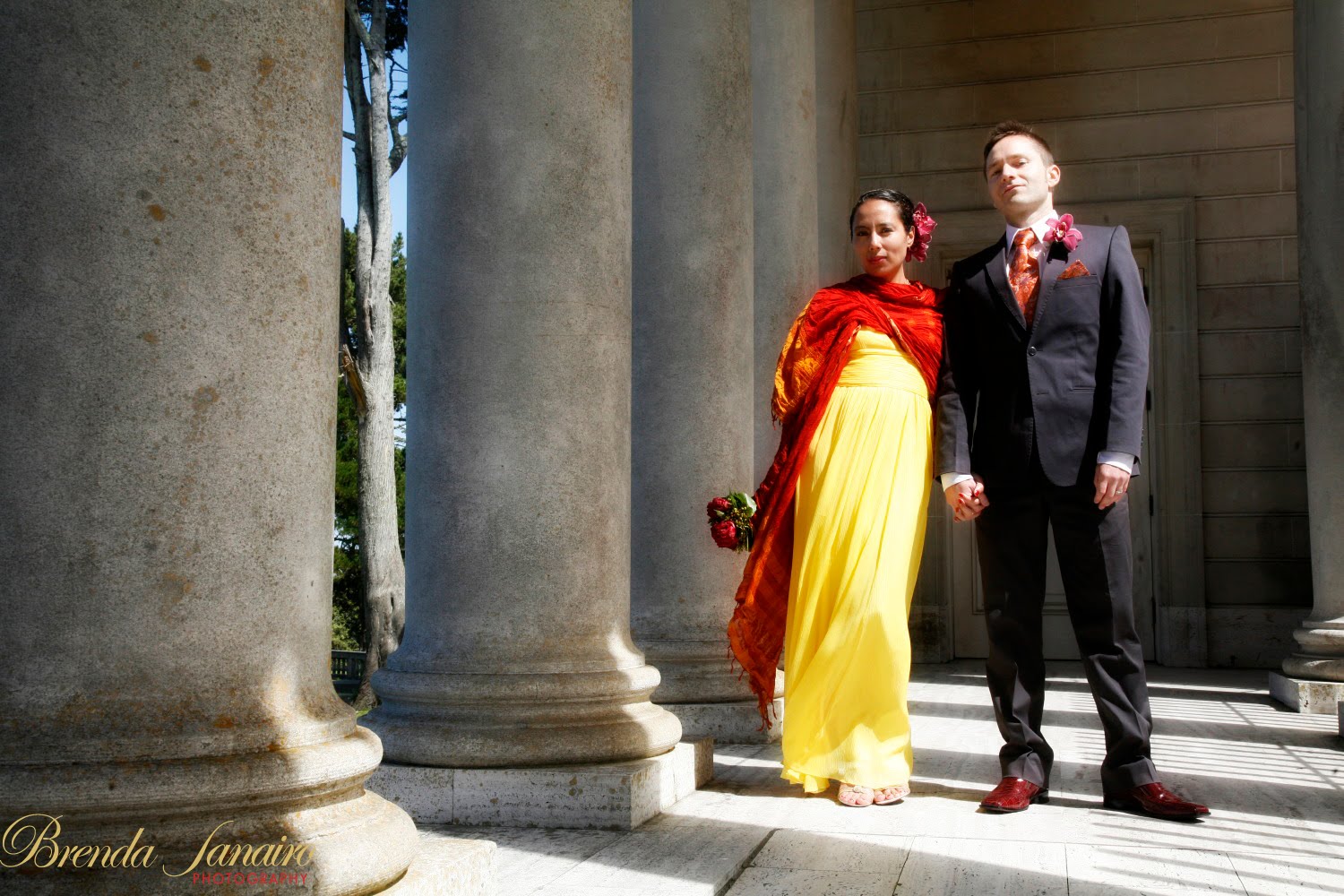
On the summer solstice, June 21, 2010, among dear family and close friends, my partner of twelve years and myself jaunted over to San Francisco City Hall for a civil union. When we arrived, we had just missed a tour of elementary kids who were boarding their buses as we filed in for our appointment to be wed ’til death do us part. After our ceremony under the rotunda, we whisked up to the top floor for a photo shoot meanwhile SEIU members demonstrated, singing “We Shall Overcome.” We followed our civil union with a photo shoot at one of our favorite venues, the Legion of Honors. The day closed with an exchange of vows on Ocean Beach, and after ward we celebrated with dinner at the Cliff House.

We were lucky enough to have this magical day documented by our one of our nearest and dearest friends, who I’ve known since our salad days at UCLA. The photographer, artist, and educator Brenda Janairo captured the solstice’s events with her artistry. Here’s an excerpt of her website:

Oh L’amour….Rashaan & Phil

Tuesday, July 20, 2010

I’m a sucker for love. I’m the one who watches all the weepy love flicks and cries like a baby. Yes, I admit, I love to cry. It’s not the mere action of crying that I love, but more the ability to connect to characters that I watch. To me that is what creates a beautiful film, characters I can sympathize with.
Now, when I connect to people in real life…tears do flow. A few weekends ago I had the honor of shooting the wedding of 2 amazing individuals, Rashaan and Phil.

For more photos click here.

Latest Muse: The Art of Mario De Rivera

Reading up on the Center for Babaylan Studies site, Babaylan Files, I stumbled upon the stunning art of Mario De Rivera whose work is reminiscent of Klimt and Kahlo. Someday, one of his pieces will hang on a brick and mortar wall of mine. For now, virtual admiration will have to do. For more on De Rivera’s paintings, check out the online thumbnails to his exhibit, “Fragments of Incantations” opening in June at the Hiraya Gallery in Ermita, Philippines.


Fragments of Incantation, 122 x 122 cm . Oil, Acrylic, Modeling Paste and Photo Transfers . 2003


Perfect Age: 121.5 x 121.5 cm . Oil, Acrylic, Modeling Paste and Photo Transfers . 2003

Recommended Reads

Everyone loves lists. Combine them with books and magic is made. Here’s a few recommended reads passed along to family and friends at their request.


A good friend asked for suggestions of lighthearted good reads, and these titles came to mind:

Strange Pilgrims1. EM Forster’s A Room with a View, so lighthearted the story is ecstatically dizzying. An absolute fave.

2. Sherman Alexie’s Ten Little Indians, hilarious short story collection

3. Jane Austen’s Northanger Abbey, perfect reading for fall; its Austen’s take on gothic romance, which ends up more as a mysterious romp.

4. Gabriel Garcia Marquez’s Strange Pilgrims, a wondrous collection of short stories, not necessarily lighthearted but certainly marvelous.

5. Jeannette Winterson’s The Passion, a spell-binding tale in 17th(?) century Venice. One very sexy romp.


***

Bucket List Reading

You can find Dickens’ novels online at The Free Library or subscribe to Daily Lit and have chapters sent to you regularly via email.
http://www.thefreelibrary.com/
http://www.dailylit.com/
Cover of Ten Little Indians - Charles Rue Woods, Grove Press Books 

Because I can’t resist, here’s top recommendations expressly for you:

1. Love Medicine by Louise Erdrich- a classic collection of Native American stories from one of my favorite writers. (Excerpts can be found on Google books)

2. House on Mango Street or Woman Hollering Creek– There’s nothing else to say about these works but two words: Sandra Cisneros.

3. Ten Little Indians by Sherman Alexie- another great collection of Native American stories, this time gut-wrenchingly funny.

4. Charlotte Bronte’s Jane Eyre– An absolute favorite. Its got everything, magic, revenge, romance, and woman power.
http://brontec.thefreelibrary.com/Jane-Eyre

5. Gabriel Garcia Marquez’s Strange Pilgrims is filled with fantastic tales.

Hope these suggestions help. Happy Reading!

***
Classic Novels for Kindle:

Here’s three classic novels that immediately came to mind (so hard for me to name just one 🙂 Dickens’ Our Mutual Friend. Very funny, incredibly inventive, and his best work. Conrad’s The Secret Agent. Short, explosive, and relevant for today. EM Forster’s A Room with a View a light Italian romp that has plenty of philosophical fodder to give the characters and story heft. Hope these help!
Our Mutual Friend Charles Dickens Housmans Bookshop

Holiday Shopping with Head, Heart, and Hands

Still scrambling for holiday gifts? Tis the season to celebrate family, friends and community by supporting local businesses. Consider shopping with head, heart, and hands with some of these favorite local purveyors:

BOOKS

Anvil Publishing – Just released Angelica’s Daughter, “A Dugtungan Novel, a collaborative work written by five established Filipino and Filipino American women writers.  The five authors came from different countries during the creation of the novel: Cecilia Manguerra Brainard and Veronica Montes lived in California; Susan Evangelista and Erma Cuizon were in the Philippines, and Nadine Sarreal was in Singapore.” This publisher has a wide range of Pin@y literary selections that should be in every savvy reader’s library.
Arkipelago | Wood Carvings spacer

Continue reading “Holiday Shopping with Head, Heart, and Hands”

Sightings Elsewhere from the Blogosphere

Your Salonniere is grateful for such wonderful colleagues and supportive friends who have lent their time and virtual space to give some shout outs. Many thanks to Jennie Durant and Veronica Montes for coverage on your sites!

Speaking of brave and wonderful writers, I would like to draw your attention to two excellent stories. The first is “In My Country,” by Tony Robles; the second is “Like Fish to Ginger,” by Rashaan Alexis Meneses. Take a few minutes out of your Internet surfing and enjoy; I know I did.

My talented friend and fellow M.F.A. graduate Rashaan Meneses recently wrote “Like Fish to Ginger” a lovely and haunting story about a Thai immigrant and the complex chemistry of food and romance. Read the first few paragraphs here, then click on the link for more. It’s a beautiful read. The only downside is that now I’m dying for a bowl of curry…

Steamed Fish with Ginger and Scallions (Ging Zheng Yu)
Photo: Christie Johnston

New Fiction on UC Riverside’s “The Coachella Review” Fall 2010 Online Issue

Once in a blue moon, mountains are moved, seas are shifted, and your Salonniere gets lucky enough to have a piece published. If you like Thai food, love/hate Los Angeles, or enjoy quirky short fiction, please check out my short story, “Like Fish to Ginger” included in The University of California, Riverside’s The Coachella Review Fall 2010 online issue. Many thanks to SMC Fiction MFA’ers for helping to make this possible. And, if it strikes your fancy, please pass the word along to friends, family, colleagues, students, blogs, tweets, Facebook, etc. Thanks for all your wonderful support.

Try a taste:

Like Fish to Ginger

By Rashaan Meneses

Before I set out to make my mark in Los Angeles, I chased Sunee. We met in a steamy noodle house in the Dusit District of Bangkok where I elbowed my way from dishwasher to sous chef. Sunee worked as hostess. Both seventeen, she knew exactly what she wanted, and it wasn’t me. Like with a delicate soup, I had to know when to stir and when to let the ingredients meld on their own. For seven months I coaxed her to me, savoring every minute of it, the taste of falling in love. This was all ages ago when cooking was like breathing.

Check out the entire piece, about a 15-minute read, at The Coachella Review.

Los Angeles

Book Release: “Angelica’s Daughters”

PLEASE MARK YOUR CALENDAR – Saturday, Nov. 6, 5:30-7 pm, Angelica’s Daughters in San Francisco–  a reading/signing of ANGELICA’S DAUGHTERS, A DUGTUNGAN NOVEL, in a PAWA sponsored event, Saturday, November 6, 5:30-7 p.m. at the Bayanihan Community Center, 1010 Mission Street, San Francisco, California.

ANGELICA’S DAUGHTERS, A DUGTUNGAN NOVEL

Released by Anvil Publishing during the Manila International Book Fair last September, was a landmark novel entitled, Angelica’s Daughters, A Dugtungan Novel, a collaborative work written by five established Filipino and Filipino American women writers.  The five authors came from different countries during the creation of the novel: Cecilia Manguerra Brainard and Veronica Montes lived in California; Susan Evangelista and Erma Cuizon were in the Philippines, and Nadine Sarreal was in Singapore.

The five writers were members of an Internet writing group since 2003. After a few years of writing exercises, the group sought greater challenge and decided to write a dugtungan novel. A dugtungan is a genre of Tagalog novel popular early in the 20th century, in which each writer creates a chapter and hands it off to the next, who writes another chapter without direction.

The result is a novel about a diverse group of modern Filipinas – among them a FilAm whose marriage has disintegrated, an even younger Cebuana involved in a forbidden love affair, and a ballroom dancing Lola – who share a common ancestor, Angelica.

The novel has received praise from noted Filipino critic, Isagani Cruz, who says, ““This tale of two women living a century apart (and the women and men in their lives) told sequentially by five women is truly an ensemble performance worth a standing ovation.”

Award-winning Filipina writer, Felice Sta. Maria describes the novel as follows:

“Chick lit with a comfortable dose of smartness and historical verve. Angelica’s Daughters celebrates audacious heroines primed by deep passion and fairytale romance! Set in the heat of a 19th-century Asian revolution and what its setting becomes by the 21st Century, Angelica’s Daughters beguiles with its mythic splendor, threat of a generational curse, masterful betrayals, and female leads readers can fall in love with.
The story is a delightful read by five writers who cherish their Hispanic, Filipino, and American cultural roots.”

Brian Roley, Filipino American award-winning author likewise praises the book by saying, “Part of the pleasure of reading Angelica’s Daughters is seeing how deftly the authors deal with the challenge of writing in this resurrected literary form. The result, in this case, is an ensemble performance that contains something of the exhilaration of theatrical improv. One watches these accomplished authors inventively weave a historical romance, creating gripping heroines and turns of plot, crossing decades and national boundaries, tapping into cultural roots of the Philippines, Spain and America. Reading Angelica’s Daughters is a gripping experience.”

In the Philippines, the book is available from Anvil Publishing (www.anvilpublishing.com); in the US, the novel is available from PALH (www.palhbooks.com) and Philippine Expressions (linda_nietes@sbcglobal.net). Arkipelagobooks.com in San Francisco also has copies.

The novel has a site at www.palhbooks.com/cbrainardangelica.html, and a blog at http://angelicasdaughters.wordpress.com.

Globalisation & Cosmopolitanism

On the Facebook, of all places, I reconnected with a fellow SMC MFA’er and college professor who is teaching a fall semester course on “Globalization and Cosmopolitanism,” two passions of mine. Our discussions got me thinking about how I could revamp some of my composition courses. Below is a list of possible source materials that come to mind as I consider re-designing my syllabi (all sources deal with transnational politics, immigration, citizenship, etc):

FILMS

1. The Constant Gardner

2. Bread and Roses

3. Dirty Pretty Things

4. The World


5. Kinamand

6. Maria Full of Grace

7. Angel-A

8. Recommended by colleague, Where the Green Ants Dream

ESSAYS & ARTICLES
1. Roger Cohen’s NY Times’ columns deal with globalization and global citizenship, and I’ve had some classroom success with his astute article “The Global Rose as a Social Tool” published March 13, 2008:

Most of the roses I saw were destined for the Sainsbury’s supermarket chain in Britain, with a price tag of the equivalent of $10 already affixed. I asked Helen Buyaki, aged 27, one of 1,800 employees at the farm, what she earns: “4,500 shillings a month.” That’s 70 bucks.

Look at the global economy one way and Buyaki earns the equivalent of seven bunches of roses for a month’s labor. That smacks of exploitation. Look at it another and she has a job she’d never have had until globalization came along.

2. Arundhati Roy’s speech “Come September”, September 18, 2002

Nobody puts it more elegantly than The New York Times columnist, Thomas Friedman. In an article called, “Craziness Pays”, he said, “The U.S. has to make it clear to Iraq and U.S. allies that…American will use force without negotiation, hesitation or U.N. approval.” His advice was well taken. In the wars against Iraq and Afghanistan as well as in the almost daily humiliation the U.S. government heaps on the U.N. In his book on globalization, The Lexus and the Olive Tree, Friedman says, and I quote, “The hidden hand of the market will never work without the hidden fist. McDonalds cannot flourish without McDonnell Douglas…and the hidden fist that keeps the world safe for Silicon Valley’s technologies to flourish is called the U.S. Army, Air Force, Navy, and Marine Corps.” Perhaps this was written in a moment of vulnerability, but it’s certainly the most succinct, accurate description of the project of corporate globalization that I have read.

BOOKS
1. Unmasking Los Angeles: Third World Cities, non-fiction collection of essays, edited by Saint Mary’s professor, Deepak Sawhney

2. Graceland, novel by Chris Abani

3. Balzac and the Little Chinese Seamstress, Dai Saijie (also adapted into a film but the books are always better)

4. The Secret Agent, novel by Joseph Conrad

5. Travel as a Political Act, non-fiction travel book by Rick Steves

6. Cosmopolitanism: Ethics in a World of Strangers, philosophy by Kwame Anthony Appiah