Book Release: “Angelica’s Daughters”

PLEASE MARK YOUR CALENDAR – Saturday, Nov. 6, 5:30-7 pm, Angelica’s Daughters in San Francisco–  a reading/signing of ANGELICA’S DAUGHTERS, A DUGTUNGAN NOVEL, in a PAWA sponsored event, Saturday, November 6, 5:30-7 p.m. at the Bayanihan Community Center, 1010 Mission Street, San Francisco, California.

ANGELICA’S DAUGHTERS, A DUGTUNGAN NOVEL

Released by Anvil Publishing during the Manila International Book Fair last September, was a landmark novel entitled, Angelica’s Daughters, A Dugtungan Novel, a collaborative work written by five established Filipino and Filipino American women writers.  The five authors came from different countries during the creation of the novel: Cecilia Manguerra Brainard and Veronica Montes lived in California; Susan Evangelista and Erma Cuizon were in the Philippines, and Nadine Sarreal was in Singapore.

The five writers were members of an Internet writing group since 2003. After a few years of writing exercises, the group sought greater challenge and decided to write a dugtungan novel. A dugtungan is a genre of Tagalog novel popular early in the 20th century, in which each writer creates a chapter and hands it off to the next, who writes another chapter without direction.

The result is a novel about a diverse group of modern Filipinas – among them a FilAm whose marriage has disintegrated, an even younger Cebuana involved in a forbidden love affair, and a ballroom dancing Lola – who share a common ancestor, Angelica.

The novel has received praise from noted Filipino critic, Isagani Cruz, who says, ““This tale of two women living a century apart (and the women and men in their lives) told sequentially by five women is truly an ensemble performance worth a standing ovation.”

Award-winning Filipina writer, Felice Sta. Maria describes the novel as follows:

“Chick lit with a comfortable dose of smartness and historical verve. Angelica’s Daughters celebrates audacious heroines primed by deep passion and fairytale romance! Set in the heat of a 19th-century Asian revolution and what its setting becomes by the 21st Century, Angelica’s Daughters beguiles with its mythic splendor, threat of a generational curse, masterful betrayals, and female leads readers can fall in love with.
The story is a delightful read by five writers who cherish their Hispanic, Filipino, and American cultural roots.”

Brian Roley, Filipino American award-winning author likewise praises the book by saying, “Part of the pleasure of reading Angelica’s Daughters is seeing how deftly the authors deal with the challenge of writing in this resurrected literary form. The result, in this case, is an ensemble performance that contains something of the exhilaration of theatrical improv. One watches these accomplished authors inventively weave a historical romance, creating gripping heroines and turns of plot, crossing decades and national boundaries, tapping into cultural roots of the Philippines, Spain and America. Reading Angelica’s Daughters is a gripping experience.”

In the Philippines, the book is available from Anvil Publishing (www.anvilpublishing.com); in the US, the novel is available from PALH (www.palhbooks.com) and Philippine Expressions (linda_nietes@sbcglobal.net). Arkipelagobooks.com in San Francisco also has copies.

The novel has a site at www.palhbooks.com/cbrainardangelica.html, and a blog at http://angelicasdaughters.wordpress.com.

At the Salon: GoodReads Review on the anthology “Growing Up Filipino II”

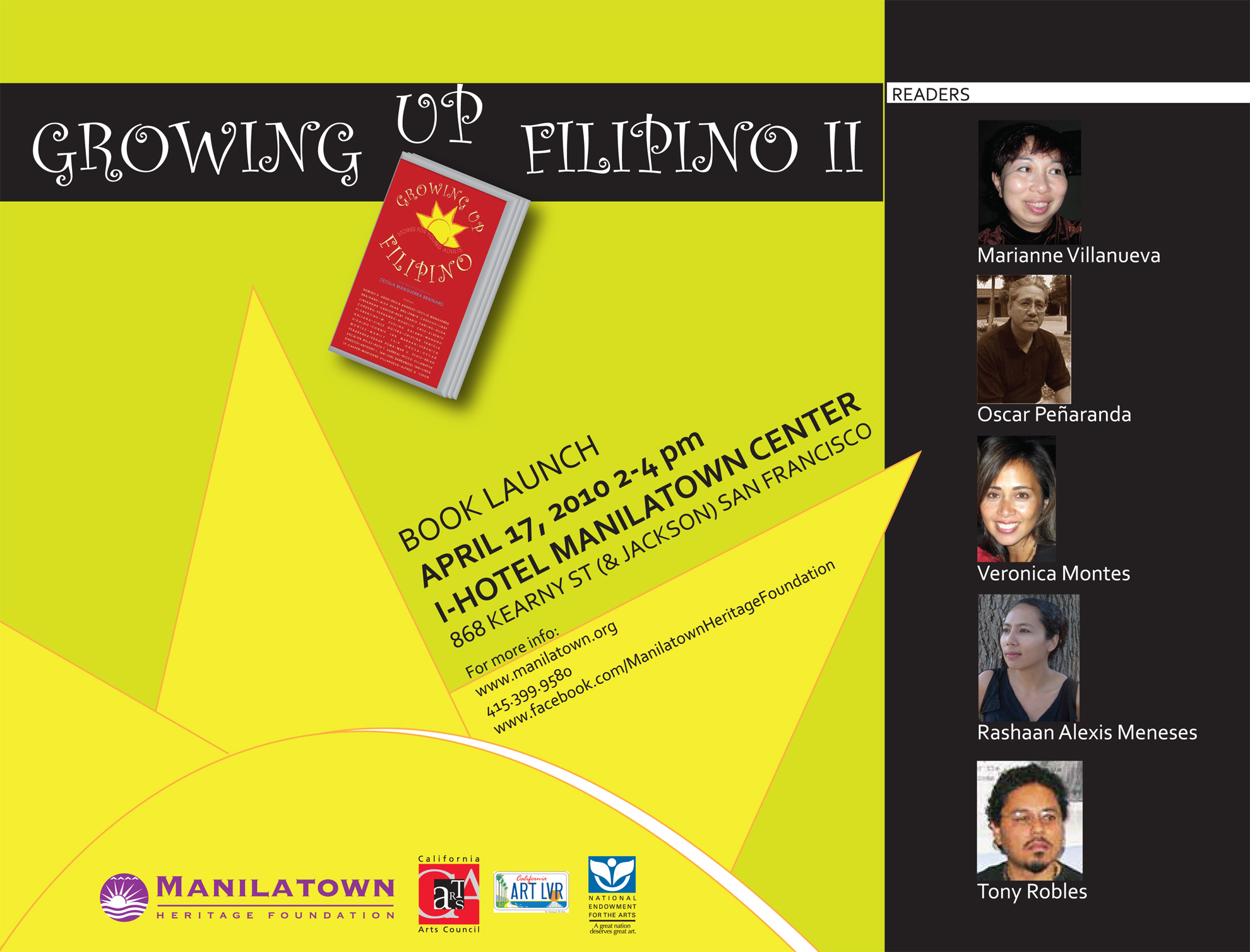
Growing Up Filipino II: More Stories for Young Adults Growing Up Filipino II: More Stories for Young Adults by Cecilia Manguerra Brainard

My rating: 4 of 5 stars
**DISCLAIMER: This review is written by one of the contributors from the anthology. Please read with discretion.**

In her Borderlands/La Frontera, Gloria Anzaldúa writes of the mestiza consciousness: “The new mestiza copes by developing a tolerance for contradictions, a tolerance for ambiguity. She learns to be an Indian in Mexican culture, to be a Mexican from an Anglo point of view. She learns to juggle cultures. She has a plural personality, she operates on a pluralistic mode–nothing is thrust out, the good, the bad, and the ugly, nothing rejected, nothing abandoned. Not only does she sustain contradictions, she turns the ambivalence into something else.” The Filipino-ness, as discussed by Rocio G. Davis in his introduction and depicted by the twenty-plus authors in this anthology, develops more than a tolerance for contradictions but zeroes in on the good, the bad, and the ugly, drawing strength, voice, character, and meaning out of the ambiguity that lies at the inherent core of Filipino and Fiilpino-American experiences. Filipino history is Pluralism, and Cecilia Manguerra Brainard through her keen compilation and organization of these deceptively simple tales shows readers the complexity of individual experiences and stories in this beautifully orchestrated anthology.

Read entire review here at Ruelle Electrique

“Into the Woods”: a faculty retreat reading list

Jenifer K. Wofford’s “MacArthur’s Nurses” (2008)

Your Salonniere has organized the reading list for this summer’s Collegiate Seminar Faculty Retreat for Saint Mary’s College of California. The theme of this retreat, “Into the Woods,” focuses on perception and consciousness of the Unknown, the Other, and the Wild. Inspired by the advocacy work of poet and professor Barbara Jane Reyes, who also introduced me to Jenifer K. Wofford’s art, these selections, juxtaposed together, will hopefully reveal surprising similarities among artists who might otherwise seem disparate. I’m looking forward to seeing how the faculty respond to the works individually and as a collective.

Schedule for the Neville and Juanita Massa Institute

at Huntington Lake, Summer 2010

July 29- August 1

“Into the Woods”

Thursday, July 29

8:00 – 10:00pm, Session I:  Percy Bysshe Shelley, “Mont Blanc” (poem), 1817.

Friday, July 30

10:00 am – noon, Session II:  Trinh T. Minh-ha, “The Language of Nativism” (46-64) (essay excerpt), from Women Native Other, 1989 [facilitator TBD].

7:30 – 9:30pm, Session III:  E.M. Forster, “Introduction” and “Other Kingdom” (short story) from The Celestial Omnibus and Other Stories, 1947 [facilitator TBD].

Saturday, July 31

10:00am – noon, Session IV:  Carlos Bulosan, “The Growth of Philippine Culture” (115-123), “My Education” (124-130), “Freedom from Want” (131-134) (essays) from On Becoming Filipino: Selected Writings and Jenifer K. Wofford, “MacArthur Nurses” (painting) 2008, and MacArthur’s Leyte Landing, (photo) October 1944 [facilitator TBD]

7:30 – 9:00pm, Session V:  Louise Erdrich, “The Good Tears” from Love Medicine (novel excerpt) 1984.

Sunday, August 1

10:00am – noon, Session VI:  Slavoj Zizek, “The Communist Hypothesis” (111-125) (philosophy excerpt) from First as Tragedy, Then as Farce, 2009.


Savoring Memories from “For the Love of Chocolate” at the 2010 Asian Culinary Forum’s Symposium

On a windy and chilly May afternoon, when Bay to Breakers turned the streets of San Francisco into a cirque de la jeunesse, the Asian Culinary Forum hosted their 2010 Symposium “Filipino Foods: Flavor + Innovation” at the International Culinary School in the Art Institute of San Francisco-California’s UN Plaza building. Their previous symposium focused on Pan-Asian cuisine and was held at the Ferry Building. We arrived just in time for the Merienda Reception, which featured the special ingredient, tsokolate.

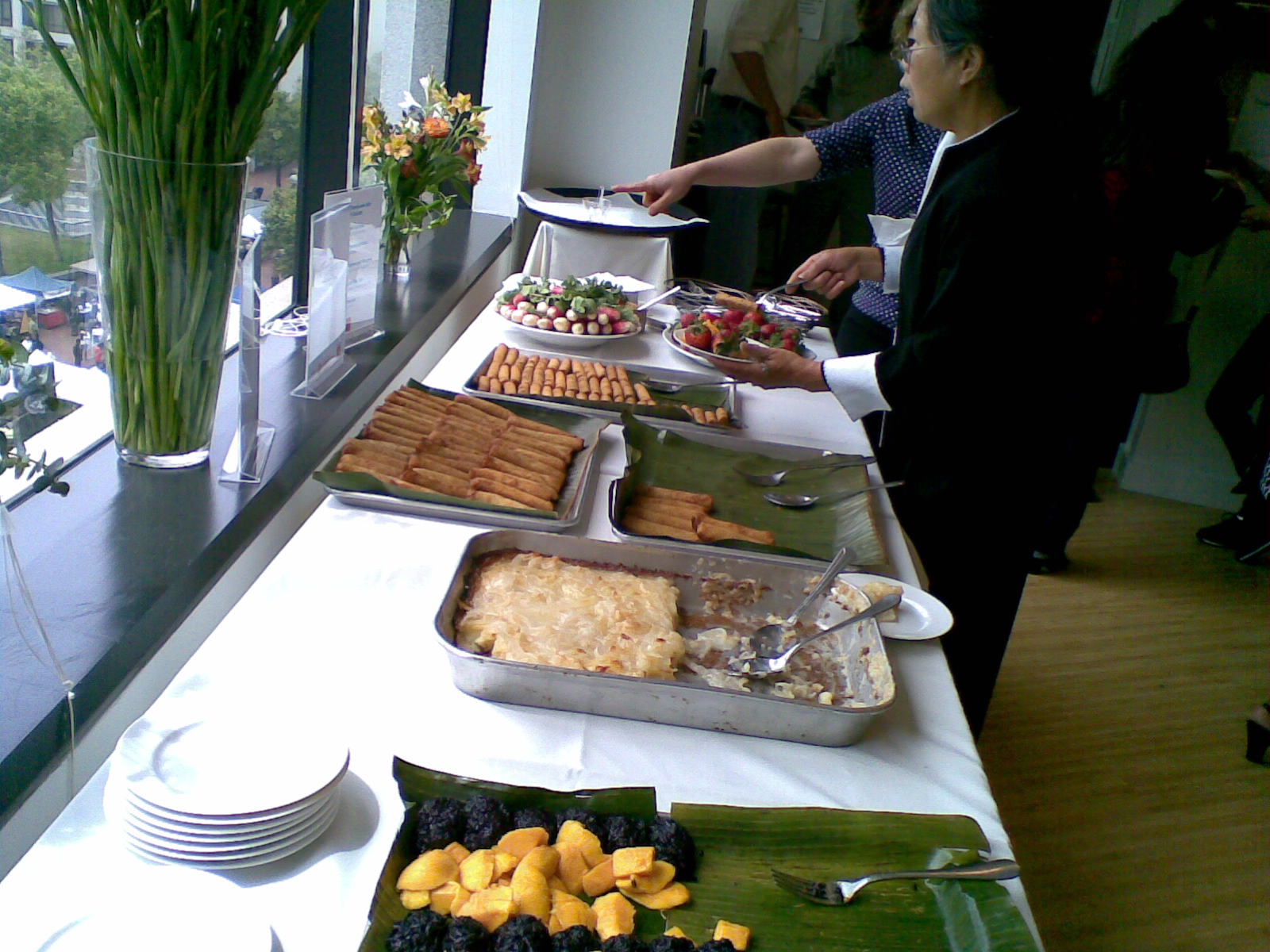
Mangos, sugar snap peas, and strawberries

The bar served VuQ0’s coconut vodka, a refined version of the poison my grandpa spun tall tales about involving heavy doses of tuba, also known as lambanug or bahal. We also sipped sweet mango wine from Haliya, reviewed at Winecentric, but our favorite was the dalandan juice, a tasty sweet citrus fruit that leaves your mouth hankering for more.

Marti Chocolatt

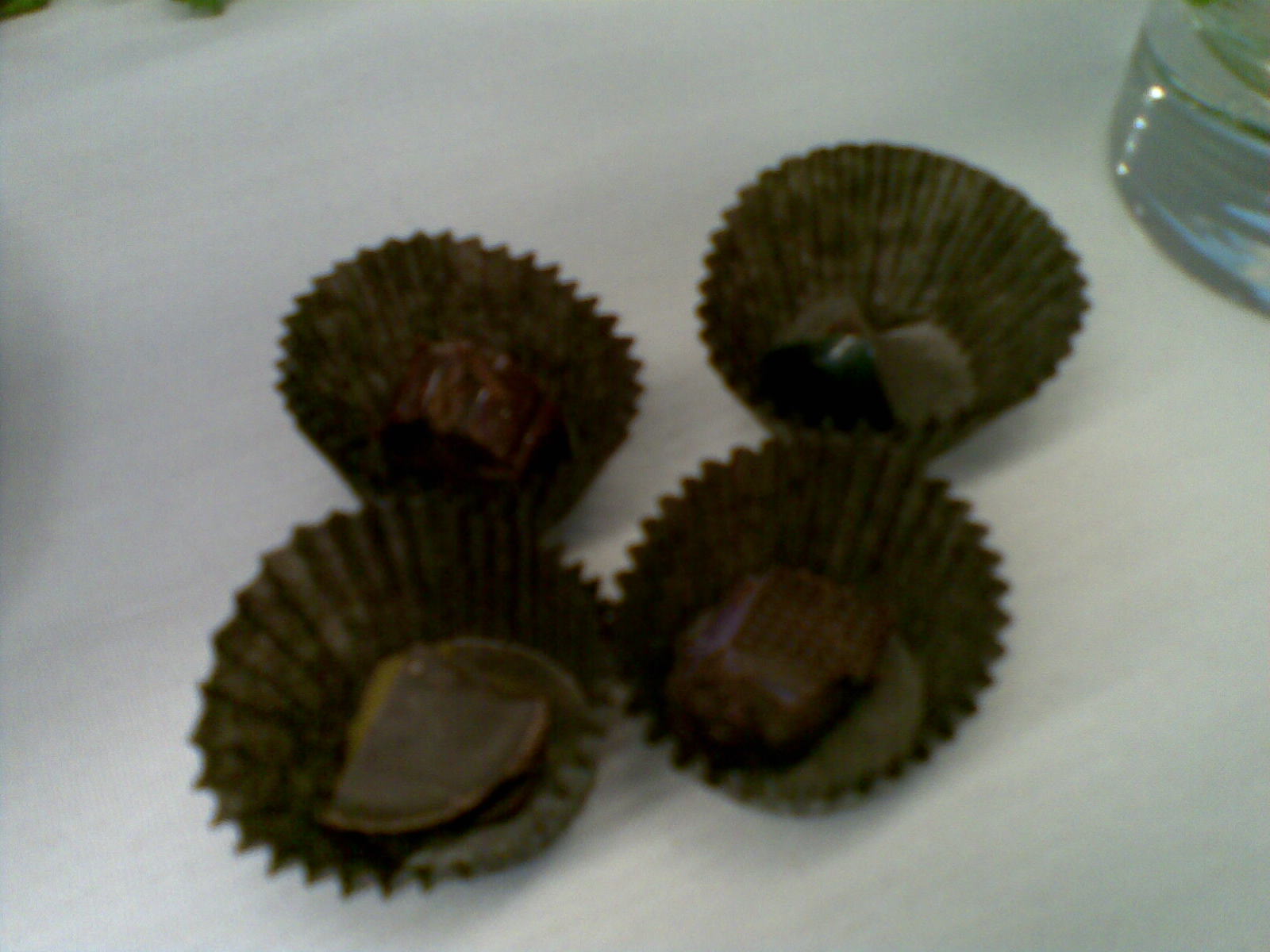
The spread was both elegant and rich, offering tightly wrapped rolls of lumpia, thick turons plump with jackfruit, and platters filled with sweet, sticky bibingka. Marti Chocolatt based in Los Angeles presented a beautiful table of dark and fruity sweets. The highlight of course was champarado (chocolate rice pudding), prepared by chocolatier Toney Tibay and paired with tuyo (salted herring), which was nothing but savory. Samples of chocolate covered langka (jackfruit), kalamansi, buko pandan, and ube tempted every guest who couldn’t just have one.

Champurado with salted fish

Tables for attendees provided individually wrapped uraro, arrow root, candies made of cassava. While we feasted on Filipino favorites, we met Lauren del Rosario, Director of Sales and Business Development for Azukar Organics, which makes coconut sugar and flour. Low glycemic and gluten-free, the sugar is both sweet with a wonderful nutty essence. Delish. We can’t wait to cook and bake with it. If only it was distributed in the Bay Area, but So Cal people can easily get their hands on this product at LA health stores.

The reception eased us into the reading that followed, “Eating Our Words: Writings about Food & Family,” featuring Barbara Jane Reyes, Aileen Suzara, Aimee Suzara, Lizelle Festejo, Yael Villafranca, Lisa Sugitan Melnick, and your Salonniere.  For more on the literary event, check out the post “Writing + Food” on Ruelle Electrique.

“Eating Our Words: Writings About Food & Family” at the Asian Culinary Forum’s 2010 Symposium, Filipino Flavors: Tradition + Innovation

https://i0.wp.com/www.asianculinaryforum.org/ACF/Asian_Culinary_Forum_-_2010_Symposium_Adobo_Throwdown_files/acfhp_web.jpg

Filipino Flavors: Tradition + Innovation

Literary Reading

EATING OUR WORDS: WRITINGS ABOUT FOOD & FAMILY

Sun May 16 | 1:00–2:30 pm, with light refreshments

Local writers share their poems, fiction and essays about two of the most important facets of life: our families and our food. Barbara Jane Reyes, Rashaan Alexis Meneses, Aileen Suzara, Aimee Suzara, Lizelle Festejo, Yael Villafranca and Lisa Suguitan Melnick read from their books and works-in-progress. Oscar Bermeo emcees.

$5 general admission, $3 students. Ticket sales end May 12! [buy now]

Location: The International Culinary School at The Art Institute of California-San Francisco

1170 Market Street, San Francisco, CA

Join the Asian Culinary Forum in the heart of San Francisco for an exciting, weekend-long celebration of the foods of the Philippines. Information on other weekend events here: http://www.asianculinaryforum.org

LIZELLE FESTEJO is the Assistant Director/Program Manager and Job Readiness Instructor at The Bread Project, a culinary and commercial baking job training program based in the East Bay. She was an organizer of Filipino American Coalition for Environmental Solidarity’s (FACES) first Kain’Na Cooking School fundraiser and also a 2008 Fellow for Robert Mondavi Winery’s Taste3. Lizelle consults for the San Francisco International Chocolate Salon organized by Tastetv.com. As a writer and community worker, her passion is fueled by bringing communities and families together through the multi-faceted and inter-generational powers of cooking, eating and food itself.

LISA SUGUITAN MELNICK’s daily life is a colorful melange of multi-cultural experience. Yes, she eats adobo with chopsticks, serves miso soup alongside pancit, and adds a touch of shoyu to the vinegar sauce for lumpia. Lisa’s work has appeared in Latin Beat Magazine, Philippine News, CATESOL (California Teachers of Speakers of Other Languages), The Advocate, and Filipinas Magazine. A third-generation Filipina/Latina American, she is currently working on Ima Ni Soledad, a memoir of vignettes which present Filipino-American experience in contexts that highlight the reverence for family and generosity of spirit. Lisa shares her life with partner of 27 years, Mark, their son Ryan Akira, and Miss Jazz, a doberman mix diva dog.

RASHAAN ALEXIS MENESES, born and raised in the seismically diverse and fractured landscape of California, earned her MFA from Saint Mary’s College of California’s Creative Writing Program. She was named a 2005-2006 Jacob K. Javits Fellow and awarded the Sor Juana Ines de La Cruz Scholarship for Excellence in Fiction. She received her B.A. in English with a specialization in Fiction, Creative Writing from the University of California, Los Angeles. Recently, A Room of Her Own Foundation named her a Finalist for The 2009 Gift of Freedom Award and her latest short story, “Here in the States” is included in the anthology, Growing Up Filipino II: More Stories for Young Adults.

BARBARA JANE REYES was born in Manila, Philippines, and raised in the San Francisco Bay Area. She received her B.A. in Ethnic Studies from the University of California, Berkeley and her M.F.A. at San Francisco State University. She is the author of Gravities of Center (Arkipelago Books, 2003) and Poeta en San Francisco (Tinfish Press, 2005), which received the James Laughlin Award of the Academy of American Poets. Her third book, entitled Diwata, will be released by BOA Editions, Ltd. in September, 2010. Her poetry, essays, and reviews have appeared in Latino Poetry Review, New American Writing, North American Review, Notre Dame Review, and XCP: Cross Cultural Poetics. She has taught Creative Writing at Mills College, and Philippine Studies at University of San Francisco. She lives with her husband, poet Oscar Bermeo, in Oakland.

AILEEN SUZARA is a second generation Pinay raised in California and Hawai’i who began exploring the kitchen at childhood. Her passion for social justice led her to the Filipino/American Coalition for Environmental Solidarity and positions as an environmental educator. Aileen now brings that commitment towards sustaining the recipes and rituals of Filipino foodways. Her words appear in Earth Island Journal, The Colors of Nature, Growing Up Filipino, and others. Aileen received a BA from Mount Holyoke College and recently graduated as a Natural Chef from Bauman College.

AIMEE SUZARA completed her M.F.A. at Mills College in 2005 and has been sharing poetic and multidisciplinary work since 1999. Her play, Pagbabalik (Return) in 2007 was selected for several festivals and granted the Zellerbach Community Arts Fund in 2006-7. Her poetry collection, the space between, was published by Finishing Line Press in 2008, and her writing appears in several journals and anthologies, including Check the Rhyme, An Anthology of Female Poets and Emcees (Lit Noire Press), 580 Split (forthcoming issue) and Walang Hiya/No Shame (forthcoming anthology). Currently, she is collaborating on text-dance works with two companies: Amara Tabor-Smith’s Deep Waters Dance Theater for “Our Daily Bread”; and choreographer Frances Sedayao, Aimee Espiritu and Michael Torres for “A History of the Body,” to be hosted by the Oakland Asian Cultural Center. A passionate advocate for arts and literacy, she teaches English at community colleges and leads workshops on poetry and performance.

YAEL VILLAFRANCA is a Kundiman fellow, an organizer with Babae San Francisco/GABRIELA-USA, and a student at the University of San Francisco. She gets emotional when she eats.

OSCAR BERMEO is the author of the poetry chapbooks Anywhere Avenue, Palimpsest and Heaven Below. Born in Ecuador and raised in the Bronx, he now makes his home in Oakland with his wife, poeta Barbara Jane Reyes. Oscar was the founding curator/host of the Acentos Bronx Poetry Showcase, and a founding curator/host of the synonymUS Collaborative Open Mic at the Nuyorican Poets Cafe. Oscar has been a featured writer at a variety of venues and institutions including the Bowery Poetry Club, Intersection for the Arts, Kearny Street Workshop, Bronx Academy of Letters, Rikers Island Penitentiary, San Quentin Prison, the Loft Literary Center, Sacramento Poetry Center, UC Berkeley, Columbia University, UNC Chapel Hill, NYU and many others.

“School Library Journal’s” Review of “Growing Up Filipinio II”

Published May 1, 2010 and written by Roxane Meyers Spencer of Western Kentucky University, Bowling Green:

BRAINARD, Cecilia Manguerra, ed. Growing Up Filipino II: More Stories for Young Adults. 254p. PALH. 2010. Tr $29.95. ISBN 978-0-9719458-2-1; pap. $21.95. ISBN 978-0-9719458-3-8. LC 2002104406.

Gr 9 Up—This collection of 27 short stories, the follow-up to the critically acclaimed Growing Up Filipino (PALH, 2003), reflects the impact of post-9/11 wartime sensibilities among Filipino writers living in the Philippines, the United States, and Canada. Although similar topics of family, memoir, and coming-of-age thread through both collections, the pieces are not grouped by theme, but nevertheless weave a constantly shifting tapestry of Filipino identity. The challenges and conflicts of unique ancestry and struggles for identity provide a rich background for modern urban realism. The brittle memoirs reflected in “Here in the States,” “Nurse Rita,” and “Hammer Lounge”; original legend in “A Season of 10,000 Noses”; and breathtaking tragedy in “How My Mother Flew,” among others, are compelling reading.

Read entire review

Mantones de Manila at La Pena Cultural Center

An installment of the five part series “Enlaces” exploring the Spanish, Indigenous, Arabic, and African influences in the music and dance of the Americas, on February 20 at La Pena Cultural Cultural Center in Berkeley, “Manton de Manila” showcased the beautiful embroidered silk shawls introduced across the globe by the Spanish.

Featuring:
María de la Rosa & Rudy Figueroa – Mexican Dance
Parangal Dance Company – Philippine Folk Dance
Theresa Calpotura-Classical Guitar
Asociación Cultural Kanchis – Peruvian Dance
De Rompe y Raja – Afro-Peruvian Cultural Association
Javier Trujillo – Peruvian Guitar
Virginia Iglesias – Flamenco Dance
Jorge Liceaga – Spanish Guitar
Edwin Lozada – Poetry
Paul Flores – Narrator
Exhibition of Mantones de Manila – Courtesy of Edwin Lozada (Carayan Press)

Curated by Edwin Lozada, editor of Field of Mirrors and member of PAWA Inc., Lozada owns an impressive collection of mantones de manila that span from 1820 to present time, gathered from all over the world. The show traced the history of these embroidered shawls back to Canton, China, purchased by the Spanish in Manila, which starting from 1571 through 1811 served as an integral port to the Galleon Trade. The popularity of these shawls spread to Mexico, Peru, and Spain, just to name a few countries. Weaving song and dance while chronicling the shawl’s diaspora, we start first in Veracruz, Mexico.

Unfortunately, no videos or photographs were allowed by the audience, but to get a feel for the similar threads that run throughout these cultures across the globe, here are some samplings from other sources. The first performance was Mexico’s National Dance, the Jarabe Tapatio:

After the dance, the dancers told the story of La China Poblana who was neither from China or Puebla but may have been a Mughal Princess named Mirrha taken captive by the Spaniards and brought to Puebla where she was bought by a wealthy Dona and Don and christened Catarina de San Juan. She’d fashion the most beautiful embroidered skirts that glittered and shimmered, and wear them when she went to the market. The ladies of Puebla soon adopted her style, and the skirt spread across Mexico. For more on Mirrha’s history check out Stitches in Time.

https://i0.wp.com/www.yucatanliving.com/article-photos/events/10082007-frida.jpg

Image from Yucatan Living

The evening’s performance then transported us to the port that made the embroidered shawl so famous. From Manila, “El Paseo”:

We also learned of Saint Martin de Porres (1579-1639) the Black Saint or La Santa Negra, the first saint of the Americas. Born illegitimately from a Spanish nobleman and a young, former black slave, he grew up poor but learned the medical arts at the age of ten and was already devoted to taking care of the sick. Porres later joined the Dominican Order and led a life committed to charity.

http://sandradi.files.wordpress.com/2009/11/saint-martin-de-porres.jpg

Image from Novena

In honor of the Saint of Peru, two dancers performed La Marinera:

The dancing ended with a rousing and riveting flamenco from Andalusia Spain:

And the rest of night belonged to the mantones themselves. Spanning from 1820 to 1940 (?), the later the shawl was made the more elaborate the embroidery and the longer the fringe, each one more beautiful than the next. From striking reds, gorgeous greens, vibrant blues and purple, the mantones de manila are marvelous creations made more unique and more lovely by the many different cultures that have stylized this shawl and called it their own. This show made me wonderfully proud to be a Chicapina.

https://i0.wp.com/www.museo-oriental.es/imagenes/didactica/Filipinas%2C%20trampol%C3%ADn%20hacia%20Oriente/Bordados%20y%20mantones%20de%20Manila.jpg

Image from Museo Oriental, Valledolid

For more information check out “Truth about the manton de Manila” by Bea Zobel Jr. on TravelSmart.net and watch for Lozada’s much anticipated book on the history and influence of the manton de manila.

___

Enlaces (Connections That Bind Us) El Mantón de Manila presented by La Peña Cultural Center in collaboration with Gabriela Shiroma (CulturARTE), Carayan Press, PAWA, Inc., Community Music Center-San Francisco

“the many ways in which our individual memories, histories, and stories may intersect with our cultural memories, histories, and stories”

Poet and Professor Barbara Jane Reyes covers the University of San Francisco fiction talk and workshop for her class “Filipino American Arts” in her post “Random: Culture, Commodity, Performance, Production”

…I am also thinking about erasure and invisibility (so, what’s new?). Last week in class, we discussed Lysley Tenorio’s story, “Save the I-Hotel,” which moves back and forth between the 1930’s and 1977, specifically the day of the final evictions of the I-Hotel. The story follows two men, laborers named Fortunado and Vicente, who are I-Hotel residents during that entire time period. We get the kind of care they exhibit toward one another, one helping the other find employment, sharing space however cramped, protecting each other from white male violence, keeping each other company when loneliness and homesickness are consuming, lending a coat to keep the other warm. It’s very tender. How do these things not amount to love, and how is this love never romantic? So that’s that, about erasure and silence; we simply cannot know that 100% of the Manongs were hetero, though we never ever hear about Manongs who were not.

I am also thinking of Rashaan Alexis Meneses’s visit to my class, also last week. She discussed how she came to her story, “Here in the States,” from the anthology Growing Up Filipino II, and her series of stories about immigrant workers in our urban areas (specifically, Los Angeles), what things about their American lives we never know because even though they’re omnipresent, we never ask them to tell us their life stories. She talked about the process of writing these stories and considering an audience who may not have the same cultural knowledge, how much to explain and translate, and how to explain and translate, while balancing what the story needs, at what pace it needs to move, from whose point of view it must be told.

She also conducted a writing workshop for my students, based upon memories, items that always occupy a special or significant place in our memories, and how to go about writing about these things. We started with a list of seven items and from there, did a freewrite engaging all the senses. I like this, the practice of keeping a written inventory of memories to which we can always return as artists. I like how this practice can bring to light the many ways in which our individual memories, histories, and stories may intersect with our cultural memories, histories, and stories. My students had some really great responses, and were, for the most part, quite open about why those items were so important to them, and where they are now in relation to these items. I later on told Rashaan about my mental inventory, and that I always go back to the same memory; all of th.e items on my list pertain to that memory of visiting Papa’s house in Gattaran when I was six…

Read the rest of the post here.

More coverage on the fiction workshop at the University of San Francisco will be forthcoming…