Last Thursday, 19 February, yours truly had the honor and pleasure to share inspiration and inspired work at The Emerald Tablet’s “Under the Influence” co-founded and hosted by writer Evan Karp. Tucked away in North Beach central, the venue is both a cozy and spacious spot featuring some beautifully impressive artwork by Tibor Simon-Mazula. During introductions, Karp asked the audience how many had been to The Emerald Tablet before, and out of a packed house, only one person raised their hand, so the event brought in a roomful of newbies, including myself.
co-founder and host Evan Karp
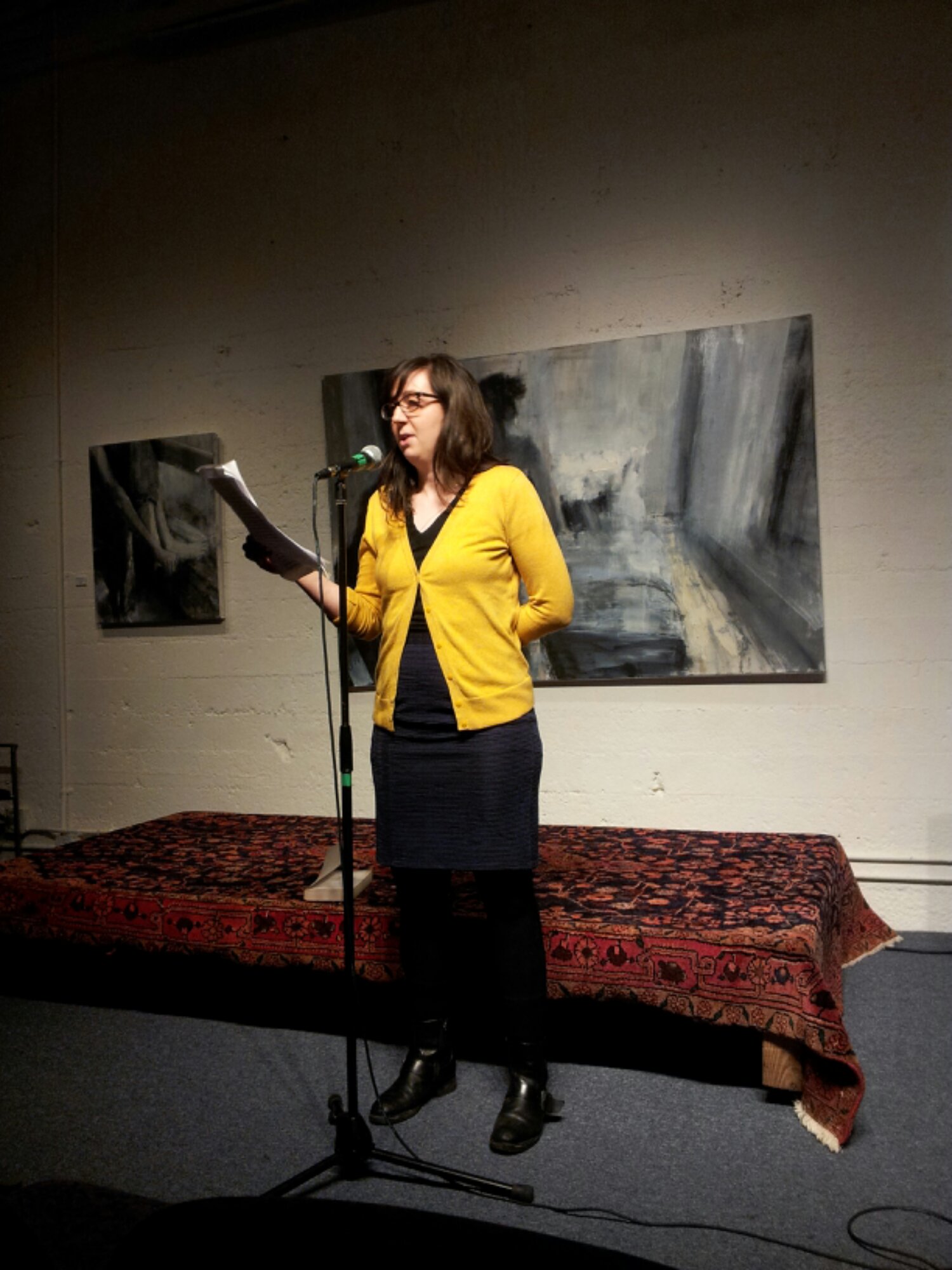
Tapped to read first, I dutifully followed “Under the Influence’s” ekphrastic guidelines and read completely new work, written for the evening and inspired by Italo Calvino’s Cosmicomics, Robert MacFarlane’s Wild Places (and though I didn’t mention it that evening, but also Rebecca Solnit’s A Field Guide to Getting Lost).
Yours truly
Since yours truly was coming down from all those butterflies after reading first, I hope I can be forgiven for failing to snap a pic of second reader Patrick Newson, who shared an excerpt from his fellow Oregonian Ken Kesey, and then dived right into some fiction with New Zealand as both background and character: “always in the shadow of that big brother to the West…where language is only a barrier for the weak. ”
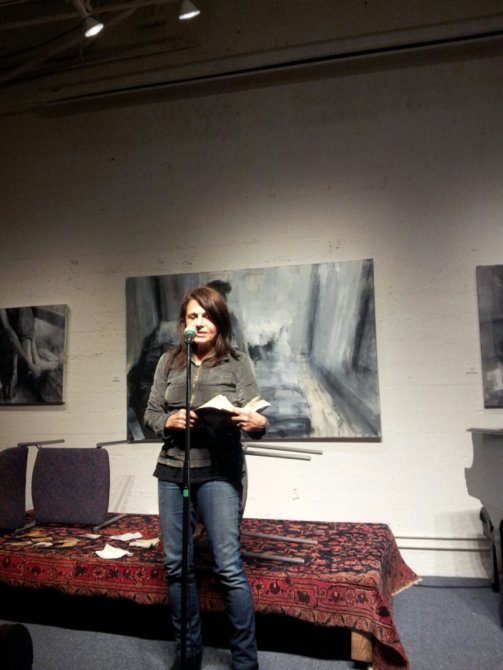
Thaisa Frank
Thaisa Frank had stories nestled inside stories, which was part of the spirit she channeled that evening, an 19th century writing desk. She described the writing desk as an instrument for “gentlemen of means” and explained how the desk had recently been stolen otherwise it would have been sitting on stage before us. Years ago though, her mother convinced her to buy the antique during a family trip to Brontë country. Frank spoke of how influence can cause anxiety, calling on Harold Bloom, but she found that losing the writing desk was also freeing in a sense. In the chest was her mother’s journals, which reading later after her mother had passed, she realized, despite the difficulties of their relationship, many of the entries could have been written by Frank herself.
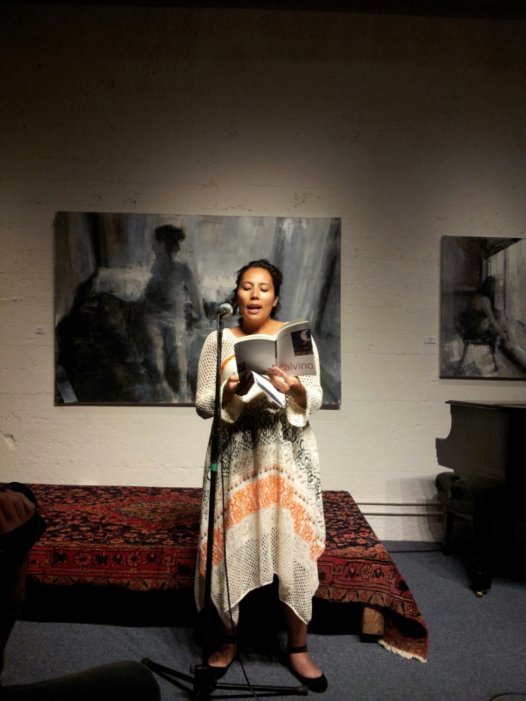
Abbie Amadio
Abbie Amadio, also a fiction writer had one of the most memorable bios, admitting she was worried about technological detachment and conspiracy theories. Reading from a novel-in-progress, she channelled Bret Easton Ellis, knowing full well the kind of reaction he typically draws from readers. Amadio explained how she came to read Ellis for the night, by closing her eyes and randomly pulling a book from her shelf. Her piece was about a telephone survey collecting data for memory enhancement: “I hear my robotic voice and type Jerry P’s memory to databank and already forget it soon as its typed.”
Joe Stillwater and his daughter
Filmmaker Joe Stillwater and his daughter shared one of their favorite children’s author who wrote the story Moonman, Frank Ungerer. They showed pictures of Moonman looking down on Earth and getting jealous of all the people having fun. So Moonman crashes onto Earth and gets arrested but because he’s a moon he can slim himself down during his phase to escape.
The father-daughter reading gave yours truly an idea, and now I’m hoping to host lit events where writers with kids bring their kids to read a story or share a piece of art that influences both parent and child, and then a parent reads his or her work. We’ll see if we can get this in the mix.
Driving back to East Bay
Always a treat to be out and about inspired by local artists and by local environs. Thanks “Under the Influence” for this artistic drunken affair! To see how it all went down, check out the video here:
Since I’ve got a thing for the ekphrastic, I’m really looking forward to participating in this unique literary event. Here’s why:
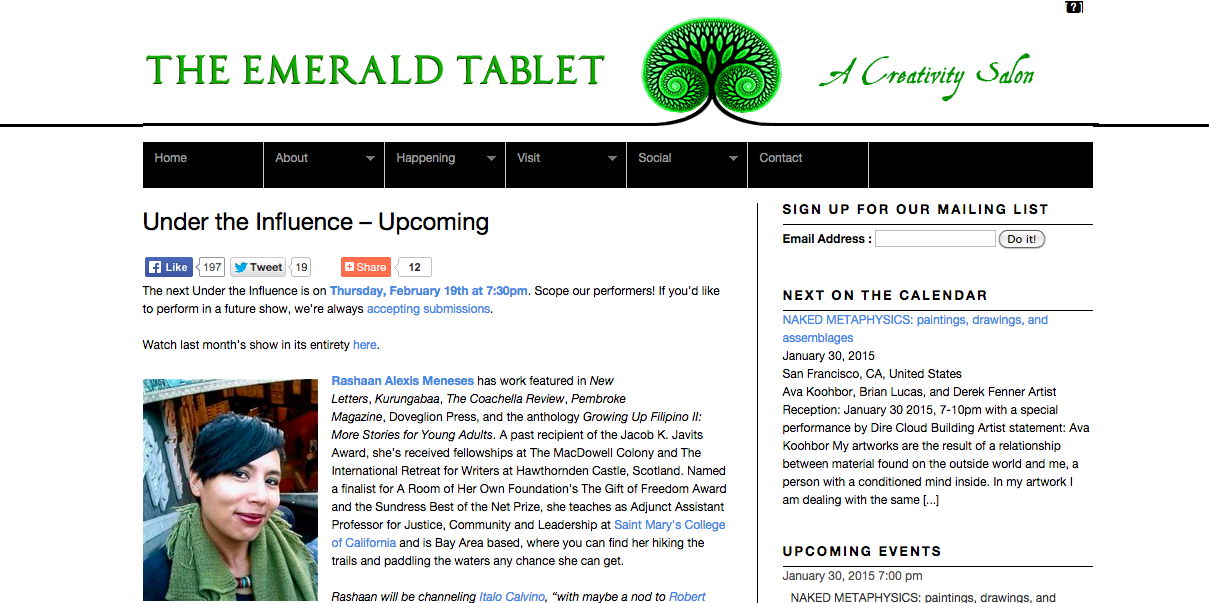
The Emerald Tablet is proud to host the third round of its first homegrown performance series, co-created with and hosted by Quiet Lightning‘s Evan Karp.
Four artists perform work by some of their major influences, followed by original work created for the show that channels that influence. Artists have 15 minutes to perform and will help select the following month’s performers, so that each show is inspired by the one before. In addition, each month an influence will be announced, and we will accept submissions of original work in response; one will be selected to be performed in the next show.
Mark your calendars, please spread the word, and hope to see at what should be an enlightening experience. More to come…
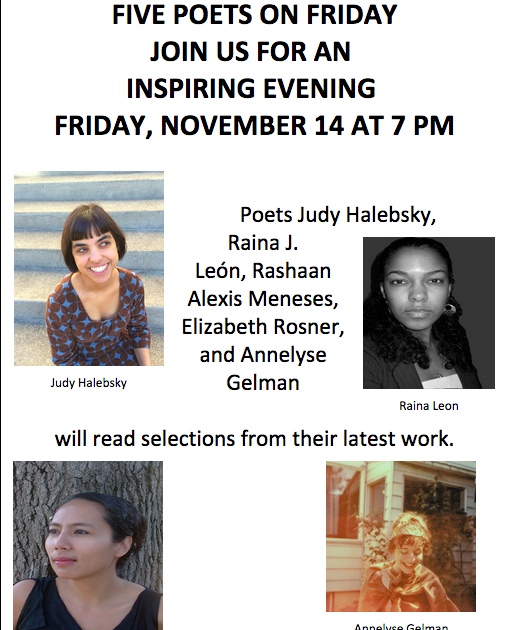
Organized by the amazing Dr. Raina León, yours truly will be reading alongside Raina León, Judy Halebsky, Elizabeth Rosner, and Annelyse Gelman. Please join us for an evening of literary pleasure on Friday 14 November, 7pm at Orinda Books (276 Village Square, Orinda, CA 94563).
Please consider sharing the love, and forward through your social media of choice to students and all lovers of lit.
Portugal has long been a place to visit since I drew up the post-college list of “50 Things I Want to Do Before I Die.” Almost fifteen years later, I finally got to see the land of my namesake. I’d always thought our family name was Spanish–that was until I was introduced by my in-laws to the Brazilian legend Jorge Ben, who’s real name is Jorge Duilio Menezes.
My interest in our Portuguese background only grew after reading Stegan Zweig’s biography Magellan. In all seriousness, anyone who is a fan of Lord of the Rings and The Hobbit should really pick up this adventure tale. Its just as breathtaking and riveting–only thing is this story is brutally true. Not only is my paternal family name Portuguese in origin, but Fernão de Magalhães AKA Magellan, the great Portuguese pilot purportedly the first person to circumnavigate the globe, landed on my maternal grandfather’s island Limasawa near Leyte and died on Mactan killed by Philippine chief LapuLapu. Portugal is in the blood. This was proved soon as we touched down in Lisbon, and I had to show my passport to customs. The officer asked without hesitation, “where did you get that name?” I told l him I was part Filipina, and he answered, “That name is Portuguese, you know.” I got the same response when I departed the country and every other time I had to show my I.D. Apparently our handle draws attention.
Thanks to the Youth and/in Literature Conference hosted and organized by CETAPS of the New University of Lisbon I was able to visit this land of my European heritage. To learn more about the conference, click here.
Outside of academia, our time in Lisboa was nothing but captivating. She is a city of heart-breaking beauty. So many gorgeous buildings, such striking architecture and art from so many different historic epochs all in various stages of decay–a striking difference between the U.K., which has endless reserves of money to restore and preserve their architectural and cultural heritage. Not that Portugal is to blame for the decay and neglect.
The conference in Lisbon spent a good deal of time discussing Portugal’s inequality both among its own population and in contrast to other E.U. and U.K. states. The conference organizer took good time to criticize and analyze how the rest of the world wrongly classifies them as part of the self-destructive misnomer “PIGS,” and I’m looking forward to enhancing materials and topics for my Modern Global Issues course as well as explore this country’s history and future for later writing projekts based on ideas learned and experiences had in this diverse and complicated country.
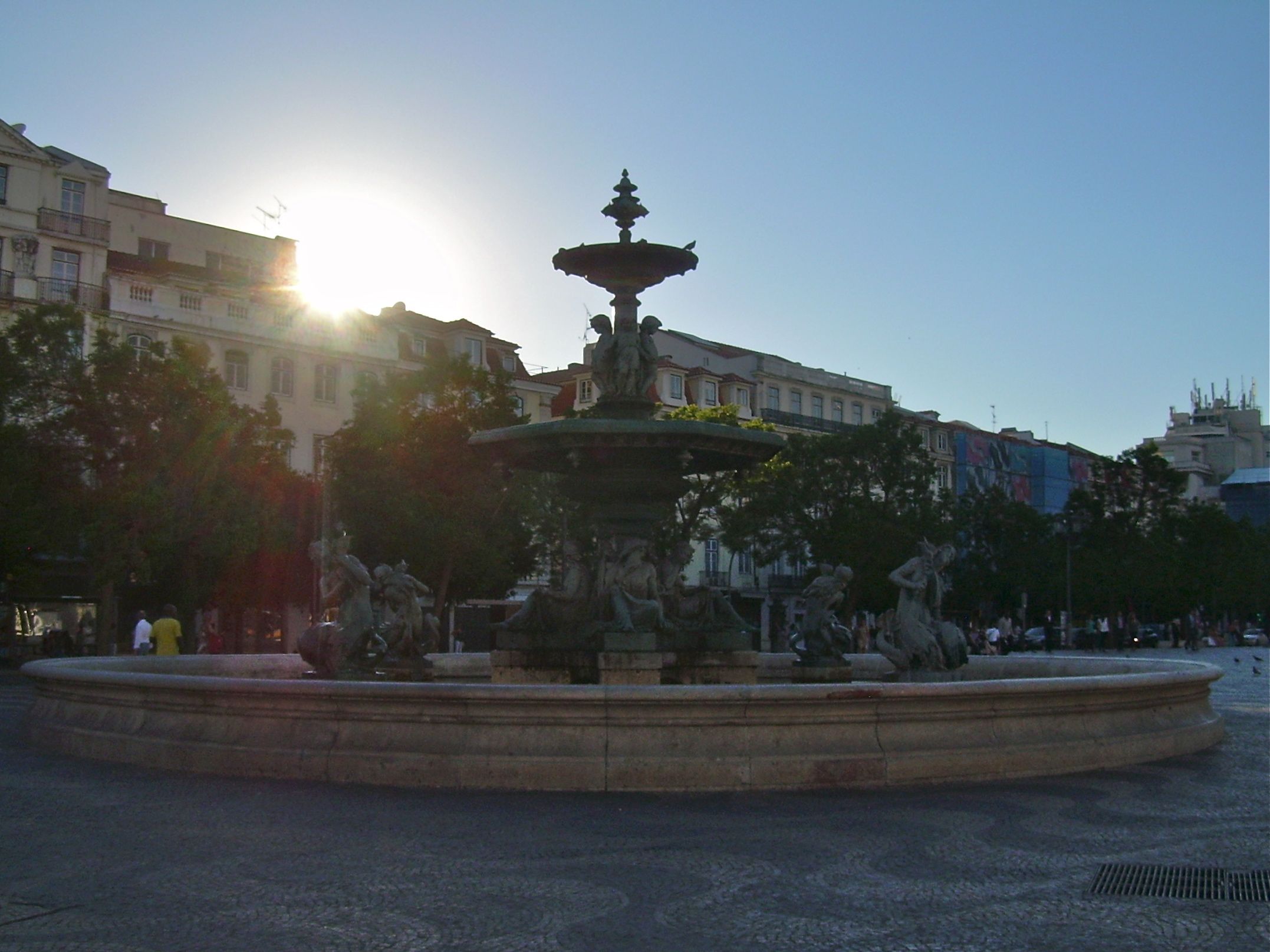
If you like fresh seafood, custardy pastries, the hot sun burning down in the daytime, and balmy nights wandering crowded avenues and alleys then you’ll love Lisboa. So much of Portugal’s capital reminded me of my other favorite and complicated metropolis, the City of Angels. When we hailed a cab at the airport, our driver greeted us with one simple word “Diga.” Our ride to the hotel could have easily been mistaken for a trek across the 405 or the 10 freeway. The shining slant of the sun was just as blinding as it is in Los Angeles. Oleanders, yucca, bougainvillea, and penstemon all competed in showy force along freeway embankments and bordering sidewalks. The air was hot and dusty. Street art covered every blank surface, grabbing the eye’s attention.
We stayed at the Continental Holiday Inn Hotel at Rua Laura Alves 9, only a five minute walk from the university where the conference was held, and at the other corner of our hotel complex was a cafe and patissiere where we enjoyed all sorts of sweet and puffy delectables during our stay. Soon as the conference let out, we were free to explore the city, so we spent the money and hopped on board the Lisbon sight-seeing double decker bus to get a good lay of the land. Sweltering hot, we took in both sun and city, traveling first to Belém.
Our first day of exploring this country of explorers led us to the historical monument Padrão dos Descobrimentos (Monument to the Discoveries). Built to commemorate the fifth centennial of the death of Prince Henry the Navigator, this edifice sits at the edge of a pier overlooking the River Tagus, the point of departure for all the great Portuguese sailors, including Vasco de Gama.
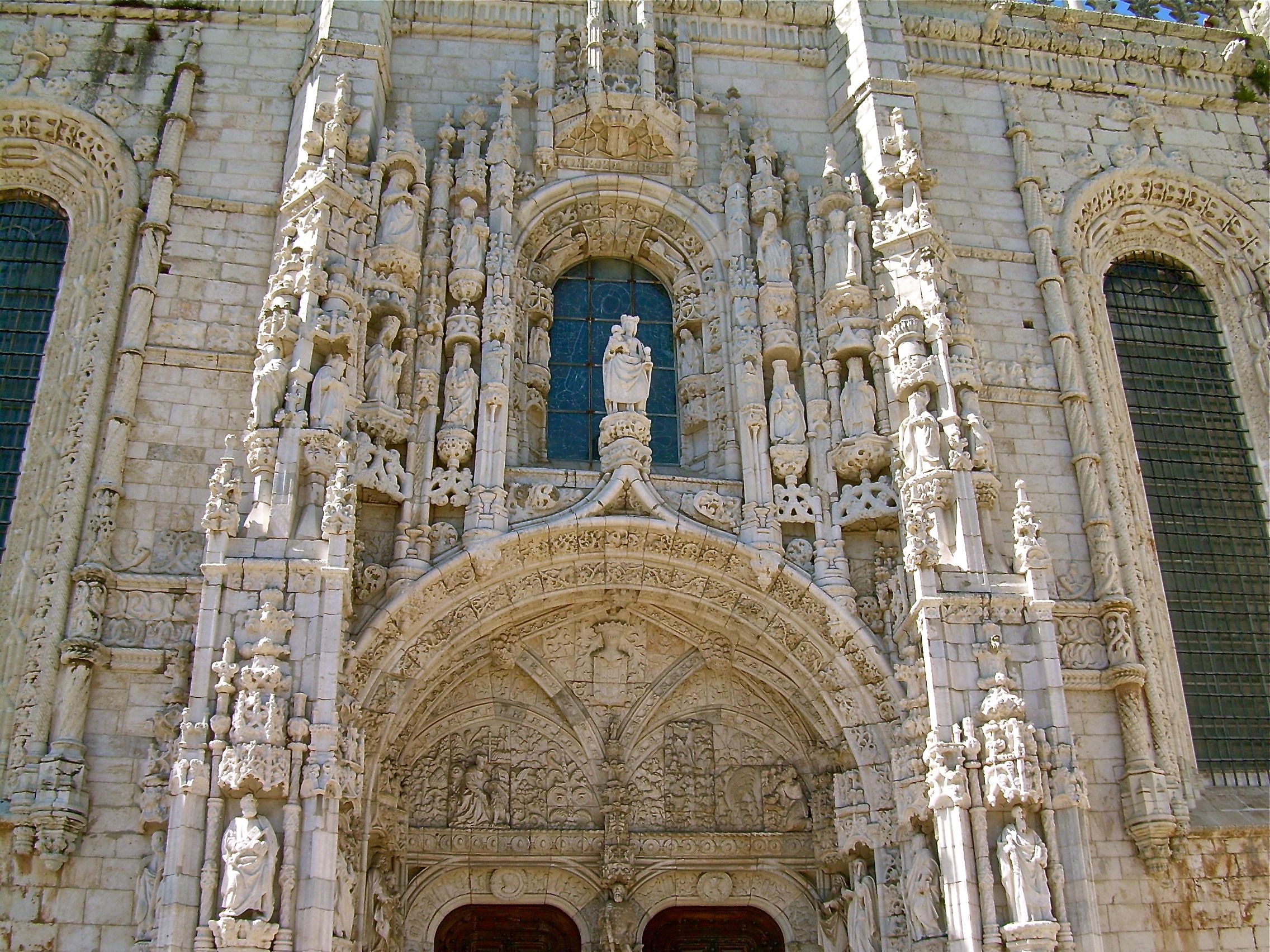
We continued the maritime theme by visiting Mosteiro dos Jerónimos (Jerónimos Monastery) where de Gama is buried and where the cathedral’s ornate architecture features nautical symbols, ship’s knotting and ropes. The colorful statues of the Virgin Mary and Child are most exquisite and looking upon them its no wonder how the Catholic faith can take hold of hope and the imagination. It is this Monastery where most every famous sailor last prayed before pushing off to foreign waters.
Just across the way from the Monastery is the Museu de Marinha, where yours truly spent a good few hours scribbling notes and clicking the camera, gathering as much research as possible, which may find its way on this site, so stay tuned. Not only did this museum hold impressive replicas of the caravels that the likes of Columbus set off on to discover a passage to the Indies, but there is also a comprehensive collection of all the tools and gadgets that made precise navigation and cartography possible such as the pocket globe and compass. I dream of owning a replica pocket globe someday. This technology, invented by the Arabs, adopted by the Portuguese, and advanced by the British, made each culture ruler of the sea at some point in history.
They say Venice is one of the few places to truly meet expectations. Well, Lisbon shatters expectations altogether. She is full of surprises. Music is everywhere, pumped into the Metro station and in cafes and fado bars. Music is on street corners and in the rhythm of the daily life. On two separate evenings, we stumbled upon two open air concerts right next to the city centre Metro. The first concert was performed by a youth orchestra playing contemporary “classic,” and the second was an adult orchestra playing a more traditional composition. A night can’t get more magical, under the stars, a cool breeze blowing through and a full orchestra performing with skill. Lisbon is a constant state of amazement.
For a taste of Portuguese song, feast your ears on the following: Melody Gardot’s Lisboa, António Zambujo’s Flagrante, and Ana Moura’s Desfado.
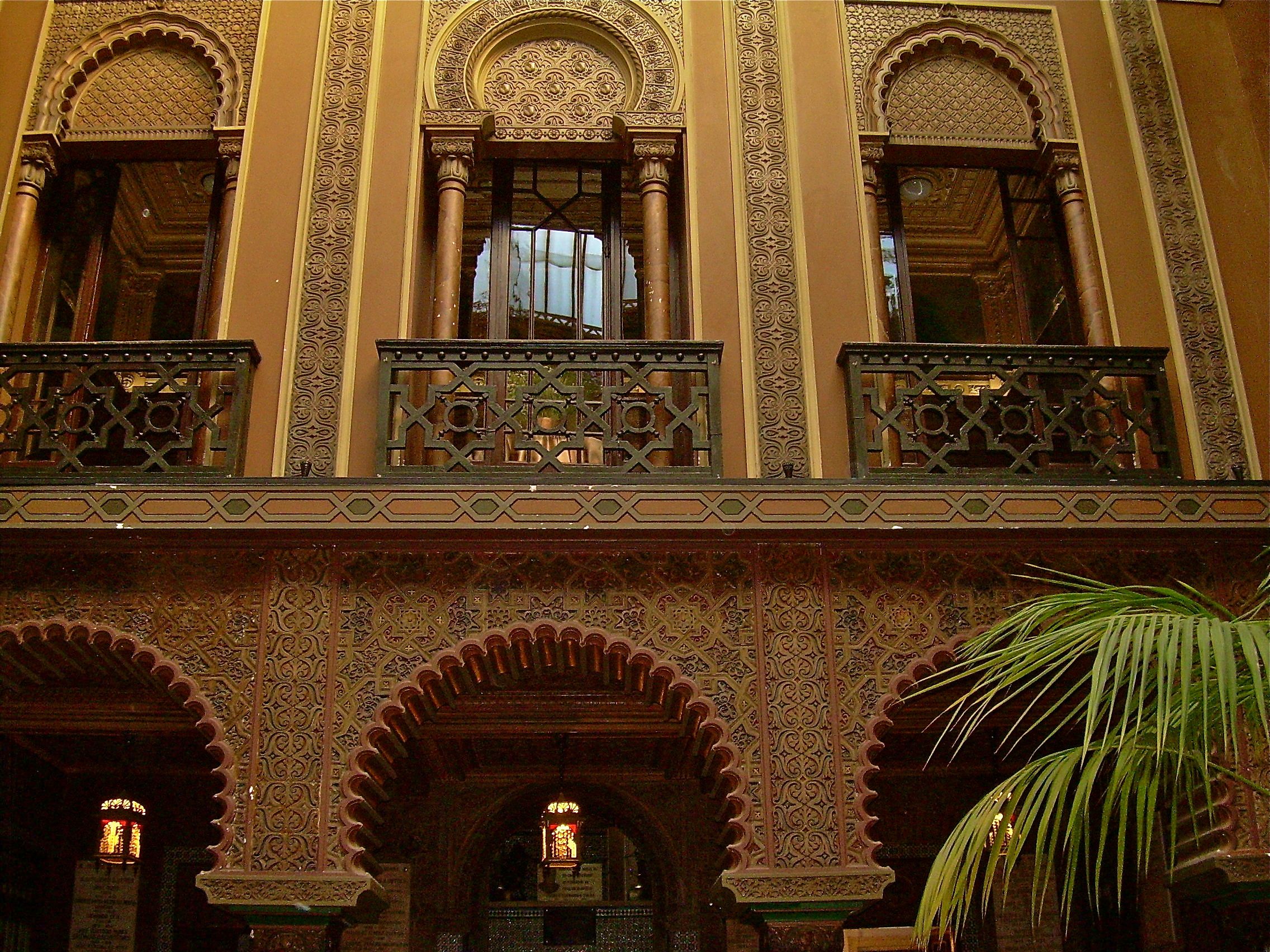
Another evening we dined at the Casa de Alentejo, a 17th century Moorish palace turned into a club meeting ground and now a restaurant to enjoy a real Portuguese meal. The entrance is a nondescript facade that we would have otherwise missed if it wasn’t for the large party standing and chatting outside. Once inside, a long stairwell leads you to a jaw-dropping atrium elaborately tiled with lavish wooden arches. The second story holds a ballroom and dining rooms, where walls are covered with pastoral paintings. Not a place to be missed.
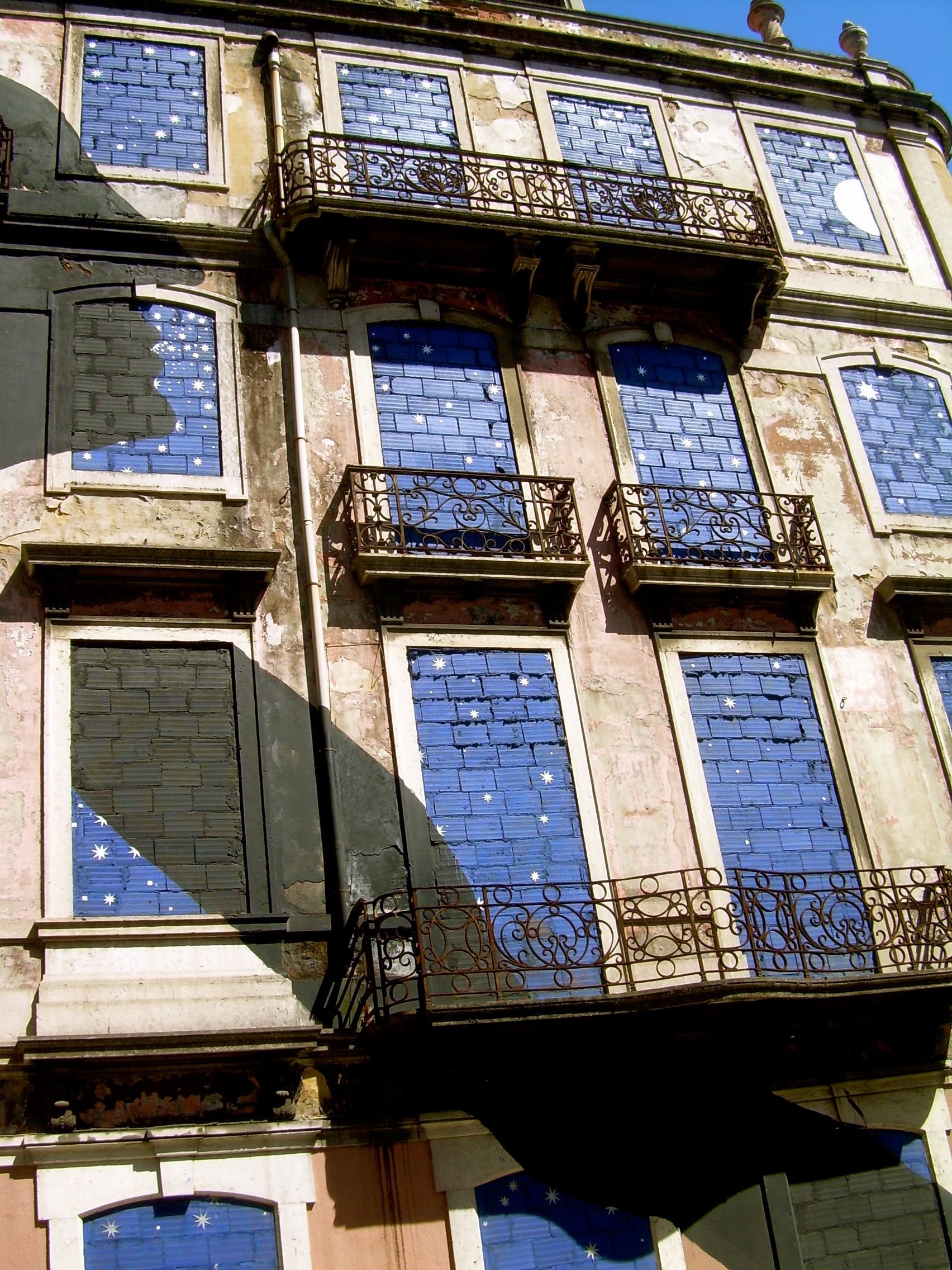
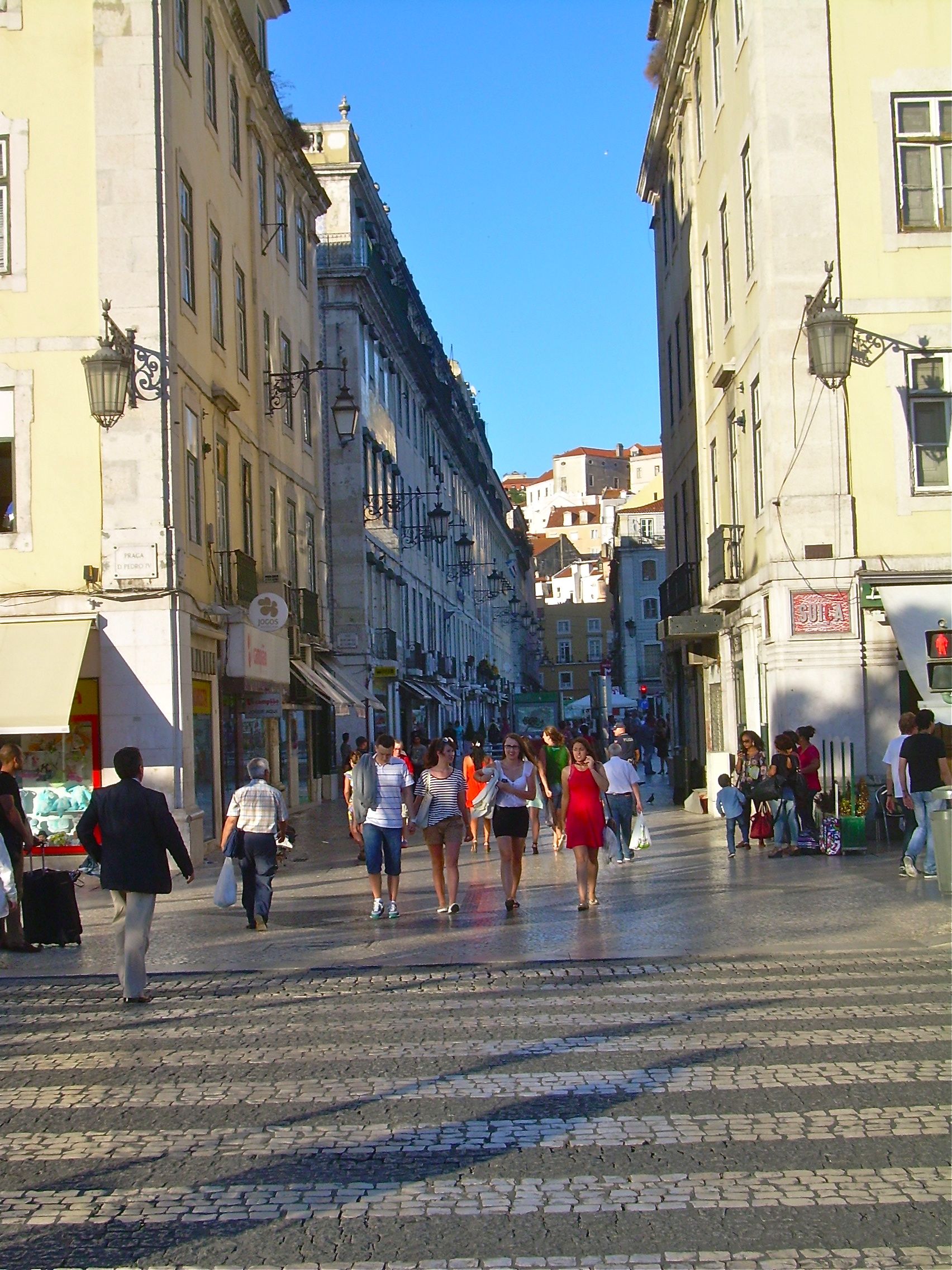
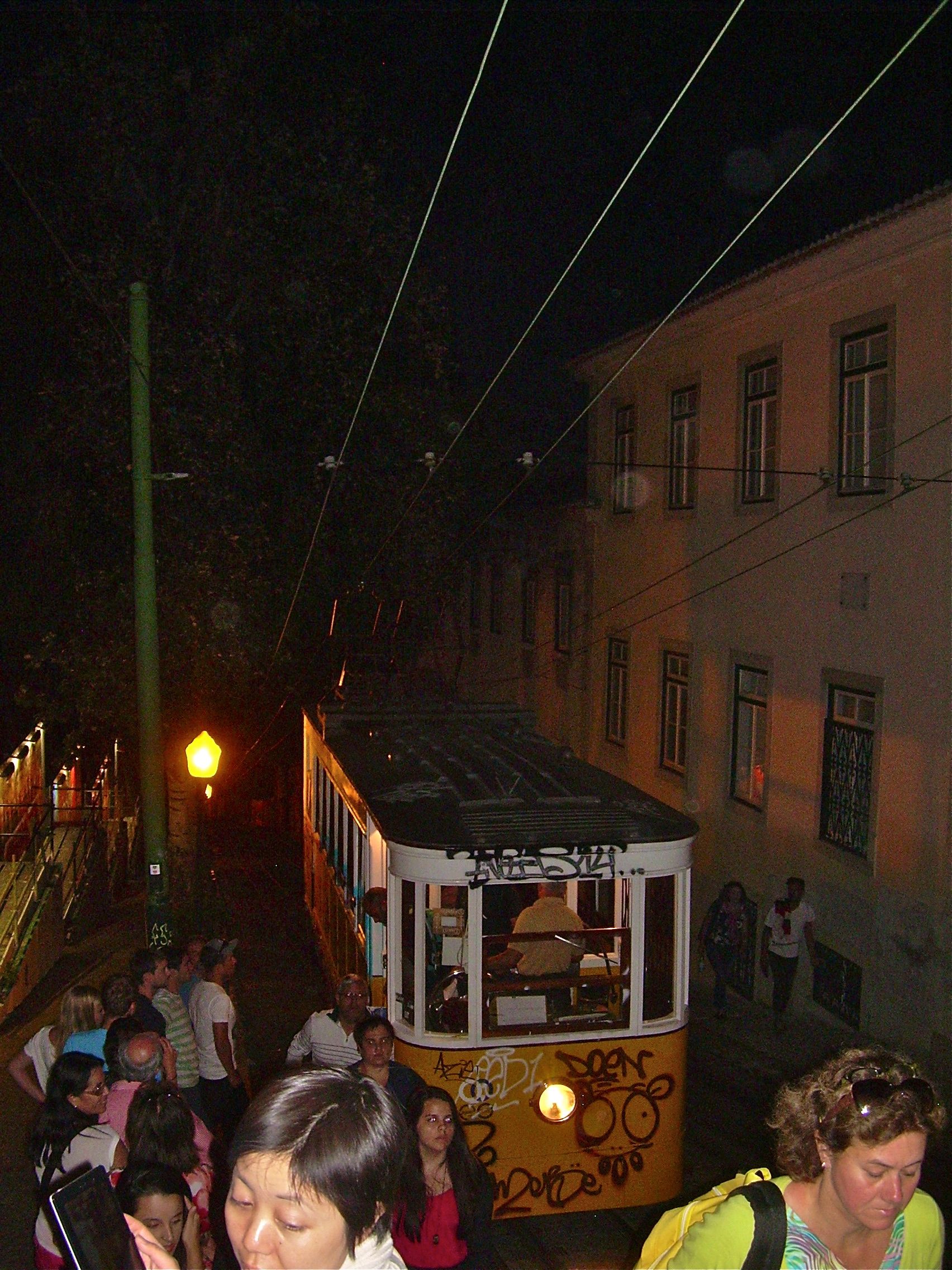
No trip abroad would be complete without a day of shopping, and we got our fill at Baixa and a seven-story El Corte Ingles. A city as artful as Lisbon carries its own laid-back and sophisticated sense of style. Not a hipster to be seen, the clothes match the weather, bright, eye-catching, and celebrating sun and flesh. After the hard work of bargain hunting, we topped off the evening with a ride on one of the funiculars to see the panoramic views offered by the Bairro Alto. Like the Casa de Alentejo, the Gloria Funicular would otherwise be missed if one didn’t know what to look for. Tucked in an alleyway, the tram chugs slowly up a steep hill, where we passed ladies making the same trek on foot wearing five or six inch heels. Blink, and you’ll miss one of the many street art murals that makes Lisbon distinct.
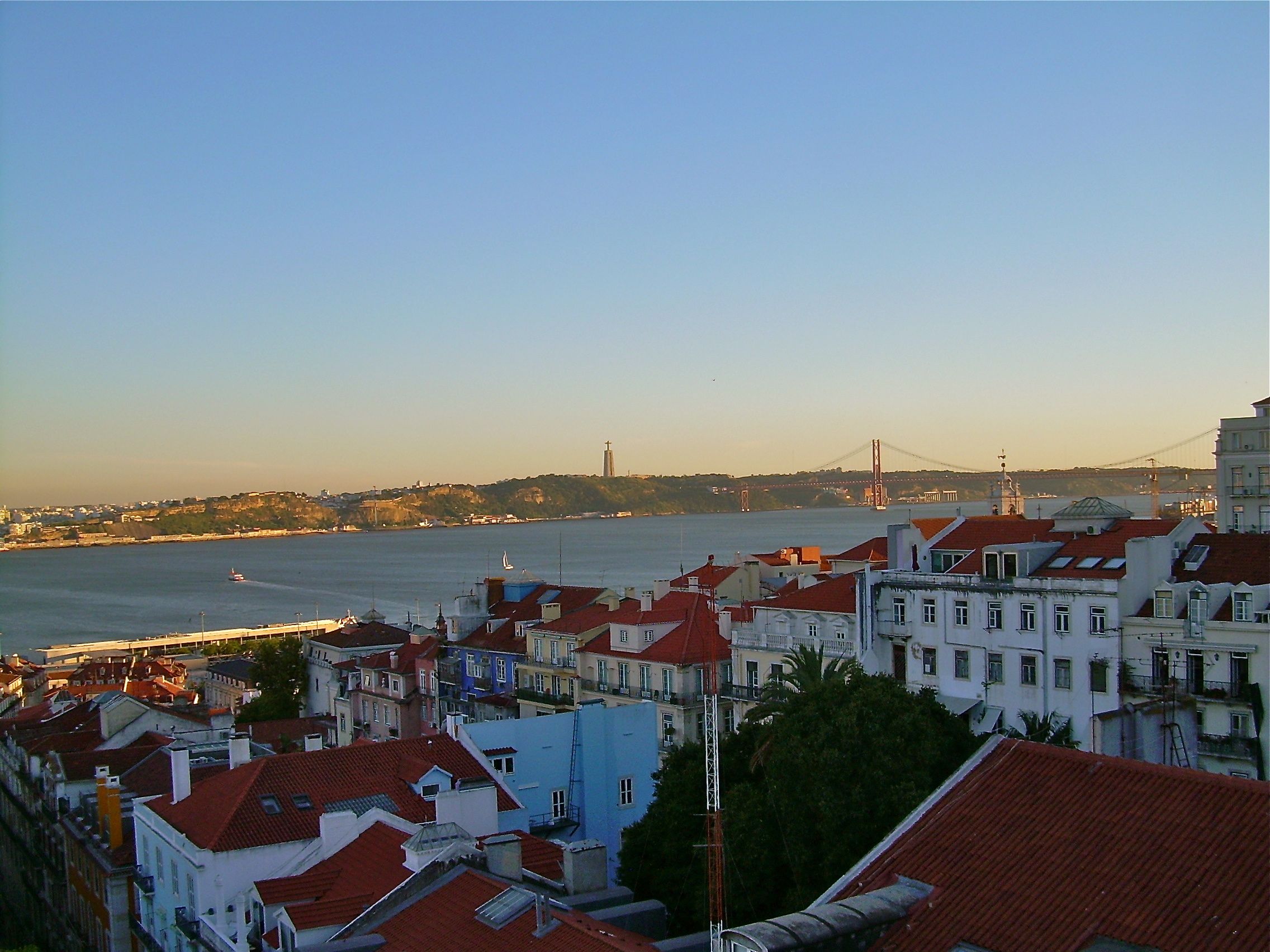
Our last night in Lisbon had us living life like we’re golden. Our guidebook, The Lonely Planet’s Pocket Guide to Lisbon insisted no other bar offered a better view and snazzier place to enjoy a cocktail than the Terrace at Bairro Alto Hotel. Its a tiny space where you have to wait in the downstairs bar before you can get called up for seating to enjoy a 180 degree view of the city with the River Tagus in the distance and the Golden Gate. We sipped martinis and watched the moonrise. Life is a blessing!
But Lisbon wasn’t the final stop on our summer travels. There is still Sintra, a romantic hillside city just thirty minutes away from Lisbon. Check back here for more on the city of poets.
For years, if not decades, Oxford has been calling. The history, the mystique, and the recent unshakeable addiction to the murder mystery series Lewis, known as Inspector Lewis here in the States, have only fueled the impulse to visit this artistic and intellectual epicenter. So, yours truly finally got a chance when an abstract proposal was accepted for Interdisciplinary.net’s 7th Annual Diasporas Conference held at Mansfield College this summer, which inquiring minds can read about here, but this post is about pleasure not business though the two often bleed together for this literary devotee.
Arriving 1 July, with a thankfully uneventful trip across the U.S. and over the Atlantic, we stayed at the Royal Oxford Inn. Clean, cozy with wonderfully accommodating staff and a surprisingly spacious loo, the inn is just a hop, skip, and a jump from the train station, proving convenient when we ventured into London the evening of our first full day in the U.K., but we’ll get to that shortly.
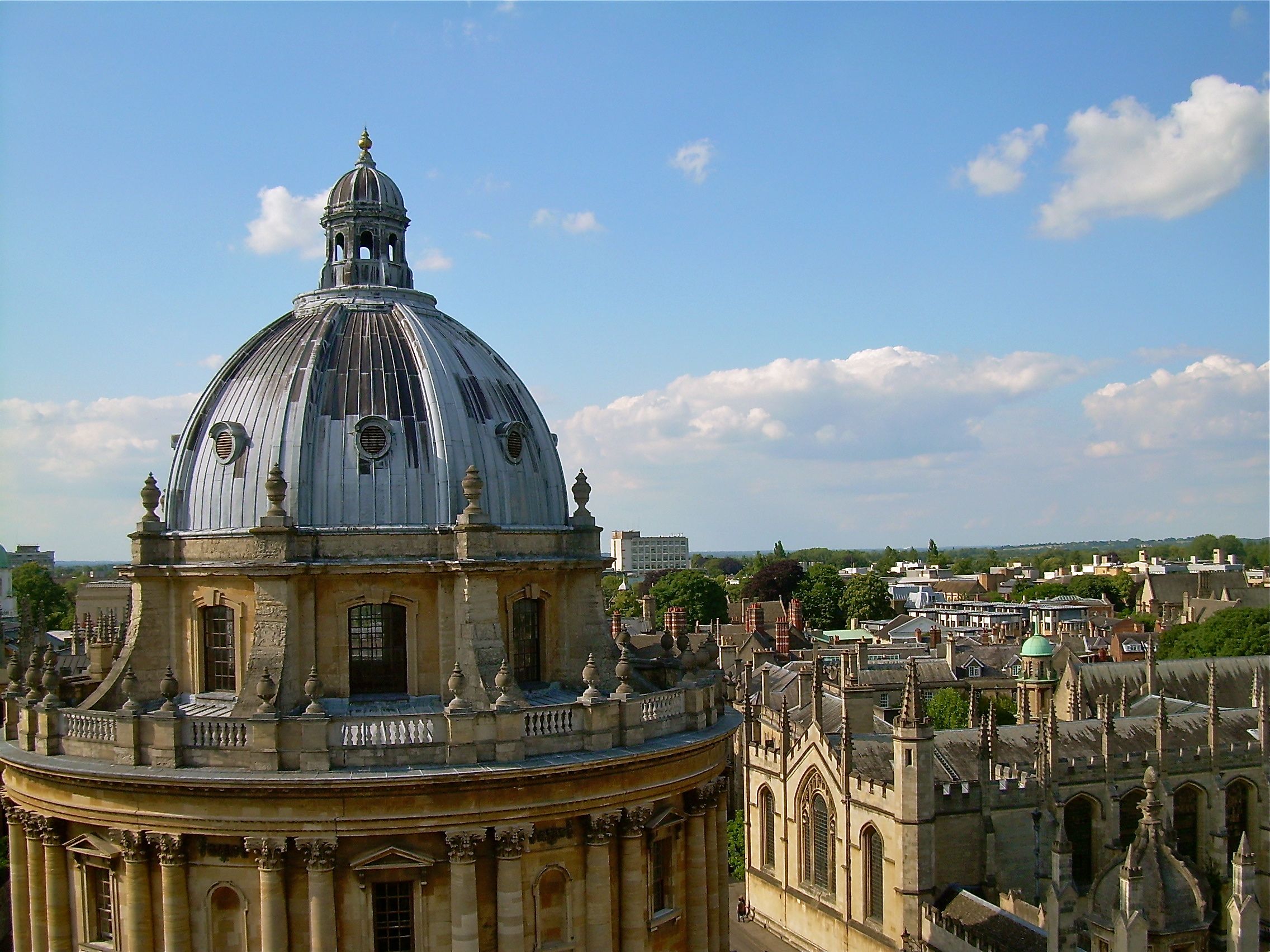
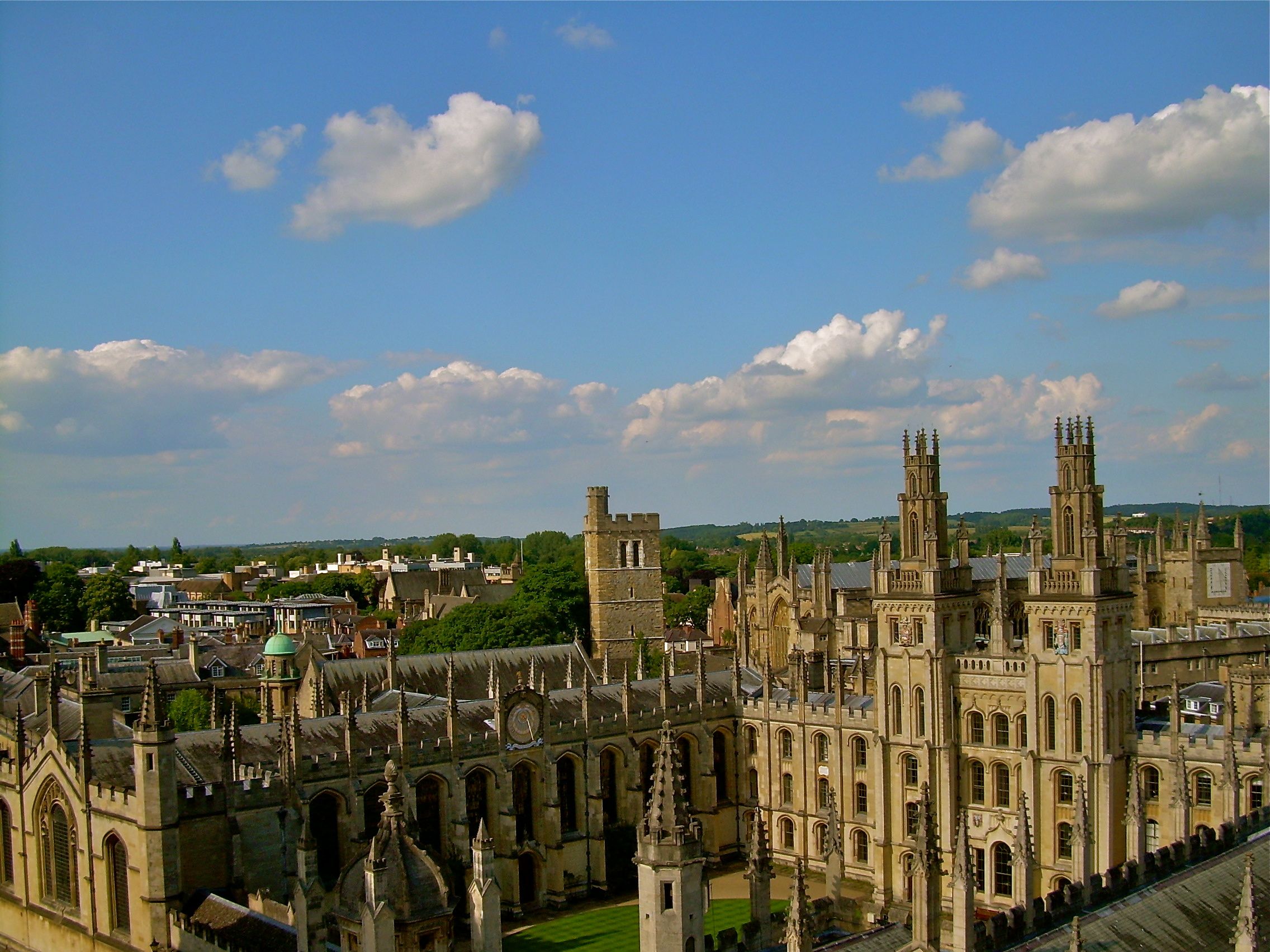
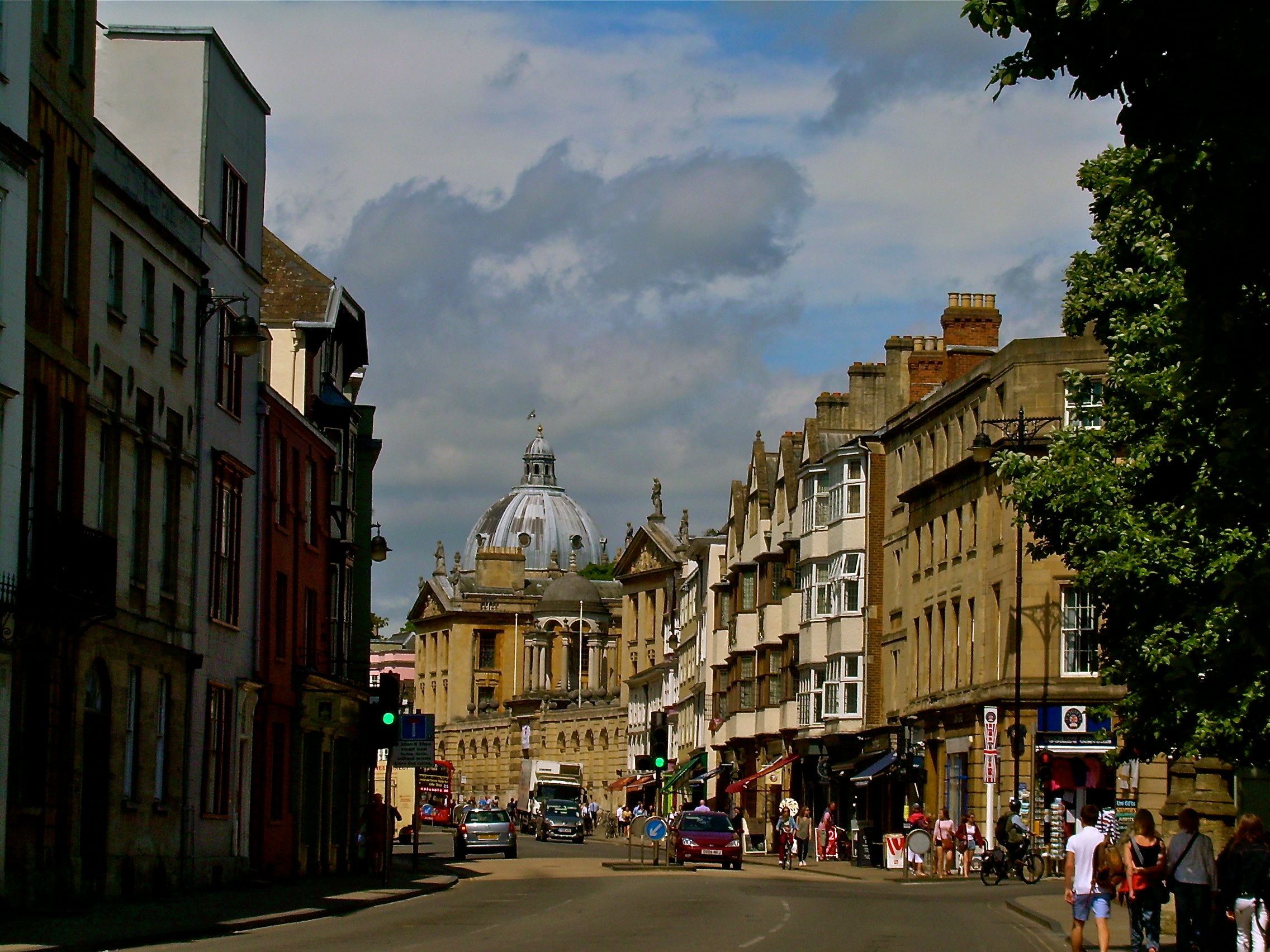
The evening of our arrival had us sight-seeing at the University Church of Saint Mary the Virgin sandwiched between All Souls College and Brasenose College and right smack dab next to the iconic Radcliffe Camera of the Bodleian Library. Dusty and musty, we sneezed our way up the 127-step tower climb and took in the panoramic views of Oxfordshire, squeezing our way past other photogging vista-lovers and gawking at the hundreds of gargoyles who growled and grinned above us. The sights over head, below, and all around only affirmed we had arrived and were ready to conquer.
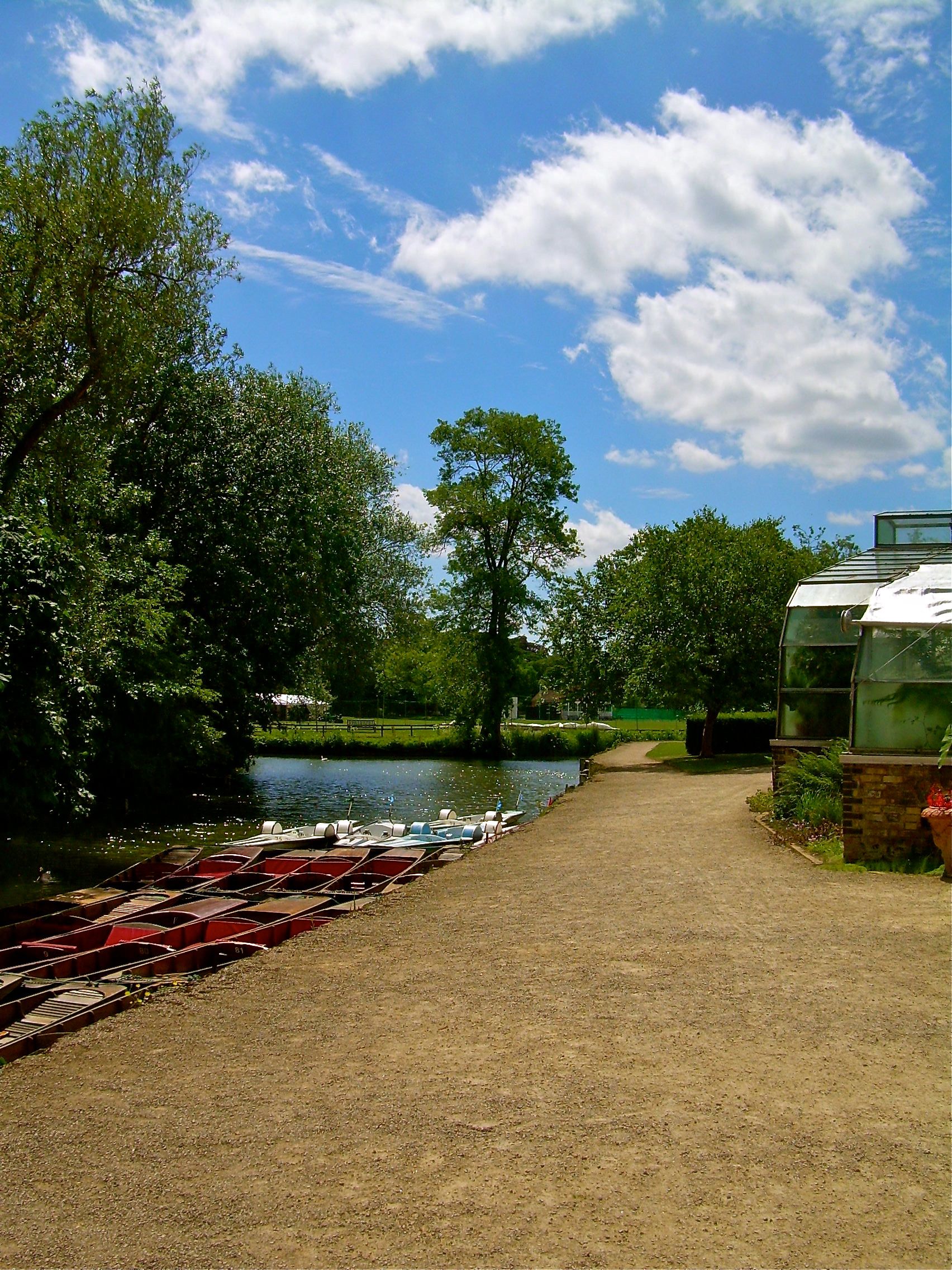
Our second day in Oxford couldn’t have started or ended better. First, a beautiful run along the Thames and then through Oxford Meadows, followed by lunch at The King’s Arms with good friend and great poet Dr. Gregory Leadbetter, who was one of the six fellow residents at Hawthornden Castle last June. Such a treat to catch up!
After our luncheon reunion, we boldly made the trip to London to catch Richard Armitage in The Crucible at the Old Vic, which was no small feat facing the frenzied chaos of Wednesday rush hour in the tube. We might as well have been in the seventh circle of hell, but Mr. Armitage proved worthy of every ounce of frustration and discomfort that included being squeezed into cars, pushed and pulled through the thick and throng of commuters, and getting lost in the tropically humid labyrinth that is The Underground.
At the time of our visit, the production was still previewing to audiences, but performances were startlingly electric. I often found myself unable to breathe. Sarah Cooley deeply impressed with her debut as Abigail Williams and though many of the actors, including Mr. Armitage himself, fell back on yelling rather than emoting, Anna Madeley as Goody Proctor was able to command the house with just a whisper. The theater-in-the-round was also an unforgettable experience, being able to see the audience react as the story unfolded from so many angles. We didn’t return to Oxford until one in the morning, yet yours truly felt like she was floating on clouds from London.
The third day had us visiting the Bodleian, which featured an exhibit on World War I correspondence, The Great War: Personal Stories from Downing Street to the Trenches. A letter from Yeats protesting the violence gave reason enough to shudder at this recent history that tore our world apart only one hundred years ago.
New College later lifted the spirits once we entered the cloister where Mad Eyed Moody turned Draco into a ferret in The Goblet of Fire. More than 600 years old, the gardens are just as impressive as the cloister’s ancient statues that haunt the corners with their shadow-like, ghostly figures. Here you can follow the ancient wall of the city and hear time rustle centuries old legends and stories.
Tea, tasty fat scones, and a wicked lamb stew at the Vaults & Garden Cafe next to Saint Mary’s Church reminded us, to our misfortune, of Sergeant Hathaway’s misadventures in the Lewis episode “Wild Justice”, which you’ll just have to see yourself to understand. Still, we managed an afternoon at The Ashmolean where twenty minutes before closing yours truly happened to stumble on the exhibits of East meets West during and after the age of exploration when Asia and Europe began to trade. So despite missing the Tutenkhamun show, which opened 24 July many notes were dutifully scribbled in the travel journal for a current projekt in the mix.
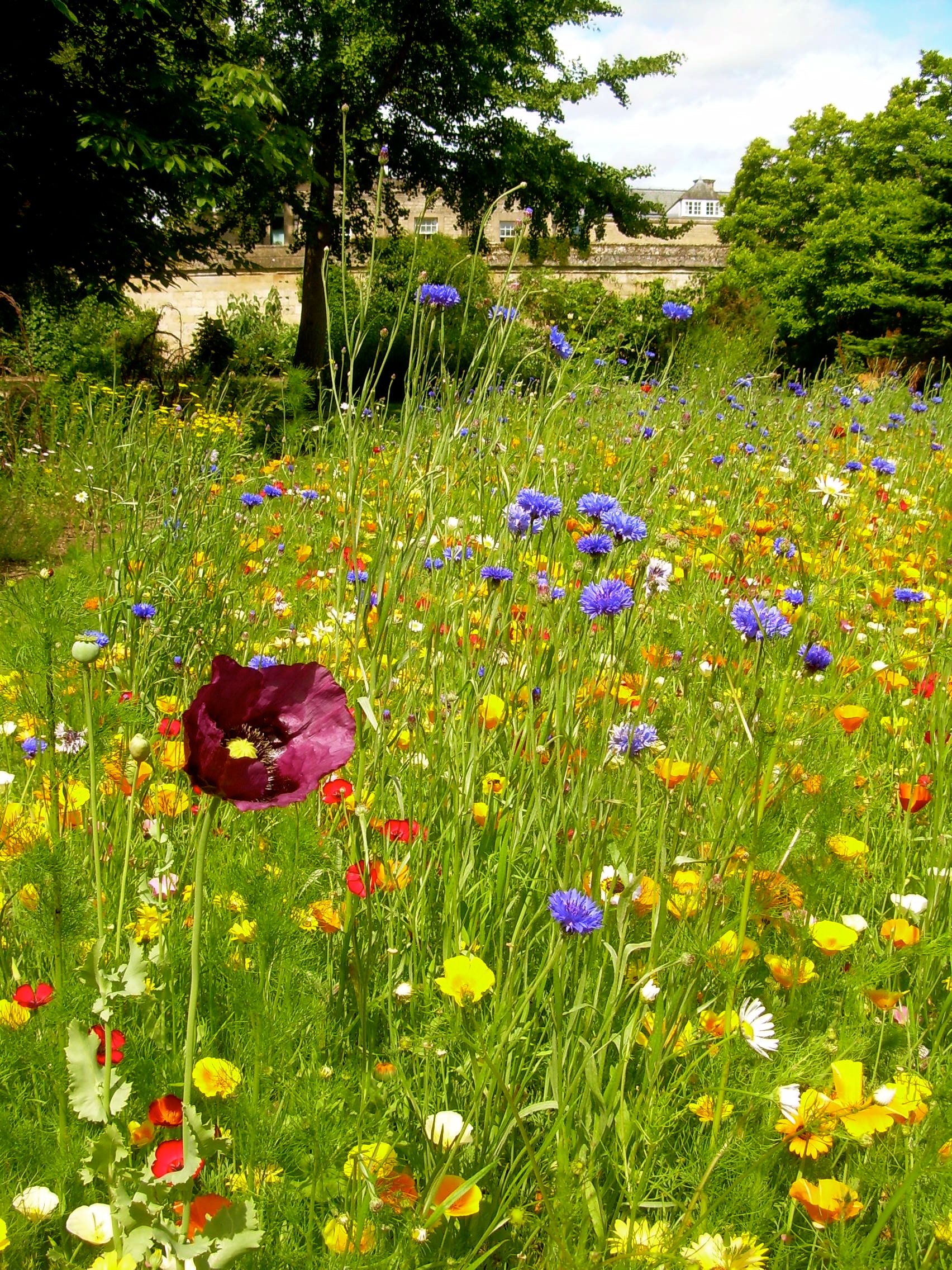
On our third day, we made our own garden party at the Oxford Botanic Garden, one of the oldest gardens and the first scientific garden in Europe, but more notably for this telly junkie the sight of another favorite Lewis episode, where Sergeant Hathaway dallied with love and lost. Of course, this was where Lewis Carroll concocted many of his stories and just paces away from our picnic spot, two students tangled in heated debate over some professor and lecture. You can’t stop the brain power here.
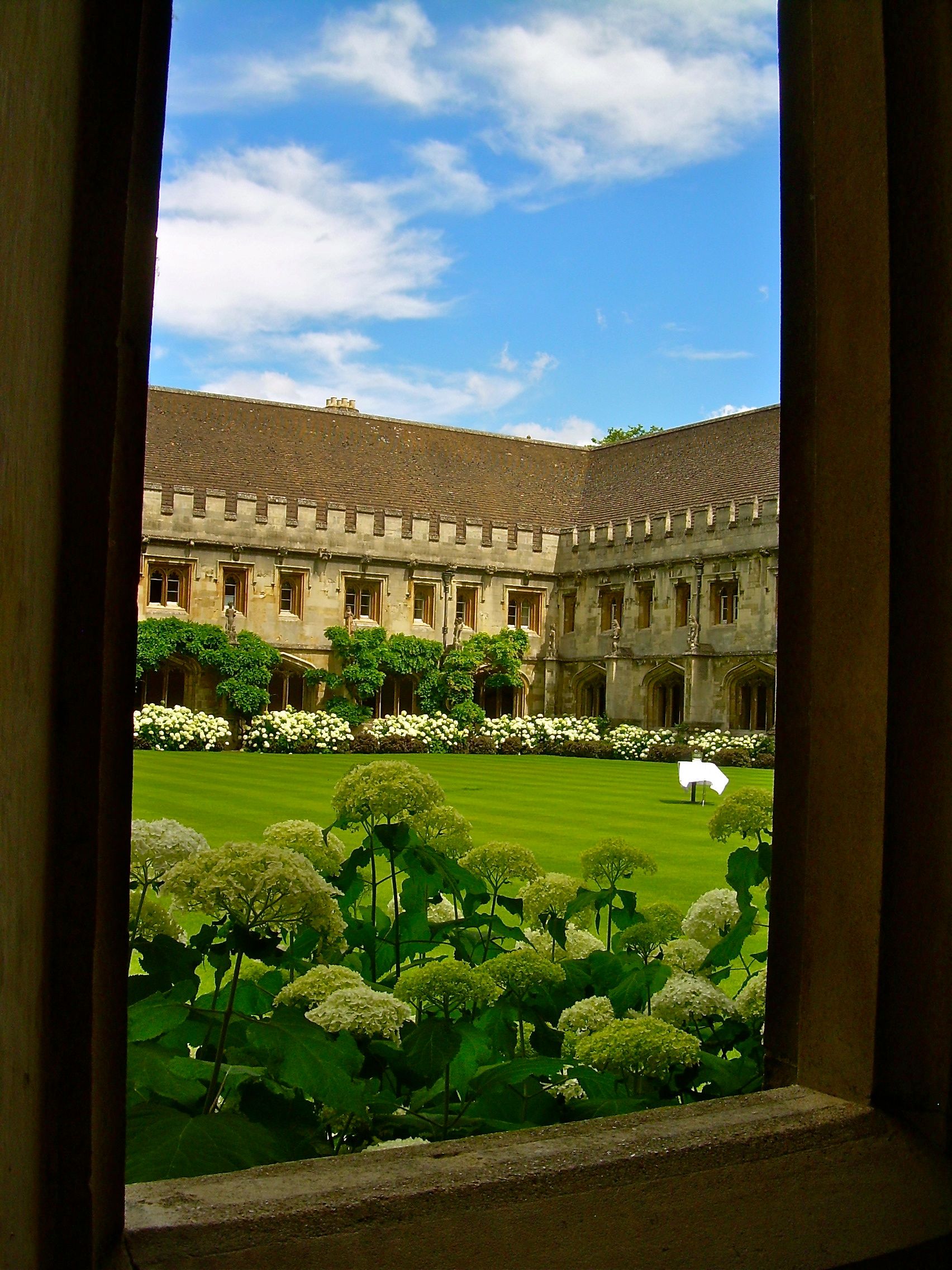
Magdalen College across the street was the next jaunt. The chapel holds some of the most magnificent stained glass windows depicting Biblical images in smooth, velvety rich colors with Pre-Raphaelite attention to texture and movement. We took our time on these college grounds to amble a path following the River Cherwell, spy on deers in the deer park, and admire a Goliath plane tree. The weather for our entire stay was unexpectedly warm and welcoming. Our first few days greeted us with eighty degree heat, and we got soaked by rain showers only once, having packed jumpers and tights that only took up needless space in the luggage.
Some of the best eats we had were at The Inklings’ favorite pub, The Eagle and Child, a pilgrim’s destination for fans of Tolkien and C.S. Lewis. There were plenty shops to feast at The Covered Market, and we enjoyed the rare chance to dine at one of our favorite British Asian chains Wagamama with fellow colleague and Diasporas conference presenter Dr. Dana Herrera, her beautiful family joining us for an evening of fun. Dr. Herrera’s presentation was absolutely insightful and engaging on Overseas Filipino Workers and the use of social media. I look forward to reading more of her work and here’s hoping we can meet up again in California sooner rather than later.
Blackwell’s, Britain’s most beloved bookstore, pulled us in twice during our stay, and yours truly picked up a copy of Javier Marías All Souls to get more intimately acquainted with the university along with William Golding’s The Inheritors to read for later. Throughout our Oxford explorations, we were counseled by the good book The Pocket Guide to Oxford, a must for anyone curious about the history and the hidden gems of this sacred space.
We couldn’t help but take a peek at the Sheldonian Theatre, designed by Christoper Wren, where many of the graduation ceremonies are held, and where the dome offers yet another astonishing panoramic view of the city.
Before we knew it, our three days of soaking up the sights came to an end, and the three-day conference began. Pleasure soon turned to business, which means we didn’t get a chance to enjoy punting on the Thames, hire a bike to cover more ground, visit the Wolvercote & Trout–an old haunt of Inspector Morse–catch an evening of madrigals performed on punts, or see any one of the outdoor Shakespeare productions including As You Like It or A Midsummer Night’s Dream.
Perhaps next time, fingers crossed.
If we had to go back in time for this trip, we really should have taken a double decker bus around Oxford on our first day since when we left we spotted all these sights we meant to visit but couldn’t find on the map or through the trusted but faulty inter-web. Those buses may be expensive and touristy but proved more reliable since there’s nothing like seeing the lay of the land with your own two eyes.
Our fourth trip to the U.K. only fortified our love for these great isles, and yours truly is already anxious for the next visit. In the meantime, what we won’t be missing are: double tap faucets, weak hand dryers, sharing a bathroom in the dorm at Mansfield College, showers in a separate quarter from the toilets, no lifts, and baked beans for breakfast.
What yours truly will be missing and eagerly waiting to enjoy again are: all the variations of accents, watching Lewis whilst in Oxford, Pret a Manger, the English countryside, Blackwells, tea and biscuits, ginger beer everywhere in all shapes and forms–not just Crabbies.
Should we find ourselves in Oxfordshire again, we’ll be referring to this New York Times travel article and The Oxford City Guide to help us plan our itinerary in the land of Radiohead and Stornoway. For now, I’ll be faithfully watching Lewis to savor the memories, ever grateful for the chance to set foot in such storied land.
SMC MFA @ Lit Crawl 2014 features Joshua Braff, Lily Brown, Robert Andrew Perez, Susan Sasson and yours truly. Save the date for Saturday, 18 October, 6pm, location TBA.
The Diasporas Conference ran con-currently with Interdisciplinary.net’s other conference “The Apocalypse”, and it was great fun asking those presenters how the apocalypse was going during mealtime. I also got a much appreciated dress rehearsal from the apocalyptic attendees who asked about my research and then surprised me with a host of questions, which even more surprisingly I found myself not only able to answer but enjoyed mulling over and discussing.
So what was presented in Oxford? Along with fantastic papers such as fellow Saint Mary’s College Professor Dana R. Herrera’s “#OFW: Social Media and the Public Discourse Regarding Overseas Filipino Workers” provocative topics included:
What Difference a Century Makes: Caribbeans in the Amazon in the Turn of the 20th and the 21st Centuries, Maria da Graça Martins
Locating the Self in a Disaporic Space: A Study of Imtiaz Dharker’s Poetry, Rimika Singhvi
The Stories We Tell: Drifting and Linking in Dionne Brand’s Prose, Eshe Mercer-JamesEconomics and Diaspora, Ram Vemuri
Each of the presenters on my panel complemented each other’s work, as we all spoke on ambivalence and pluralism to deepen the discussion of diasporas from multiple perspectives. See for yourself:
Session 8: Border-crossing Narratives Chair: Richard Merritt
Then the World Widened: Daring Creative Writing Students to be Cartographers of the Global Imagination, Rashaan Alexis Meneses
John MacKenzie’s Letters I Didn’t Write: Home is Where You Are, Kristen Smith
Collaborations in Diaspora: Canadian Experiments in Cross-Diasporic Multi-Authored Poetry, Heather Smyth
And what exactly did I present?
The abstract:
Then the World Widened: Daring Creative Writing Students to be Cartographers of the Global Imagination
Pankaj Mishra called for a “bolder cartography of the imagination” in his essay “Beyond the Global Novel” (Financial Times 2013), and a chorus of critics echoed his sentiments posing that the “global novel” or “world literature” sacrifices the specificity of real political traumas for the sake of deadened, feel-good multiculturalism. Though no matter how publishers and academics categorize, plenty of creative writers in our proliferating MFA and PhD creative writing programs aim to tackle transnational narratives. Likely to fictionalize aspects of their own transnational experience or origins, a novelist-in-training will set the world as her stage and her characters as polyglots. How will she avoid the relativistic dead-zone of multicultural platitudes while interrogating notions of politics and identity? How does she begin to depict what Mishra demanded as a “challenging cultural otherness”?
The global or transnational storyteller will likely implement such techniques as the multi-stranded narrative. She will have to demonstrate multilingual sensitivity, and her fiction will undoubtedly straddle simultaneous senses of space and time. This paper examines ways for creative writing students to practice these specific techniques by exploring the works of Kiran Desai’s The Inheritance of Loss and Chris Abani’s Virgin of Flames both of which demonstrate linguistic virtuosity and polyphonic narratives with the intent to grasp what Bertolt Brecht named the “estrangement effect.” Taken from a craft rather than theoretical approach, this paper will illustrate ways to shape a de-centered, global narrative. For a cartographer at this scale must pursue intersections of truth and art, which requires from the writer and the reader a mutual construction of story and meaning. The writer, in this sense, relies on ambiguity and ambivalence to create a purposeful vertigo that is both world-making and world-breaking.
An excerpt:
In crafting the polyphonic narrative, the writer will want to assume that all perspectives, no matter the social or economic standing, have something to lose. From the wealthiest and most comfortable to those who are beyond the margins, every voice has to count. So how to justly cover the stakes? How to viscerally capture the urgency of what’s at stake for each character? The writer must ask herself:
How does each character represent a microcosm and how do these individual microcosms make a multiverse?
How does each perspective contradict, complement, mirror, and refract one another?
How best to splinter the self of each character, knowing that heart, body, and mind are in opposition with one another for each character?
How do these oppositional forces within each character map time and space both for the characters and for the reader?
The takeaway from this conference in this particular network is that passion is key. Interdisciplinary.net goes to great lengths not to emphasize titles or rest on stature but to focus on shared interests and dialogue. Each of the presenters were deeply invested in their topics, which was most engaging and inspiring.
As for what happened in Lisbon, the two conferences couldn’t have been more different. The first one was small and intimate. Forty attendees maximum aside from the two organizers, everyone present sat on a panel, so attendance was expected through the duration of the conference. Conversely, at the New University of Lisbon, I never got a hold of how many attendees were present because people were always coming and going. Half of the presentations were in Portuguese, so panel attendance was uneven depending on which language was spoken. Despite the variation, the opening keynote speaker, Shane Blackman, Professor of Cultural Studies, Canterbury Christ Church University, Kent, United Kingdom, proved most informative and timely, speaking on ethnography, which yours truly will be experimenting with come fall semester.
My panel included:
1) Bulgaria and Spain, Petya Yankova and Lida Aslanidou (University of York & City University London, UK)
2) “Then the World Widened: Daring Creative Writing Students to be Cartographers of the Global Imagination”, Rashaan A. Meneses (Saint Mary’s College of California, USA)
3) The Biggest Loser: Mercer Mayer’s Little Critter Series, the Queer Art of Failure, and the American Obsession with Youth Achievement, Michelle Ann Abate (Ohio State University, USA)
Of course, with the good counsel of a wise colleague I didn’t present the same paper from Oxford, but riffed off the original and found myself deeply interested in exploring how the bildungsroman of the 19th century reflects the building of a nation that mirrors the building of an individual through socialisation. Pushing the idea into a contemporary context, I’m curious to see how the bildungsroman, especially concerning the global novel, examines how individuals gain agency in parallel to how ethnic minorities might pursue sovereignty in the face of national hegemony. Yes, a mouthful, but this is the stuff that revs my engine. With that said, here’s an excerpt:
3. Performing Identity
Our identities demonstrate our allegiance to certain traditions and our rejection of other traditions. We essentially perform our allegiances or denial through identity. How we act and who we act with is our show of moral, personal, spiritual and physical integration into specific communities and even our integration into our larger global society. Jopi Nyman speaks to this in “Performing Englishness”: “By rewriting the generic repertoire of the Bildungsroman, the novel does more than represent a post-colonial critique of a Western genre. Rather, by redefining the process of learning in the context of the nation as a way of learning how to be English, the novel addresses questions of (national) identity and stresses its performative character.”[1] Identity is performative demonstrating our membership or rejection of values and traditions, and we might see the parallels between how the shaping of an individual identity reflects the shaping of a community or even a nation as Benedict Anderson speaks to in his Imagined Community.

[1] Nyman, p 97.
And now what?
I’m eager to continue exploring how global writers explore issues of identity, transnationalism and politics through craft techniques. I’m also hoping to scheme up a panel+workshop with fellow literary artists to explore the following themes:
1. How does your literary work serve or shape your social action or your commitment to social justice?
2. How do we read AND write for craft versus culture (in terms of being a person of color writer)?
3. How can writing & reading chart a “living” map of culture, identity, self, and community?


















 Rashaan Alexis Meneses