Please share the news and mark your calendars: PAWA Event with Lysley Tenorio, Wednesday, November 28, 6:30pm

[For immediate release. Contact PAWA pawa@pawainc.com]

Save the date, and please help spread the word!

Please join PAWA as we present Lysley Tenorio, author of the critically acclaimed Monstress. Writer and educator Rashaan Alexis Meneses will moderate.

When: Wednesday, November 28, 2012
Doors open at 5:30 pm | Event begins at 6:00 pm
Where: The Philippine Consulate
447 Sutter Street San Francisco, CA 94108

Arkipelago Books will handle book sales.


About Monstress

Monstress introduces a bold new writer who explores the clash and meld of disparate cultures. In the National Magazine Award-nominated title story, a has-been movie director and his reluctant leading lady travel from Manila to Hollywood for one last chance at stardom, unaware of what they truly stand to lose. In “Felix Starro,” a famous Filipino faith healer and his grandson conduct an illicit business in San Francisco, though each has his own plans for their earnings. And after the Beatles reject an invitation from Imelda Marcos for a Royal Command Performance, an aging bachelor attempts to defend her honor by recruiting his three nephews to attack the group at the Manila International Airport in “Help.”

Lysley Tenorio reveals the lives of people on the outside looking in with rare skill, humor, and deep understanding, in stories framed by tense, fascinating dichotomies—tenderness and power, the fantastical and the realistic, the familiar and the strange. Breathtakingly original, Monstress marks the arrival of a singular new voice in American fiction.

Lysley Tenorio is the author of Monstress (Ecco/HarperCollins). His stories have appeared in The Atlantic, Zoetrope: All-Story, Ploughshares, Manoa, The Chicago Tribune, and The Best New American Voices and Pushcart Prize anthologies. A former Stegner Fellow at Stanford, he has received a Whiting Writer’s Award, and fellowships from The MacDowell Colony, Yaddo, and the National Endowment for the Arts. He teaches at Saint Mary’s College of California, and lives in San Francisco.

Born and raised in the seismically fractured and diverse landscape of California, Rashaan Alexis Meneses earned her MFA from Saint Mary’s College of California’s Creative Writing Program where she was named a 2005-2006 Jacob K. Javits Fellow. Nominated for a Sundress Best of the Net Prize, recent publications include a personal essay in Doveglion Press, short stories in the Australia based literary journal Kurungabaa, UC Riverside’s The Coachella Review, University of North Carolina’s Pembroke Magazine, and the anthology,Growing Up Filipino II: More Stories for Young Adults. She currently teaches as Adjunct Professor for Liberal & Civic Studies at Saint Mary’s College and will be a resident at MacDowell Colony in 2013. Her website is http://rashaanalexismeneses.com.

Upcoming Writing Workshop at Mills College on “Political Narratives in Colonial Amnesia: Filipino/American Landscapes”

Honored to be invited as a speaker for writer Melissa Rae Sipon-Gabon’s Political Content & Engagement Writing Workshop where I’ll be discussing “Political Narratives in Colonial Amnesia: Filipino/American Landscapes” on Sunday, November 18 at Mills College.

PAWA is proud to co-sponsor this free and important writing workshop.

POLITICAL CONTENT & ENGAGEMENT

in story, memoir, and poetry

——-

five FREE writing workshops
participants’ reading gala
“i am ND” anthology

——-

DATES | Oct. 21, 2012 at 2pm–4pm
and every other Sunday onwards
(11/04, 11/18, 12/02, 12/16)

LOCATION | Mills College
5000 MacArthur Boulevard

——-

instructor melissa r. sipin and hosted by

ANAKBAYAN East Bay
TAYO Literary Magazine
Philippine American Writers & Artists
Mills College

“Every colonized people—in other words, every people in whose soul an inferiority complex has been created by the death and burial of its local cultural originality—finds itself face to face with the language of the civilizing nation; that is, with the culture of the mother country. The colonized is elevated above his jungle status in proportion to his adoption of the mother country’s cultural standards.”

— Frantz Fanon

This political content & engagement workshop invites writers to shape their memoir, poetry, prose, or performance work with an emphasis on impacting perceptions, be thy political, personal, social, literary, or cultural. We exchange our writing and develop voice and authority while working on techniques to elevate the richness and toughness of our voice. We read and analyze authors to observe how they effectively move the reader, affect perception, and perhaps opinion. Class discussions focus how our work affects how we are perceived and how the events of the world are understood. The elements of each genre are addressed as well.

amplify your writing
cultivate your craft

——-

Weighing in on Puente Project Annual Student Leadership Conference 2012

On Saturday, October 13, I’ll be participating in this year’s Annual Puente Student Leadership Conference taking place at Saint Mary’s College, where I’ll be facilitating two back-to-back writing workshops titled “Power of Voice.” I’m hoping to sneak into Gary Soto’s keynote address and greatly looking forward to working with ambitious students who have already set themselves as leaders in their communities.

Puente Project is partnering with SMC undergraduate admissions and the Saint Mary’s College Intercultural Center to co-host a conference for over 500 Puente Project students from the San Francisco Bay area.  A University of California program, Puente Project is a college preparatory program  that serves low income, youth of color who are the first in their families to attend college.  Puente is open to all students,  with about 90 percent of our students being Latino descent.   The purpose of this conference is to expose Puente students to a new college campus and to begin their exposure to leadership, college preparation, and identity development as a college going student.

Mini Agenda

Breakfast: 8:00 am – 9:00 am

Welcome 9:30 am

Keynote Speaker: Gary Soto, Author and Playwright: 9:50 am -10:30 am

First Workshop Session: 10:45 am – 11:35 am

Second Workshop Session with new student group: 11:45am- 12:35 pm

Students back to Soda Center for closing program: 1:30 pm

Students Dismissed: 3:15 pm

Latest short story “With Hummingbird in Hand” published by Australian-based journal “Kurungabaa”

Over ten years in the making, after hundreds of revisions and countless reincarnations, my short story, “With Hummingbird in Hand,” will finally see the light of day thanks to the editors at the Australian-based journal Kurungabaa.

Here’s an excerpt:

The oil in the deep fryer bubbled and cracked as Yesenia and Claudia orchestrated the breakfast shift. Parked in a littered alley next to a super-sized Home Depot in a ragged quarter of East Hollywood, Yesenia’s mobile kitchen, Mariscos de Madrugada, served as a beacon for over-worked souls who scrambled through gridlock, measuring their lives by paychecks and commutes. Outside their kitchen, police sirens blared, cars backfired, and horns honked. The mariachis they hired to entertain their hungry customers played at the curbside. The trim of their charro outfits gleamed in the early morning sun as the rush of orders kept coming.

Check out the original announcement on Kurungabaa’s website, where you can pick up a copy for yourself.

Latest Issue Vol4 No1 © 2012!

  • Vol. 4 No. 1 out now!


**

Prose

Derek Hynd

Susan  Gottlieb

Rebecca Olive

Louise Victoria Jeffredo

Shaun Tomson

Aga Maksimowska

Michael Scott Moore

Greg  Bogaerts

Cori Schumacher

Andrea Frost

Brian Barbeito

Carole Lander

Clifton Evers

Madelaine Dickie

Byron Alexander Campbell

Rashaan Meneses

Taylor Claire Miller

Poems

Kim Satchell

Corrina Cop Rain  Mcfarlane

Kathy Jetnil-Kijiner

Susan  Adams

Louise Victoria Jeffredo

Trevor Abes

Carolyn Abbs

Celeste Snowber

Mara  Nichols

Rhonda Melanson

Art

Dane Peterson

Hugo  Muecke

*

Note that the current issue is available in hard copy (the real rag) at the following fine establishments:

  •  Six Ounce Board Store, Manly

  • The Sugarmill, Narabeen

  • The Top Shop, Byron Bay (behind the counter)


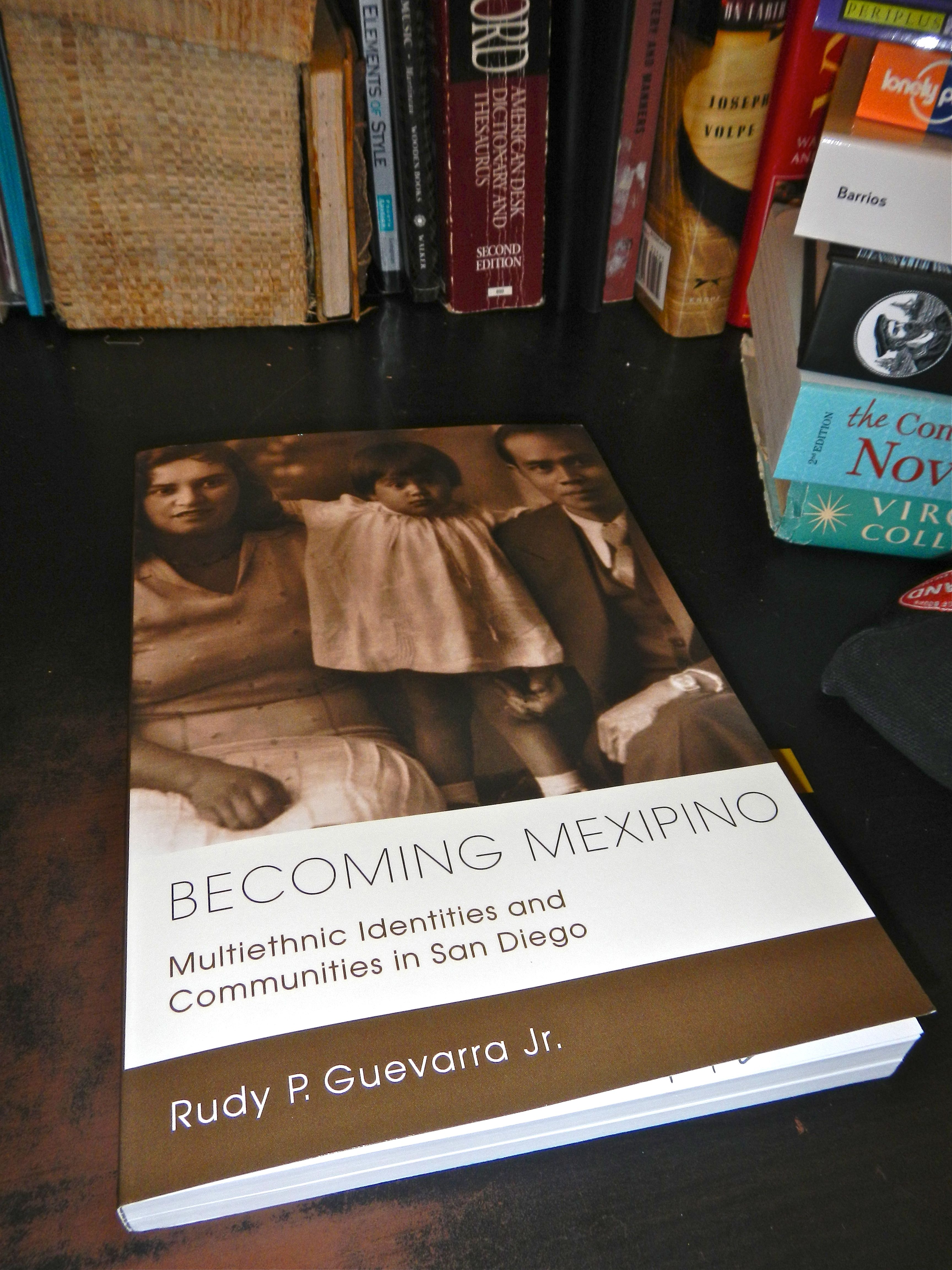
Interviewed by Dr. Rudy Guevarra Jr. in his new book “Becoming Mexipino”

Just got my signed copy of Becoming Mexipino: Multiethnic Identities and Communities in San Diego written by Dr. Rudy P Guevarra Jr. (Arizona State University) and published by Rutgers University Press. I remember when Dr. Guevarra and I first met at a FANHS (Filipino American National Historical Society) conference in San Diego years ago. We compared notes about being Mexipino or Chicapina, as my family calls us, and, later at UCLA, I would share my stories with him officially for the honor and privilege of being included in his book.

Here’s an excerpt:

Rashaan and other Mexipinos in San Diego are the bridges between both cultures because they live a multicultural existence. Multiethnic and multiracial people have already experienced an alternative worldview, which has positive implications. She described it in terms of the future of racial and ethnic mixing: ‘I think it is inevitable…Time magazine put up all the races of together to see what it [hypothetical person of the future] would look like, and it looked Filipino. You know, it’s like we’re already there, we’ve been there. We’re just bringing it to the forefront (158)

Becoming Mexipino is a social-historical interpretation of two ethnic groups, one Mexican, the other Filipino whose paths led both to San Diego, California. Using archival sources, oral histories, newspapers and personal collections and photographs, Rudy P. Guevarra Jr. traces the earliest interactions of both groups with Spanish colonialism to illustrate how these historical ties and cultural bonds laid the foundation for what would become close interethnic relationships and communities in twentieth century San Diego as well as in other locales throughout California and the Pacific West Coast.

Educators, please consider using this text in your classroom. California history lovers, ethnic study researchers, and San Diego locals, why not pick up a copy for yourself? Please help spread the word to interested parties and consider having a go yourself!

Nominated for The Versatile Blogger Award

Much gratitude to writer Rio Liang. Thanks to him, yours truly is honored and humbled by his nomination for The Versatile Blogger Award.

The Versatile Blogger website stipulates:

If you are nominated, you’ve been awarded the Versatile Blogger award. [Though not obligated to, if you want to respond in kind you can do the following.] Thank the person who gave you this award. That’s common courtesy. Include a link to their blog. Select 15 blogs/bloggers that you’ve recently discovered or follow regularly. Nominate those 15 bloggers for the Versatile Blogger Award — you might include a link to this site. Finally, tell the person who nominated you 7 things about yourself.

In the spirit of the award, I nominate the following blogs (listed in no particular order), which embody excellence in creativity; dedication to individual passions, such as writing, education, or living life with integrity; as well as demonstration of strong digital citizenship:

1. Marianne Villanueva’s Kanloan

2. Dr. Vangie Meneses

3. Barbara Jane Reyes

4. Ire’ne  Lara Silva

5. Pop Culture and the Third World

6. Oscar Bermeo

7. Lesley Carter

8. PAWA Blog

9. Jody Hedlund

10. Rhythm Planet

11. Florante Aguilar

12. Feminist Frequency

13. Chinese Pirate Productions

14. E.A.M. Harris

15. The Blog of Tieryas

Finally, as a nominee/nominator, here are seven things you can pin on me:

1. Lives for the sound of dirt crunching under my hiking boots.

2. Will be happy if I never eat another full English, Irish, or Welsh breakfast again.

3. Shamelessly practices literary promiscuity

4. My Netflix “Taste Profile”: “visually stunning, mind-bending,” “cerebral romantic,”  “dark.”

5. Named after the jazz artist Rahsaan Roland Kirk.

6. Not sure if I want to be Bill Nighy or be with Bill Nighy.

7. Has a thing for tweed.

Bill Nye
Not this Bill Nye!
This Bill Nighy:
Bill Nighy … perfectly cast as a pirate radio station manager.
My namesake:

On To MacDowell

Out of my wildest dreams, 2013 starts off with a three-week fellowship at the nation’s oldest arts colony, MacDowell founded in 1907 in Peterborough, New Hampshire. If yours truly wasn’t also accepted to The Retreat for Writers at Hawthornden Castle in Scotland for June this year as well, I’d be suffering from a serious case of imposter syndrome. And below is why. A shortened list of some of MacDowell’s past fellows and the projects they worked on during their stay should give plenty of reasons for doubt and legitimacy. Sally Field, I feel you.

Marian MacDowell in front of Edward's log cabin, the Colony's prototype studio. Archival image.

Aaron Copland
Meredith Monk
Duncan Sheik
Nick Carbo
Amy Bloom
Lan Samantha Chang

Louise Erdrich (known to have worked on one of my all time favorite novels, Love Medicine)

James Baldwin (Giovanni’s Room)
Eric Gamalinda
Jessica Hagedorn
Garrett Hongo
Allison Landa
Rick Moody
ZZ Packer
Nzotke Shange
Lysley Tenorio

From their website:

The mission of The MacDowell Colony is to nurture the arts by offering creative individuals of the highest talent an inspiring environment in which they can produce enduring works of the imagination.

The sole criterion for acceptance to The MacDowell Colony is artistic excellence. MacDowell defines excellence in a pluralistic and inclusive way, encouraging applications from artists representing the widest possible range of perspectives and demographics.

So, what will this soon-to-be-fellow do at MacDowell? A game plan would be nice though a very near and dear writer friend called just days before departure with her advice since she’s been to Hedgebrook, Vermont Studio Center, and East Anglia. She was adamant about not expecting too much: “You’re not going to get everything you want done, but you will get what you need.” Echoing the wise words of Mick Jagger, she confessed wishing someone had told her that during her residencies.

The expectations thus far have waned and waxed with anticipation, and we’ll see which if any come true, knowing that as my partner’s ukelele instructor once warned during a music lesson, a creative person is never satisfied by their creation, prepare to be perpetually dissatisfied and to feed off your dissatisfaction.

With that in mind these goals may sound abstract but here they are: to tighten voice & style or at least have a stronger sense of each. Not that the entire projekt will be tightened but a firmer grasp on voice & style, and how it changes from character to character, from start to finish, just a keener sense on what each of them are and their evolution would be wonderful. Which leads to the question about structure. Does voice and style dictate structure? Is it vice versa or do the two really have nothing to do with the other? Perhaps that question will be answered on the Eastern seaboard.

More than anything a mental map of where this projekt needs to go is the ultimate aim, and that map needs explicit directives on voice, style, structure, and tone, knowing that all of this should evolve from one chapter to the next depending on character and progression of plot.

This residency is not only a good chance for the physical, mental, and spiritual kick in the arse as all good travel is since I’ll be clear across the country in a completely new and snowy environment. There’s also the mingling with other writers, painters, musicians, architects, sculptors, and who knows what these encounters may bring, but the relationship that is utmost in mind is the intent to gain a newer, closer, almost incestuous, yes, I said it, intimacy with the projekt. Even after five years, it still feels so much of a foreign beast. Is there anyway that the projekt might feel like a part of me, an extension of self? And in getting to know this piece better, getting skin close to it, is there a possibility of taking Writing to a different level? To not just make this art a second nature but first? That may be asking too much.

Satisfaction with dissatisfaction. If that’s one guarantee, I may just be ready.

If you have advice about New Hampshire, Boston, cold weather fun, what do and what not to do at residencies, and or creative-making, I’m all ears. Happy 2013. May yours be a healthy and bright new adventure!

Barbara Jane Reyes Shouts Out on Poetry Foundation’s Harriet the Blog

Poetry Foundation’s Harriet the Blog has the honor and pleasure of hosting a regular online column with poet and professor Barbara Jane Reyes, who’s latest poets speaks truth to power, breaking silence and representation while giving a shout out to Pinay voices, including yours truly.

Do your soul a favor, and check out her words and Pinay works:

Teaching and Writing Pinay Lives and Voices

By Barbara Jane Reyes

As an author, I’ve been very uncomfortable, being expected to “represent” an entire community. Some years back, as a guest speaker in Willie Perdomo‘s VONA workshop, Building the Poetry Manuscript, I was asked by one Pinay student what that felt like, being a Pinay expected to “represent.” I told her I disliked it; though I think my work can be resonant and relevant to a Filipina American experience, it’s my own take on that wildly divergent thing. Moreover, something I’ve known since I was young, something to which my parents can attest, is that I am never the Pinay that people expect Pinays to be.

Read the entire post here.

Maraming salamat Barbara for making community!

How it went down at this year’s ACTC 2012: “Preparing for and Living in the Real World through Core Texts”

This year’s 18th Annual Associated Core Texts & Courses Conference, in Milwaukee, Wisconsin, sponsored by Carthage College, and focusing on the theme: “Liberal Arts Education and the World: Inquiring into, Preparing for, and Living in the Real World through Core Texts” took place 29 March through 1 April at The Hilton Milwaukee City Center Hotel, where I presented with the following panel

“Conrad, Ellison, and Narrative Structure:

Blending Critical Thought and Student Engagement”

Aaron P. Smith, Marian University of Fond du Lac, “Authentic Self-Existence for the Visibly Marginalized;” Lamiaa Youssef, Norfolk State University, “Narrative Lenses and the Journey toward Self-Knowledge;” Justin Ponder, Marian University, “A Walking Personification of the Negative: Listening to Stories in Invisible Man;” Rashaan Meneses, Saint Mary’s College of California, “We’re All ‘Others’ Now: Revisiting Joseph Conrad’s Heart of Darkness in the Age of Post-post-colonialism.”

Chair: Jean-Marie Kauth, Benedictine University

Some of the speakers and panels that caught my attention were the following:

Robert Gurval, Department of Classics, University of California, Los Angeles: “Harmony and Homer on the Pearl River Delta: The Foundations of a New Liberal Arts in China”-

  • China is looking at Western liberal arts colleges to help shape their higher education though instead of calling their undergraduate core curriculum “general education” they’ve opted to use the term “gateway education” to indicate that students are beginning the path to learning
  • self in search of self
  • self as social institutions
  • Liberal Studies as training for life
  • introduce poetry first as foundation to politics, which is the gateway to political and economic theory

From the panel, “The Function of Core Texts and Their Programs,” Nicholas D. Leither, Saint Mary’s College of California, “Skepticism Destroyed Their Paradise: Generative Thinking and and ‘Believing’ in the Text”-

  • argues that students lose innocence in college when they’re taught to become the skeptic
  • more often than not in the classroom creative thinking isn’t valued, nor seeing several POV’s simultaneously
  • Rational thinking limits
  • “When we take a critical approach, we forget to believe.”
  • Critical versus generative, students need to take a leap of faith

From the panel, “Concepts of the Self in East and West,” Yaqun Zhang, Xiamen University “Confucius’ Gentleman Personality and Its Influence on Academic Education”

  • education as a cultural mission
  • educating students to let them know they are part of a a social and civic commitment
  • seeking harmony not sameness
  • having a sense of appropriate conduct

From my own panel on Conrad and Ellison, Aaron P. Smith Marian University of Fond du Lac, “Authentic Self-Existence for the Visibly Marginalized” (concerning Ellison’s Invisible Man)

  • one must have existence to become authentic, meta-alienation
  • alienation requires confrontation
  • those who create new values need an audience to receive

This year’s conference not only emphasized true and vigorous cultural exchange between the U.S. and China since ACTC has been collaborating with Chinese universities to help shape their curriculum, but another important theme emphasized again and again was inter-disciplinary exchange and pairing texts that weren’t so obvious on the surface, but in comparing say Machiavelli to Lao Tzu, professors made profound connections and demonstrated an exchange of ideas and values that spanned time and geography.

Speaking on Love & Labor for Barbara Jane Reyes’ class “Filipina Lives and Voices in Literature” at USF

Thanks to professor and poet Barbara Jane Reyes and the sponsorship of the Yuchengco Philippine Studies Program and Asian Studies Program, I was able to guest lecture for Reyes’ Spring 2012 course “YPSP 195-01/ANST 195-02: Filipina Lives and Voices in Literature” at the University of San Francisco on Tuesday, April 3, 2012. Before my presentation, sixteen savvy students read my short personal essay “Barbie’s Gotta Work,” published in Doveglion. The essay was included in the course’s unit on “Work and Domesticity.”

Reyes recently discussed this very same class and its inception in her recent post on the Poetry Foundation’s Harriet The Blog:

One day, I’d casually asked our program chair whether he was interested in an all Filipina/Pinay (Filipino women) literature course, and he said, yes, draft a syllabus, and we’ll get it approved by the curriculum committee. It was approved. It was quickly filled. This is the first semester I am teaching the course, and I’m still in disbelief. All Pinay Literature. I always think, wow, where was this class when I was young, and when I needed it most. It seems a lot of people have been asking this question too, as I have been asked by more people than I can count, for my syllabus and reading lists. So, in this space, I will be talking a bit about some of the items from my syllabus, in the hopes that it will prompt readers further.

Read entire post here.

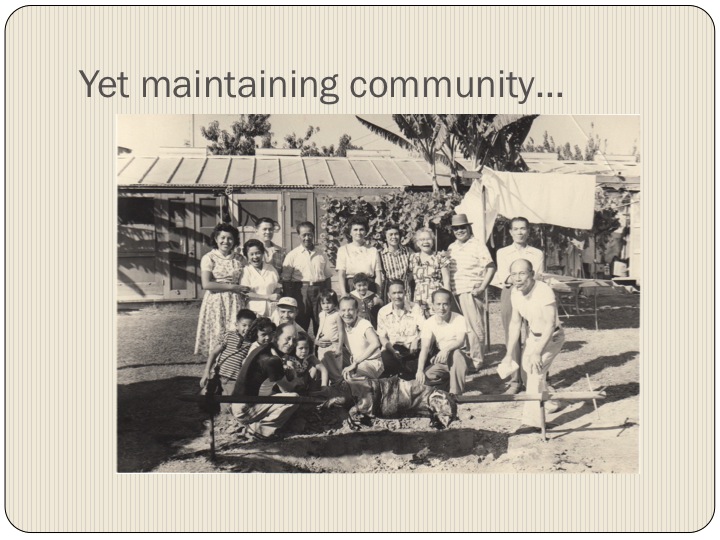
For my guest lecture, after giving a brief power point presentation, featuring pictures of my family, my maternal and paternal grandparents at work and at play in their youth, the students asked challenging questions about the superficiality of Barbie and how that was complicated in the essay and what it was like to be a professor of color. Another student broached the gap between generations, wondering how to relate with family members who might not share the same  educational experiences. This brought on the idea of exploring the roots that hold us together and the stories family members share no matter where their paths in life take them.

We discussed looking at life and literature through a prism of lenses, much like looking through a kaleidoscope; we can shift the angles. We also talked about family memories that shape who we are. Some of the students shared their own experiences, remembering the work of their mothers, fathers, and grandparents.

Below is a sneak peek at the writing exercise students worked on, sifting through their past and their parents’ and grandparents’ pasts to uncover half-forgotten memories concerning love and labor, two themes that I keep coming back to with my own writing.

Love & Labor Writing Exercise

  • How do your parents and/or grandparents use their body at work?
  • How did work define your parents and/or grandparents?
  • What sense of self and purpose did they find through their labor?
  • Describe one of your parents or grandparents at work: What is the setting? What are their hands doing? Explain the actions of the body and mind.
  • How are they interacting with their setting? With other people at work?