“The Next Big Thing,” courtesy of Marianne Villanueva

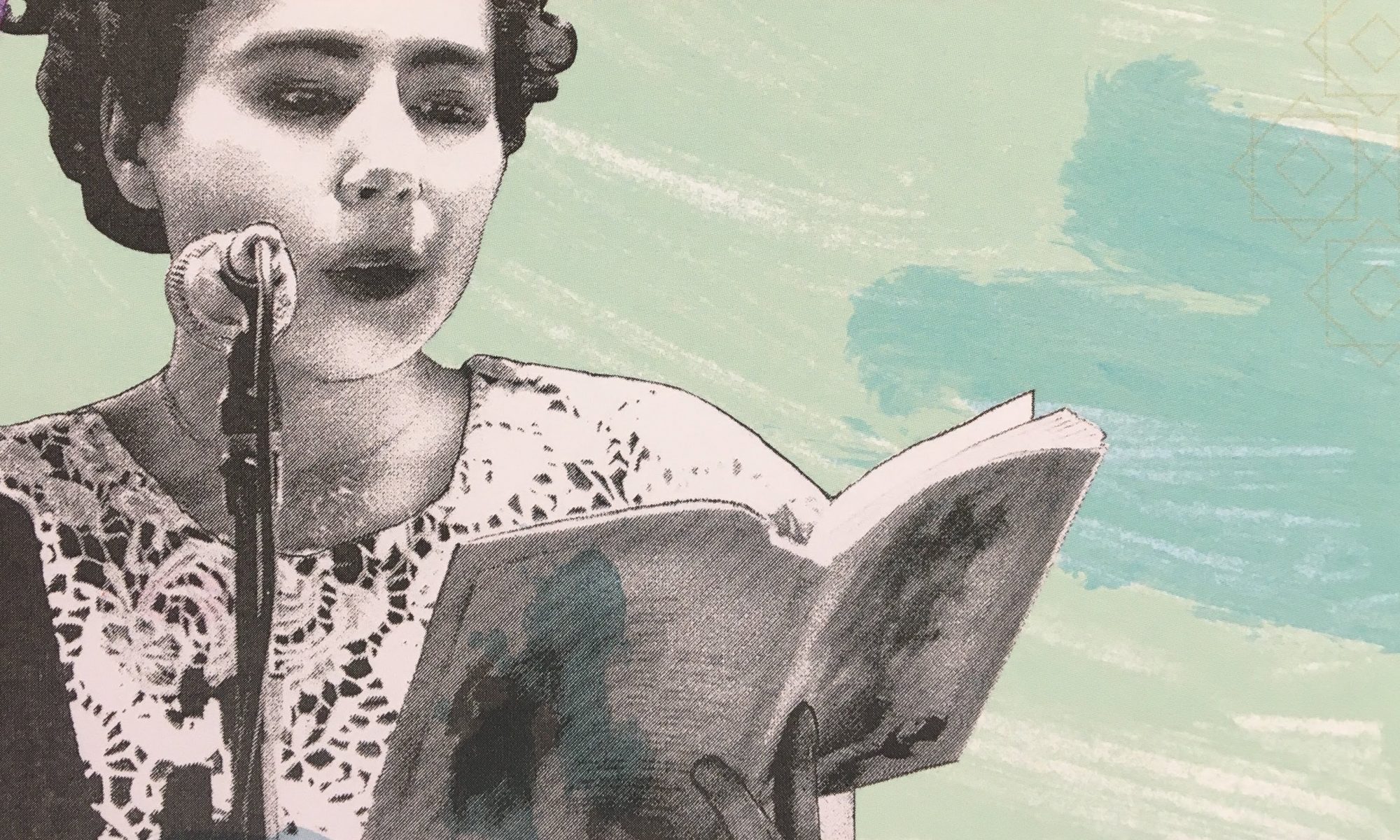
Vicente de Memije, Aspecto symbólico del mundo híspanico, 1761.

Blushing intensely right now not just because I’ve been tagged by Marianne Villanueva as “The Next Big Thing” but I’m also shamefully late in responding to the recognition, but in the spirit of better late than never, here are some musings over this meme’s query. Cheers, Marianne, for the shout out!

1. What is the working title of your book?

Sorry, this one is under wraps.

2. Where did the idea for the book come from?
For the last four or five years, I’ve been obsessed with this New York Times article: http://www.nytimes.com/2005/05/29/magazine/29FILIPINO.html?pagewanted=all&_r=0

3. What is the genre of the book?

Its all made up.

4. Which actors would you choose to play your characters in a movie rendition?

I wish I was more current with Filipino actors, but there’s no getting around the fact it’d have to be an APC (All Pinoy Cast).

5. What is the one-sentence synopsis of your book?

Work-in-progress.

6. Who is publishing your book?

One step at a time, please, thank you.

7. How long did it take you to write the first draft of your manuscript?

Probably a year and a half. I’ve been on negative one draft for the last two or three years…

8. What other works would you compare this book to within your genre?

I’m stealing as much as I can from Kiran Desai’s Inheritance of Loss, and I would love to nab from Carsten Jensen’s We The Drowned, but that’s just me dreaming. Oh, and there’s some heavy borrowing from Fitzgerald’s Gatsby in terms of POV and who is or who isn’t the main character.

9. Who or what inspired you to write this book?

The NY Times article cited above is the primary mover for this; there’s also my grandparents on both sides who immigrated for love and labour. A PBS documentary, The Learning, from the POV series really resonated and keeps me on the straight and narrow when I lose my way with the manuscript. I’m hoping to show my students the film this Spring 2013 when I teach for the second time L&CS 123: Modern Global Issues. The projekt is very much based on ideas about diaspora, cosmopolitanism, geography & the body, and globalization.

From the POV website:

The Learning is the story of four Filipina women who reluctantly leave their families and schools to teach in Baltimore. With their increased salaries, they hope to transform their families’ lives back in their impoverished country. But the women also bring idealistic visions of the teacher’s craft and of life in America, which soon collide with Baltimore’s tough realities. A co-production of CineDiaz and ITVS in association with The Center for Asian American Media, with funding provided by the Corporation for Public Broadcasting and American Documentary | POV. (90 minutes)

Image from the International Observatory on Statelessness: All of the children were born in Sabah to illegal Filipino immigrants

Finally, DRM Irving’s Colonial Counterpoint has been a wonderful resource and fount of inspiration. Here’s just a taste on why from Chapter 1 “Colonial Capital, Global City”:

Manila was the world’s first global city. Its foundation as a Spanish colonial capital in 1571 forged the last link in a chain of trade routes that encircled the Earth. For the first time in human history, there emerged a system of transoceanic connections that allowed for the regular transport of people around the world and sustained exchange of ideas and commodities. Early modern Manila’s interstitial function in opening (and in some ways closing) the Chinese market to the world, together with its role as a cultural, commercial, and geographical nexus between Asia and the Americas–and, by extension Africa and Europe–endowed it with a global economic and political significance, outstripping that of any other city in the region…Manila was, essentially, a microcosm of the world. (19)

10. What else about your book/your writing might pique the reader’s interest?

Two words: Murder Mystery.

***

And to pay it forward, I’m expected to pass the mic around to five writers who I consider “The Next Big Thing,” and they are:

Jennie Durant

Emily Breunig

Melissa Rae Sipin-Gabon

Liz Green

Allison Landa

Here’s to a new year of writing and recognition! Much appreciated.

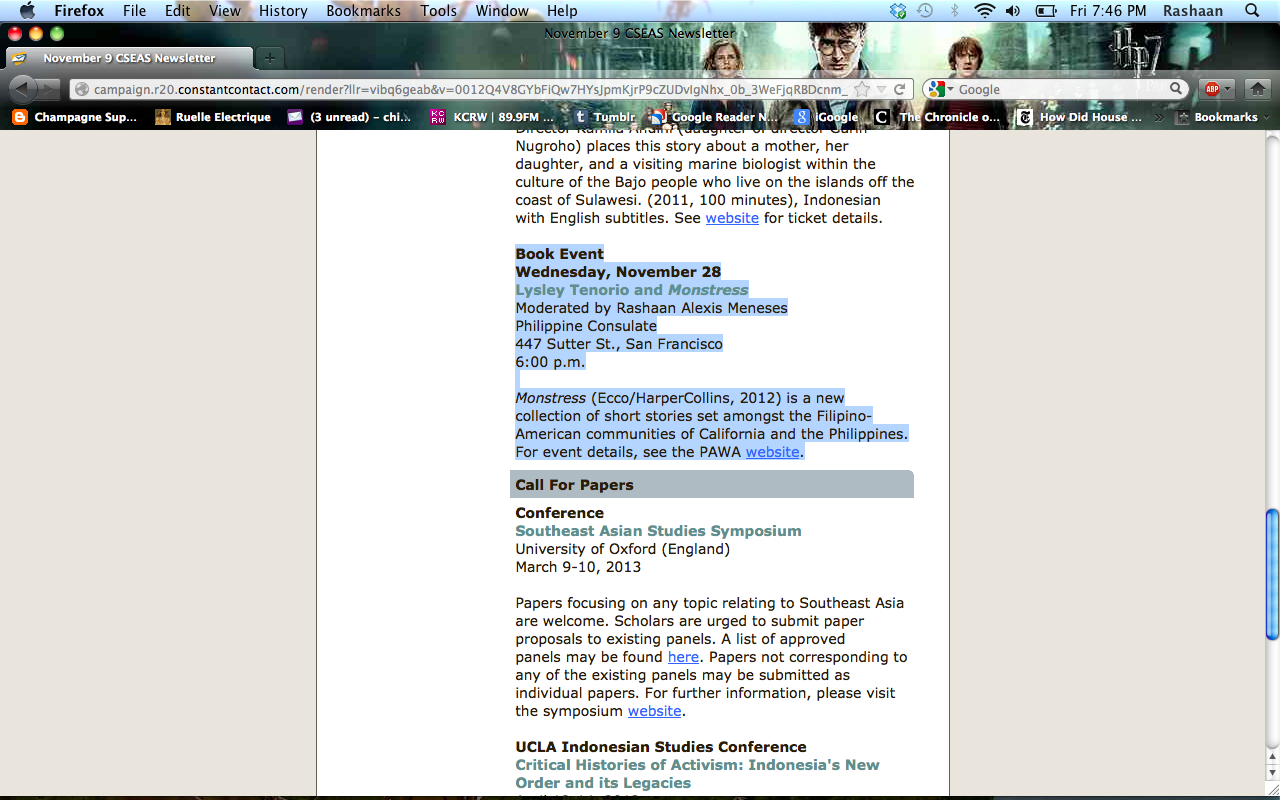
Excerpt on Lysley Tenorio’s Reading at San Francisco Philippine Consulate

On Wednesday November 28, after a wet and windy day, yours truly had the pleasure and honor of introducing my grad school mentor and thesis advisor fiction writer and Professor Lysley Tenorio, who’s new book, Monstress, a short story collection, was recently published by Ecco. Organized by PAWA Inc and hosted by the San Francisco Philippine Consulate, the literary event was started off with a welcome from the Consul General.

The introduction went something like this:

 A former Stegner Fellow at Stanford, Lysley Tenorio has received a Whiting Writer’s

Lysley Tenorio

Award, fellowships from The MacDowell Colony, Yaddo, and the National Endowment for the Arts. His stories have appeared in The Atlantic, Zoetrope: All-Story, Ploughshares, Manoa, The Chicago Tribune, and The Best New American Voices along with Pushcart Prize anthologies.

His latest book, Monstress published by Ecco/HarperCollins was reviewed in the New York Times where ANDREW HAIG MARTIN called his collectiona refreshingly off-kilter approach to the lives of Filipinos in America.”

Katy Waldman from SLATE.com wrote “it is the unassuming pitch of these stories that makes them so exquisitely deadly.”

And Dan Lopez in Lambda Literary described the collection saying: Hard lives and hard choices take center stage in Monstress, but this is no bleak landscape that Tenorio limns. Woven throughout the collection is a wry narrative of ambition. These characters whether they are gay or straight, American or Filipino, all share an abiding desire to succeed, their shared identity of otherness paradoxically empowering as it appears to disenfranchise. In that sense, they belong to a larger project of outsider fiction.”

To read more about the event, click here.

Rashaan Alexis Meneses

Last Call for Tenorio and his Monstress at the SF Philippine Consulate: Wednesday 28 November

Please join PAWA as we present Lysley Tenorio, author of the critically acclaimed Monstress. Writer and educator Rashaan Alexis Meneses will moderate.

When: Wednesday, November 28, 2012
Doors open at 5:30 pm | Event begins at 6:00 pm
Where
: The Philippine Consulate
447 Sutter Street San Francisco, CA 94108

Arkipelago Books will handle book sales.


About Monstress

Monstress introduces a bold new writer who explores the clash and meld of disparate cultures. In the National Magazine Award-nominated title story, a has-been movie director and his reluctant leading lady travel from Manila to Hollywood for one last chance at stardom, unaware of what they truly stand to lose. In “Felix Starro,” a famous Filipino faith healer and his grandson conduct an illicit business in San Francisco, though each has his own plans for their earnings. And after the Beatles reject an invitation from Imelda Marcos for a Royal Command Performance, an aging bachelor attempts to defend her honor by recruiting his three nephews to attack the group at the Manila International Airport in “Help.”

Lysley Tenorio reveals the lives of people on the outside looking in with rare skill, humor, and deep understanding, in stories framed by tense, fascinating dichotomies—tenderness and power, the fantastical and the realistic, the familiar and the strange. Breathtakingly original, Monstress marks the arrival of a singular new voice in American fiction.

Lysley Tenorio is the author of Monstress (Ecco/HarperCollins). His stories have appeared in The Atlantic, Zoetrope: All-Story, Ploughshares, Manoa, The Chicago Tribune, and The Best New American Voices and Pushcart Prize anthologies. A former Stegner Fellow at Stanford, he has received a Whiting Writer’s Award, and fellowships from The MacDowell Colony, Yaddo, and the National Endowment for the Arts. He teaches at Saint Mary’s College of California, and lives in San Francisco.

Born and raised in the seismically fractured and diverse landscape of California, Rashaan Alexis Meneses earned her MFA from Saint Mary’s College of California’s Creative Writing Program where she was named a 2005-2006 Jacob K. Javits Fellow. Nominated for a Sundress Best of the Net Prize, recent publications include a personal essay in Doveglion Press, short stories in the Australia based literary journal Kurungabaa, UC Riverside’s The Coachella Review, University of North Carolina’s Pembroke Magazine, and the anthology,Growing Up Filipino II: More Stories for Young Adults. She currently teaches as Adjunct Professor for Liberal & Civic Studies at Saint Mary’s College and will be a resident at MacDowell Colony in 2013. Her website is http://rashaanalexismeneses.com.

Made the College’s Weekly Bulletin

Blushing profusely since yours truly was trying to keep this under the hat, but a dear friend and writer, who earlier this year encouraged applying to residencies and fellowships, insisted on sharing the good news. Who knew the news would spread to Saint Mary’s weekly bulletin?

Please share the news and mark your calendars: PAWA Event with Lysley Tenorio, Wednesday, November 28, 6:30pm

[For immediate release. Contact PAWA pawa@pawainc.com]

Save the date, and please help spread the word!

Please join PAWA as we present Lysley Tenorio, author of the critically acclaimed Monstress. Writer and educator Rashaan Alexis Meneses will moderate.

When: Wednesday, November 28, 2012
Doors open at 5:30 pm | Event begins at 6:00 pm
Where: The Philippine Consulate
447 Sutter Street San Francisco, CA 94108

Arkipelago Books will handle book sales.


About Monstress

Monstress introduces a bold new writer who explores the clash and meld of disparate cultures. In the National Magazine Award-nominated title story, a has-been movie director and his reluctant leading lady travel from Manila to Hollywood for one last chance at stardom, unaware of what they truly stand to lose. In “Felix Starro,” a famous Filipino faith healer and his grandson conduct an illicit business in San Francisco, though each has his own plans for their earnings. And after the Beatles reject an invitation from Imelda Marcos for a Royal Command Performance, an aging bachelor attempts to defend her honor by recruiting his three nephews to attack the group at the Manila International Airport in “Help.”

Lysley Tenorio reveals the lives of people on the outside looking in with rare skill, humor, and deep understanding, in stories framed by tense, fascinating dichotomies—tenderness and power, the fantastical and the realistic, the familiar and the strange. Breathtakingly original, Monstress marks the arrival of a singular new voice in American fiction.

Lysley Tenorio is the author of Monstress (Ecco/HarperCollins). His stories have appeared in The Atlantic, Zoetrope: All-Story, Ploughshares, Manoa, The Chicago Tribune, and The Best New American Voices and Pushcart Prize anthologies. A former Stegner Fellow at Stanford, he has received a Whiting Writer’s Award, and fellowships from The MacDowell Colony, Yaddo, and the National Endowment for the Arts. He teaches at Saint Mary’s College of California, and lives in San Francisco.

Born and raised in the seismically fractured and diverse landscape of California, Rashaan Alexis Meneses earned her MFA from Saint Mary’s College of California’s Creative Writing Program where she was named a 2005-2006 Jacob K. Javits Fellow. Nominated for a Sundress Best of the Net Prize, recent publications include a personal essay in Doveglion Press, short stories in the Australia based literary journal Kurungabaa, UC Riverside’s The Coachella Review, University of North Carolina’s Pembroke Magazine, and the anthology,Growing Up Filipino II: More Stories for Young Adults. She currently teaches as Adjunct Professor for Liberal & Civic Studies at Saint Mary’s College and will be a resident at MacDowell Colony in 2013. Her website is http://rashaanalexismeneses.com.

Six Songs of Myself

Something fun while trudging through the quagmire of mid fall semester, The Guardian UK covers “Six Songs of Me: Just why music matters so much to us …” and yours truly just couldn’t resist playing along.
Below are the six songs that have given meaning to life. Have a go and maybe create your own play list.

Check out my playlist here.

What was the first song you ever bought?

  • On the cassette tape, Michael Jackson’s Thriller with “Human Nature” on repeat. 

What song always gets you dancing?

  •   I can’t lie on this one, 2pac’s “How Do U Want It?”

What song takes you back to your childhood?

What is your perfect love song?

  • Tom & Elis, “Aguas de Marco” played for our reception.

What song would you want at your funeral?

  • Morrissey, “Sing Your Life” (Tried to find a Smiths songs but they’re all horribly inappropriate)

Time for an encore. One last song that makes you, you.

  • The Smiths “Stretch Out and Wait” All time, hands down, absolute favorite.

Upcoming Writing Workshop at Mills College on “Political Narratives in Colonial Amnesia: Filipino/American Landscapes”

Honored to be invited as a speaker for writer Melissa Rae Sipon-Gabon’s Political Content & Engagement Writing Workshop where I’ll be discussing “Political Narratives in Colonial Amnesia: Filipino/American Landscapes” on Sunday, November 18 at Mills College.

PAWA is proud to co-sponsor this free and important writing workshop.

POLITICAL CONTENT & ENGAGEMENT

in story, memoir, and poetry

——-

five FREE writing workshops
participants’ reading gala
“i am ND” anthology

——-

DATES | Oct. 21, 2012 at 2pm–4pm
and every other Sunday onwards
(11/04, 11/18, 12/02, 12/16)

LOCATION | Mills College
5000 MacArthur Boulevard

——-

instructor melissa r. sipin and hosted by

ANAKBAYAN East Bay
TAYO Literary Magazine
Philippine American Writers & Artists
Mills College

“Every colonized people—in other words, every people in whose soul an inferiority complex has been created by the death and burial of its local cultural originality—finds itself face to face with the language of the civilizing nation; that is, with the culture of the mother country. The colonized is elevated above his jungle status in proportion to his adoption of the mother country’s cultural standards.”

— Frantz Fanon

This political content & engagement workshop invites writers to shape their memoir, poetry, prose, or performance work with an emphasis on impacting perceptions, be thy political, personal, social, literary, or cultural. We exchange our writing and develop voice and authority while working on techniques to elevate the richness and toughness of our voice. We read and analyze authors to observe how they effectively move the reader, affect perception, and perhaps opinion. Class discussions focus how our work affects how we are perceived and how the events of the world are understood. The elements of each genre are addressed as well.

amplify your writing
cultivate your craft

——-

“For years I thought my sister was La Llorona”: Gary Soto rocks the Puente Annual 9th Grade Student Leadership Conference

Saturday, October 13 2012, yours truly was invited to present at the Annual 9th Grade Student Leadership Puente Project Conference held at Saint Mary’s College where five hundred students hailing from San Jose, Salinas, and Union City and other Bay Area and central coast students listened to keynote speaker Gary Soto and attended workshops on everything from College Student Panels, STEM, Law Panel, Youth Service, and Medical and Health Sciences Panel.”

In the Soda Center where they were welcomed to the campus these high school freshman couldn’t keep still in their seats and why should they? The Executive Director Frank Garcia of the Puente Project spoke before the keynote address and advised everyone can choose their paths. “Take control of your destiny. I thought I’d be a farm worker all my life” he shared because that’s what his parents were. Explaining the purpose and mission of Puente, the California-wide project works in conjunction with 61 colleges, 34 high schools and includes 14,000 students, all “who are making decisions about what kind of path they will take. Adelante, move forward!” he ended his presentation and introduced National Book Award winner, writer and poet Gary Soto.

As he was came onto the stage, the students cheered, yelled his name, and shouted that they’d read many of his books. It was the welcoming of a much deserved hero.

He greeted the packed Soda Center by first showing the different ways of saying hello, “If you’re from China or Japon, you bow,” he demonstrated. “If you’re from the U.S. you give a handshake, and if you’re from Richmond or Hayward you have a nod and say, ‘hey.'”

Soto rocked the crowd with his stories. He spoke of a difficult youth, of not getting along with his mother and step-father, and of running away from home in Fresno. He hitchhiked around Los Angeles in 1968 when “you could just stick your thumb out” and end up at Santa Monica Beach. In 1976, he and his brother graduated from high school.

Filled with funny and heartbreaking stories. Soto has been writing for 35 years, and confessed that he had so much fun in the 9th grade he was there for two years. Throughout the keynote address Soto scrolled through his 9th grade memories, which included noticing how the trees around his neighborhood were carved with love markings: Pedro con Consuela, Pedro con Laura, Pedro con Dolores. Soto didn’t have a girlfriend yet, so he carved for himself: Chorizo con Huevos and Huevos con Weenies. He also spoke of how for years he thought La Llorona was his sister. They kids, teachers, and staff were all howling in stitches.

Soto moved through three different genres he’s mastered, starting with his poem:

“Oranges”

The first time I walked
With a girl, I was twelve,
Cold, and weighted down
With two oranges in my jacket.
December. Frost cracking
Beneath my steps, my breath
Before me, then gone,
As I walked toward
Her house, the one whose
Porch light burned yellow
Night and day, in any weather.
A dog barked at me, until
She came out pulling
At her gloves, face bright
With rouge. I smiled,

Read entire poem here

Soto spoke of mocoso babies and how 9th grade was a pivotal time. He read from both a novel and a play recently penned after spending time interviewing undocumented youth, and though he said he wasn’t a statesman, nor was he in politics, he still believed that those undocumented, here to work and live, should have driver’s licenses if they’re going to be on the roads.

Ending with the meaning of “puente” Soto listed all that bridges stand for: something scary living under them, civilization, super structure, something you have to pay a toll to cross, uniting peoples, and a cross roads for those on a journey.

After the keynote address, yours truly facilitated two back-t0-back writing workshops titled “Power of Voice.” Initially, there was some confusion about the rooms, but the students were good sports and though they might have been expecting a workshop on “Teens and Technology” they were reacquainted with one of the oldest technologies, the pen and paper.

The first exercise borrowed from Janet Burroway’s Imaginative Writing: The Elements of Craft by Penguin’s Academic Series. We called this exercise, “Undoing a Cliché” where we listed as many clichés and over-used trite sayings as we could think of. Then we switched up the beginnings and endings, so we could take risks in our voice and startle our readers.

The students came up with startling images such as:

my feet are sicker than a dog

busy as a dog

busy as cats and dogs

Finally we ended with the an original prompt:

The Ant Who Wants to See the Moon Exercise #2

If you were a <FILL IN THE BLANK FROM THE BELOW> what kind would you be?

1.ice cream flavor: ____________________________________________
2. furniture: ____________________________________________
3. time of day: ____________________________________________
4. animal: ____________________________________________
5. sea creature: ____________________________________________
6. article of clothing: ____________________________________________
7. plant or tree: ____________________________________________
8. kitchen item: ____________________________________________
9. body of water: ____________________________________________
10. architectural structure: ____________________________________________
11. fruit or vegetable: ____________________________________________
12. book: ____________________________________________
13. game: ____________________________________________

Now choose one, circle it, and anthropomorphize or personify it. For example, if you chose a book, think of your book title as a real paperback copy and write from the point of view of that book: where has it been? Where did it come from, library, bookstore, or Amazon, etc? Who’s hands has it been in? What kind of reader does the book like? What kind of reader is the book afraid of and why? Describe a day in the life of that paperback book? Where does it live? Who does it see? What would it like to do that it can’t? What is the book’s one heart’s desire? What is the book’s greatest fear and why? Put your book in a scenario where the greatest fear or desire is at stake. Be sure to use all seven senses (taste, touch, smell, sight, sound, balance, time) and to depict time, place, setting, other characters, appearance, weather, year, day of the week, hour, etc. In essence, tell a story about your chosen subject!

I had thirty students in my first workshop and forty in my second, and they wrote their own cuentos anthropomorphizing a kitchen table who fell in unrequited love with a chandelier, and a lake who dreamed of being an ocean.