Inciting the Global Imagination in Oxford & Lisbon

Screen shot 2014-06-02 at 9.32.28 PM

Yours truly had the honor of presenting at two academic conferences this summer, 7th Global Conference Diasporas: Exploring Critical Issues, organized by Interdisciplinary.net and held at Mansfield College, Oxford, UK, 5-7 July 2014 and The International Conference Youth in/and Literature, organized by the Faculty of Social Sciences and Humanities at the Universidad NOVA de Lisboa in Lisbon, Portugal taking place 9-11 July 2014.

The Diasporas Conference ran con-currently with Interdisciplinary.net’s other conference “The Apocalypse”, and it was great fun asking those presenters how the apocalypse was going during mealtime. I also got a much appreciated dress rehearsal from the apocalyptic attendees who asked about my research and then surprised me with a host of questions, which even more surprisingly I found myself not only able to answer but enjoyed mulling over and discussing.

So what was presented in Oxford? Along with fantastic papers such as fellow Saint Mary’s College Professor Dana R. Herrera’s “#OFW: Social Media and the Public Discourse Regarding Overseas Filipino Workers” provocative topics included:

  • What Difference a Century Makes: Caribbeans in the Amazon in the Turn of the 20th and the 21st Centuries, Maria da Graça Martins
  • Locating the Self in a Disaporic Space: A Study of Imtiaz Dharker’s Poetry, Rimika Singhvi
  • The Stories We Tell: Drifting and Linking in Dionne Brand’s Prose, Eshe Mercer-JamesEconomics and Diaspora, Ram Vemuri

Each of the presenters on my panel complemented each other’s work, as we all spoke on ambivalence and pluralism to deepen the discussion of diasporas from multiple perspectives. See for yourself:

Session 8: Border-crossing Narratives
Chair: Richard Merritt

  • Then the World Widened: Daring Creative Writing Students to be Cartographers of the Global Imagination, Rashaan Alexis Meneses
  • John MacKenzie’s Letters I Didn’t Write: Home is Where You Are, Kristen Smith
  • Collaborations in Diaspora: Canadian Experiments in Cross-Diasporic Multi-Authored Poetry, Heather Smyth

And what exactly did I present?

The abstract:

Then the World Widened: Daring Creative Writing Students to be Cartographers of the Global Imagination

Pankaj Mishra called for a “bolder cartography of the imagination” in his essay “Beyond the Global Novel” (Financial Times 2013), and a chorus of critics echoed his sentiments posing that the “global novel” or “world literature” sacrifices the specificity of real political traumas for the sake of deadened, feel-good multiculturalism. Though no matter how publishers and academics categorize, plenty of creative writers in our proliferating MFA and PhD creative writing programs aim to tackle transnational narratives. Likely to fictionalize aspects of their own transnational experience or origins, a novelist-in-training will set the world as her stage and her characters as polyglots. How will she avoid the relativistic dead-zone of multicultural platitudes while interrogating notions of politics and identity? How does she begin to depict what Mishra demanded as a “challenging cultural otherness”?

The global or transnational storyteller will likely implement such techniques as the multi-stranded narrative. She will have to demonstrate multilingual sensitivity, and her fiction will undoubtedly straddle simultaneous senses of space and time. This paper examines ways for creative writing students to practice these specific techniques by exploring the works of Kiran Desai’s The Inheritance of Loss and Chris Abani’s Virgin of Flames both of which demonstrate linguistic virtuosity and polyphonic narratives with the intent to grasp what Bertolt Brecht named the “estrangement effect.” Taken from a craft rather than theoretical approach, this paper will illustrate ways to shape a de-centered, global narrative. For a cartographer at this scale must pursue intersections of truth and art, which requires from the writer and the reader a mutual construction of story and meaning. The writer, in this sense, relies on ambiguity and ambivalence to create a purposeful vertigo that is both world-making and world-breaking.

An excerpt:

In crafting the polyphonic narrative, the writer will want to assume that all perspectives, no matter the social or economic standing, have something to lose. From the wealthiest and most comfortable to those who are beyond the margins, every voice has to count. So how to justly cover the stakes? How to viscerally capture the urgency of what’s at stake for each character? The writer must ask herself:

  • How does each character represent a microcosm and how do these individual microcosms make a multiverse?

  • How does each perspective contradict, complement, mirror, and refract one another?

  • How best to splinter the self of each character, knowing that heart, body, and mind are in opposition with one another for each character?

  • How do these oppositional forces within each character map time and space both for the characters and for the reader?

The takeaway from this conference in this particular network  is that passion is key. Interdisciplinary.net goes to great lengths not to emphasize titles or rest on stature but to focus on shared interests and dialogue. Each of the presenters were deeply invested in their topics, which was most engaging and inspiring.

As for what happened in Lisbon, the two conferences couldn’t have been more different. The first one was small and intimate. Forty attendees maximum aside from the two organizers, everyone present sat on a panel, so attendance was expected through the duration of the conference. Conversely, at the New University of Lisbon, I never got a hold of how many attendees were present because people were always coming and going. Half of the presentations were in Portuguese, so panel attendance was uneven depending on which language was spoken. Despite the variation, the opening keynote speaker, Shane Blackman, Professor of Cultural Studies, Canterbury Christ Church University, Kent, United Kingdom, proved most informative and timely, speaking on ethnography, which yours truly will be experimenting with come fall semester.

My panel included:

1) Bulgaria and Spain, Petya Yankova and Lida Aslanidou (University of York & City University London, UK)

2) “Then the World Widened: Daring Creative Writing Students to be Cartographers of the Global Imagination”, Rashaan A. Meneses (Saint Mary’s College of California, USA)

3) The Biggest Loser: Mercer Mayer’s Little Critter Series, the Queer Art of Failure, and the American Obsession with Youth Achievement, Michelle Ann Abate (Ohio State University, USA)

Of course, with the good counsel of a wise colleague I didn’t present the same paper from Oxford, but riffed off the original and found myself deeply interested in exploring how the bildungsroman of the 19th century reflects the building of a nation that mirrors the building of an individual through socialisation. Pushing the idea into a contemporary context, I’m curious to see how the bildungsroman, especially concerning the global novel, examines how individuals gain agency in parallel to how ethnic minorities might pursue sovereignty in the face of national hegemony. Yes, a mouthful, but this is the stuff that revs my engine. With that said, here’s an excerpt:

3. Performing Identity
Our identities demonstrate our allegiance to certain traditions and our rejection of other traditions. We essentially perform our allegiances or denial through identity. How we act and who we act with is our show of moral, personal, spiritual and physical integration into specific communities and even our integration into our larger global society. Jopi Nyman speaks to this in “Performing Englishness”: “By rewriting the generic repertoire of the Bildungsroman, the novel does more than represent a post-colonial critique of a Western genre. Rather, by redefining the process of learning in the context of the nation as a way of learning how to be English, the novel addresses questions of (national) identity and stresses its performative character.”[1] Identity is performative demonstrating our membership or rejection of values and traditions, and we might see the parallels between how the shaping of an individual identity reflects the shaping of a community or even a nation as Benedict Anderson speaks to in his Imagined Community.


[1] Nyman, p 97.

And now what?

I’m eager to continue exploring how global writers explore issues of identity, transnationalism and politics through craft techniques. I’m also hoping to scheme up a panel+workshop with fellow literary artists to explore the following themes:
1. How does your literary work serve or shape your social action or your commitment to social justice?
2. How do we read AND write for craft versus culture (in terms of being a person of color writer)?
3. How can writing & reading chart a “living” map of culture, identity, self, and community?

Stay tuned to see what happens next…

Tagged & Tagging on the Virtual Blog Tour

(Jaipur Literary Festival, 2014, Panel session on the Global Novel with Jhumpa Lahiri, Jonathan Franzen, Jim Crace, Maaza Mengiste, Xioaolu Guo moderated by Chandrahas Chaudhry. Presented by British Council).

Returning home after a three-week trip, presenting at academic conferences and checking out the sights and sounds of Oxford, UK, Lisbon, Portugal, and its environs, yours truly came back to a warm welcome from writer Barbara Jane Reyes, inviting yours truly on a Virtual Blog Tour (see her original post on the virtual blog tour here), which is defined by Vince Gotera below (borrowed from BJR’s post):

The “virtual blog tour” is an excellent, friendly way for writers, artists, and other creative folks to bring attention to their own work as well as that of others. It begins with an invitation from another artist or writer. Then in your blog you acknowledge the person who invited you, answer four given questions about your work and your process, and then invite three other people to participate. These people then do the same thing, referring their blog readers to the blogs of three more people, and so on. It’s a wonderful sort of “pyramid scheme” that’s beneficial for everyone: the artists and writers as well as the readers of their blogs. We can follow links from blog to blog and then we can all learn about different kinds of creative process and also find new writers and artists we may not have known about before.


In case you didn’t know, Barbara was and still is to this day my Virgil to the Bay Area. When I became a NorCal transplant from the City of Angels, it was Barbara who plugged me into the writing community, Barbara who introduced me to PAWA Inc, which if you haven’t checked out, you really should, and Barbara who continues to blaze the trail that I’m panting to keep up with. So hats off to BJR, who continues to inspire and provoke imagination, intellect, and engagement. Barbara’s work is fierce both on the page and as a leader in the literary/arts community. She pushes the boundaries of word and meaning while drawing the reader into urgent intimacy. See for yourself.

From Poetry Foundation

To Be Walang Hiya

By Barbara Jane Reyes

Bubblegum lip gloss kissed,                Our lifelines, our mirrors,

I was never a singkil princess            These are Luminous Mysteries

Knuckle cracking, polished toes,        Our notebooks, our language,

I was never a Santacruzan queen      To witness, to make way,

Black eyeliner, push up bra                  Our thirst and our wedding bands —

I was never a curtsying debutante    To fill stone jars with water, to wed,

Loud, gum-smacking babygirl             Our glamour and our armor.

I was never a tiaraed Miss Fil Am     To transfigure, dazzling as the sun.

Source: Poetry (May 2014).

I love how she plays with form in the poem above, and the contrast in imagery that bumps up against one another like tectonic plates, shaking our world as we know it. Her work is simultaneously both present, in and of the moment, anchored to a particular time and region, and also timeless, stretching across centuries and continents. Please do yourself a favor and read more of Barbara Jane Reyes’ brilliant work.

Barbara Jane Reyes is the author of Diwata (BOA Editions, Ltd., 2010), winner of the Global Filipino Literary Award for Poetry and a finalist for the California Book Award. She was born in Manila, Philippines, raised in the San Francisco Bay Area, and is the author of two previous collections of poetry, Gravities of Center (Arkipelago Books, 2003) and Poeta en San Francisco (Tinfish Press, 2005), which received the James Laughlin Award of the Academy of American Poets. She is also the author of the chapbooks Easter Sunday (Ypolita Press, 2008) Cherry (Portable Press at Yo-Yo Labs, 2008), and For the City that Nearly Broke Me (Aztlan Libre Press, 2012). Her work is published or forthcoming in Arroyo Literary Review, Asian Pacific American Journal, Boxcar Poetry Review, Chain, Eleven Eleven, Fairy Tale Review, Fourteen Hills, Hambone, Kartika Review, Lantern Review, New American Writing, North American Review, Notre Dame Review, Poetry, TAYO, Unpublished Narratives, xcp: Cross Cultural Poetics, among others. She is an adjunct professor at University of San Francisco’s Yuchengco Philippine Studies Program, where she teaches Filipino/a Literature in Diaspora, and Filipina Lives and Voices in Literature. She has also taught Filipino American Literature at San Francisco State University, and graduate poetry workshop at Mills College, and currently serves on the board of Philippine American Writers and Artists (PAWA). She lives with her husband, poet Oscar Bermeo, in Oakland, where she is co-editor of Doveglion Press.


As for the Q&A part of the Virtual Blog Tour:

1. What are you currently working on?

  • A manuskript about Filipino Overseas Workers also known as OFWs or what I’m calling our 21st century troubadours.
  • Recently presented two papers on the craft of writing the global novel/fiction (see video above) or inciting a global imagination, which I’d like to pursue further, exploring how writers tackle through craft transnationalism, identity, and politics on a global scale.
  • Researching Portuguese & Spanish explorers for another projekt.
  • Hoping soon to do more research on transculturation during Elizabethan times.


2. How does your work differ from others of its genre?

See above.

I’m very much interested in this idea of the global novel or world literature (again, see above video), which I riffed on at this summer’s conferences. From the papers I presented, one of which is titled “Then the World Widened: Daring Creative Writing Students to be Cartographers of the Global Imagination” below is an excerpt, which to my own surprise pretty much sums up what I’m fixing to do with my literary pursuits:

The global novel shuttles across language borders, geographical and political boundaries, and historical epochs. Writers who take on the task of using the globe as setting and world history as backdrop are today’s cosmographers, aiming to chart where we have come from as a global society and where we may be heading. In the quest to map the core and periphery or the Global North and the Global South, these writers reveal where and how ethnic, economic, gender, political, spiritual and other divisions intersect, contradict, or complement one another. Global novelists incite what Viktor Shklovsky calls “a world-awareness”1.
…For Shklovsky, art aims to reorganize or re-envision the world, and this world awareness reaches beyond sensation; more than seeing or feeling, it requires active participation, agency, and a deliberate problematizing of awareness. Art, in this sense, is purely experiential, it is the inciting of awareness or inciting a global imagination for the reader to construct meaning and participate in the storying process.


3. Why do you write/create what you do?

Its the best and only way I know how to live.


4. How does your writing/creating process work?

I try to read, watch, and eavesdrop as widely and attentively as possible and am inspired by labour and geography. For some reason, I can’t tear myself away from the idea that how we make a living, how we pay our rent/mortgage, feed our loved ones, and spend most of our waking hours is intrinsic to how we find meaning and place. Of course this can be devastatingly limiting and deterministic, but more often than not, I find that exploring how vocation & occupation shapes a person and therefore a world is completely astonishing.

And now onto my favorite part of the Virtual Blog Tour, introducing four–though its supposed to be three, but I’m following Barbara’s lead because these writers are the bees knees–four brilliant literary artists. Please peep out their work!


Raina J. León, Cave Canem graduate fellow (2006) and member of the Carolina African American Writers Collective, has been published in numerous journals as a writer of poetry, fiction and nonfiction. Her first collection of poetry, Canticle of Idols, was a finalist for both the Cave Canem First Book Poetry Prize (2005) and the Andrés Montoya Poetry Prize (2006). Her second book, Boogeyman Dawn (2013, Salmon Poetry), was a finalist for the Naomi Long Madgett Prize (2010). She has received fellowships and residencies with Cave Canem, CantoMundo, Montana Artists Refuge, the Macdowell Colony, Kimmel Harding Nelson Center for the Arts, Vermont Studio Center, the Tyrone Guthrie Center in Annamaghkerrig, Ireland and Ragdale. She also is a founding editor of The Acentos Review, an online quarterly, international journal devoted to the promotion and publication of Latino and Latina arts. She is an assistant professor of education at Saint Mary’s College of California. http://rainaleon.blogspot.com/


Emily Breunig, from childhood onward, has lived and worked in all sorts of places, from California’s Central Valley to Texas to New England, China to Sweden to Southern California. She is fascinated with dislocation and the way that it impacts life in nearly every corner of our world–along with the tales people tell to make sense of it all. In her writing, she aspires to explore what this all means for individuals and their relationships with others as they struggle to find a community. She holds a BA from Yale University and an MFA from St. Mary’s College of California. Her first novel is represented by Levine Greenberg and short fiction is forthcoming in Pasiphae, from Valeveil Press. She lives in Silicon Valley. http://emilybreunig.squarespace.com/


Marianne Villanueva is a fiction writer who writes everything from opera librettos to short stories to novellas. Her work has been published in The Threepenny Review, ZYZZYVA, The Chattahoochee Review, J Journal, Juked, PANK, Word Riot, The Crab Orchard Review, and many other places. She is currently working on a collection of linked stories. Her blog is Kanlaon: http://anthropologist.wordpress.com/


Gregory Leadbetter’s pamphlet The Body in the Well was published by HappenStance in 2007. His book on Coleridge’s poetry, the transnatural and the dilemmas of creativity, Coleridge and the Daemonic Imagination (Palgrave Macmillan, 2011) won the CCUE Book Prize 2012. He has written radio drama for the BBC, and was awarded a Hawthornden Fellowship in 2013. He is Reader in Literature and Creative Writing at Birmingham City University, where he leads the MA in Writing and the Institute of Creative and Critical Writing. www.gregoryleadbetter.blogspot.co.uk

New work featured in “New Letters” Winter 2014 Issue

Screen shot 2014-05-30 at 4.45.08 PM

Inspired by the International Retreat for Writers fellowship at Hawthornden Castle last June 2013, “The Others Are Strangers” is a tale that worked more like a possession. I have a sense of where the voice, the imagery, and this family came from, but its not like I could point to any fixed origin, certainly not in my life, certainly not autobiographical, but still a projekt that came from something both deep and transcendent. About a young boy from Midlothian Scotland, who feels estranged from his father, mother,  and older brother, he desperately wants to be close again–to live like a family once more.

I’ve been told hard copy issues are in the mail, and I can’t wait to get my paws on them. In the meantime, I dedicate this story to my fellow Hawthorndeners who made the residency an event I never want to forget. Here’s to you Hamish, Georgina, Allisdaire, Greg, Gretchen, Rosanna, Terry, Joan, and Julian.

If you’re so inclined, take a sneak peek of the story at New Letters website and catch the shout out included in Robert Stewart’s “Editor’s Note.” Then consider purchasing a copy for yourself or any lover of lit.

The Shadow Craft: Riffing off of Kevin Young’s “On the Blackness of Blackness”

From Kevin Young’s The Gray Album: On the Blackness of Blackness

The Shadow Book: One

Lately I have been thinking about the idea of a shadow book–a book that we don’t have, but know of, a book that may haunt the very book we have in our very hands. I have even begun to think that there are three kinds of shadow books in the tradition, and hope to provide a brief taxonomy of them. Like to hear it, here it go—

First there are the kind of shadow books that fail to be written: the Africana Encyclopedia by Du Bois the second novels of Jean Toomer or Ralph Ellison that never appeared, at least in recognizable form…As readers eager for such shadow books, we search among the fragments of a life unlived…(11)

Started reading Kevin Young’s Gray Album (Gray Wolf Press, 2012), and all I can say is “what took me so long?!” What should be required reading for anyone who studies history, politics, art, culture, music–anyone who enjoys reading, period– has me thinking of all the shadows we writers and artists of color were born into, continue to live in not necessarily by choice, but have made these shadows our own, the shadows we desperately try to push out to the open.

The mind is spinning with shadows we seek, shadows we’ve prodded, shadows we claimed as spaces to play and produce, shadows such as:

shadow pedagogy
shadow curriculum
shadow reading lists
shadow craft
shadow theory
shadow panels
shadow colloquiums
shadow seminars
shadow readings
shadow communities
shadow networks
shadow social media
shadow transactions via IM, email, FB, tweets, etc.
the shadow canon.

In my dream shadow craft course, I would teach this shadow work-in-progress reading list:

Diane Glancy, Inbetween Places
Kevin Young, The Gray Album
Woolf, A Room of One’s Own
Edwidge Danticat, Create Dangerously
Gish Jen, Tiger Writing
Trinh T. Minha, Elsewhere Within Here
Anis Shivani, Against the Workshop
….

I would assign this shadow supplementary reading list, also a work-in-progress:

One of the shadow assignments would be to research a writer or artist and how s/he practices social action. Students would investigate: What does social action mean for that writer/artist? How does s/he define community, identity, and craft through social action? How does community, identity, and craft define social action for your chosen writer/artist?

Just some shadow dreaming as I continue the shadow craft of writing.

Guest-blogging at Cecilia Manguerra Brainard’s site and sharing some California Love

Yours truly enjoyed the recent honor to guest-blog for dear friend and writer Cecilia Manguerra Brainard. She’s been there since the beginning of this writer’s journey publishing one of my very first short stories that lived to see the light of day. Cecilia has blazed the path I now trek, and I’m grateful for any chance to collaborate with her. Maraming salamat! Please peep out the post here.

Screen shot 2014-03-06 at 7.50.45 AM

Spring 2014’s Gone Global

image

2014 year of the horse comes galloping in with four courses to teach this spring semester. Thankfully two of the courses will be overlapping thematically with a focus on globalization and cosmopolitanism, one of which is a freshman composition course. And just to ensure that all the muscles get stretched, yours truly is also leading two senior capstone courses for graduating students to prepare for their exit interviews and compile their e-portfolios. For a peek at what yours truly will be doing in the classroom, have a go at the course titles and descriptions below with the required course texts pictured above.

Looks to be another busy semester at full speed ahead!

LIBERAL & CIVIC STUDIES 123: MODERN GLOBAL ISSUES

Required readings

  • F. Lechner, Globalization: The Making of World Society, Wiley & Blackwell, 2009.
  • Fareed Zakaria, The Post-American World: Release 2.0, Norton, 2012.
  • Robyn Magalit Rodriguez, Migrants for Export, University of Minnesota Press, 2010.

*In regards to electronic versions of texts and tablet devices, students are expected to reference the same pages from the editions listed above. If a student is unable to match page references to the class text, his/her participation grade will be greatly affected.

Supplemental Materials

  • The Learning (documentary film), PBS, 2011.
  • Additional articles, clips and videos posted on Moodle.
  • Three-ring binder for free-writes composed both in and outside of class.

Course Description

A course on globalization would be incomplete without critical engagement with the world’s poor. This course introduces students to the concept of the Third World. We examine its historical evolution from Cold War ideology to current neo-liberalism. We go on to investigate the concept of “internal Third Worlds” as a way to move beyond the binary of First/Third worlds—rich/poor, haves/have-nots. The aim of this course is to explore whether or not First and Third Worlds are really two separate entities existing on two different planes. In other words, are the power centers of the rich world and the underdevelopment of the poor separate from each other or are they two sides of the same coin? Do third world conditions exist in the United States and vice-versa? We examine how the “jigsaw puzzle” of the world economic system is very much interrelated, interconnected and codependent. Globalization has sped up the integration of the two worlds at such a rapid rate that it is now commonplace to find oneself simultaneously in the First and Third World in virtually any location around the globe. Some of the questions explored throughout the semester are:

  • What are the consequences of radically different worlds coexisting in the same space and time?
  • What does the degree of separation between the rich and poor mean for a just and stable society?
  • How do the poor respond to their economic and political marginalization?
  • What is the role of nationalism in an increasingly globalized world?
  • What are the specific costs of global inequality and how do we assess these costs?
  • What is the role of free markets in solving numerous problems associated with globalization, i.e. global warming?
  • What are the possibilities of a global democracy? Is it something we should strive for?
  • How do individual countries and the collective global community respond to social injustice?
  • What role does social, economic, political and environmental injustice play in international diplomacy?

_____________________________________________

ENGLISH 5: Argument & Research


“Citizens of the World”

What is this thing called “Culture”? From iPhones to Islam, we’re inundated with icons and ideals. How do we distinguish between a Warhol and Warhol’s fifteen minutes? How do we partake in OXFAM and of apple pie? We’ll discuss the manifestations of “Culture” both on the home front and in the world at large, and see if we can spot ourselves among the crowd.

Required Texts:

  • The Little Brown Handbook
  • Hubbach, S. Writing Research Papers Across the Curriculum. 5th Ed. Boston: Wadsworth Cengage Learning, 2005.
  • Appiah, Kwame Anthony. Cosmopolitanism: Ethics in a World of Strangers. NY: NY: WW. Norton & Company, 2006.
  • Jen, Gish. Tiger Writing: Art, Culture, and the Interdependent Self.
  • Minha, Trinh T. Elsewhere Within Here. Routledge,
  • Supplemental handouts will be posted on Moodle

Recommended Texts:

  • The American Heritage Dictionary

 ___________________________________

Liberal & Civic Studies 130:

“SENIOR CAPSTONE II- ASSESSMENT AND PORTFOLIO”


Required Course Materials: 1 Spiral Notebook for in-class work, free-writes, and journal

Course Description

Welcome to L&CS 124, and congratulations on entering your senior year! This course is a wonderful opportunity to reflect on what you have learned & experienced, and how you have grown over the course of your L&CS and Saint Mary’s College education.  As an interdisciplinary program that seeks to educate the whole person, and strives to develop self-awareness, ethical values, and habits of social responsibility, it is important for our students that they take the time to authentically reflect and assess their development.

Learning Objectives:

  1. Students will engage in a critical evaluation of their overall academic performance.
  2. Students will demonstrate self-awareness and be able to discuss their ethical value system and habits of social responsibility.
  3. Students will be able to articulate their thoughtful beliefs and attitudes about ethnic, racial, social-class, and gender inequalities manifested in our society.
  4. Students will write a comprehensive self-assessment that addresses academic, service-learning, personal growth and future personal/professional goals.


Re-capping The Hazel Reading Series as a Newly Initiated Hazeler

yours truly reading a short story forthcoming in print
yours truly reading a short story hopefully forthcoming this year in print

2014 has already begun with some sweet honors. The second weekend of January not only included a visit from my cousin Evan Napala of the DC-based band Cigarette, who’s music you should give a listen to here. That Saturday, yours truly gave a quick and dirty Composition presentation at a faculty development workshop for Saint Mary’s College, and the weekend was wrapped up with a reading on Market Street in San Francisco at the Hazel Reading Series.

Set in a gallery where artists paint, run a printing press, and fashion clothes, a uniquely SF space that invites the city to joins in full force, The Hazel readers included the below, each invited by last reading’s previous writers, also listed.

Rashaan Alexis Meneses invited by Allison Landa
Sarah Frisch invited by Miriam Bird Greenberg
Mei Li Ooi
Carolyn Cooke invited by Ahmunet Jessica Jordan
Monique Wentzel invited by Lydia Fitzpatrick David

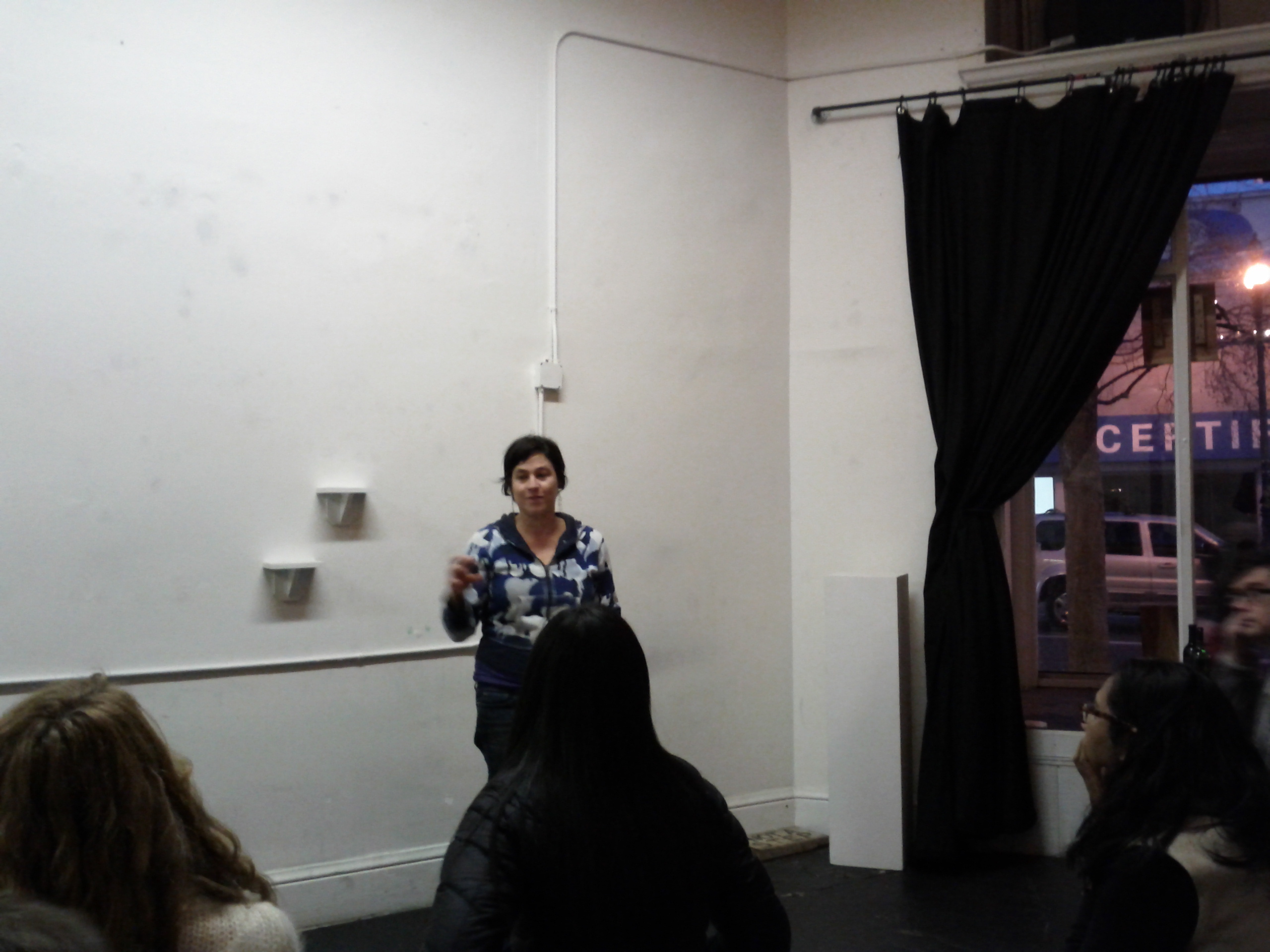
Hazelers are asked to introduce themselves and talk a bit about the piece they’ve chosen to read, which may be something they consider experimental.

Sarah Frisch
Sarah Frisch, fiction

Fiction writer and former Stegner fellow, Sarah Frisch posed a speculative piece also about giving birth but played with the idea that men do the deed while their women partners can only stand by and watch.

Mei Li Ooi
Mei Li Ooi, fiction

Mei Li Ooi was most inspiring with a performative piece utilizing the whole space at the front, assuming the role of each of her characters to capture both the audience by emphasizing tone, mood, and the urgency of her story.

Carolyn Cooke
Carolyn Cooke, fiction

Professor and Department Chair of Writing, Consciousness and Creative Inquiry in the MFA Programs at California Institute of Integral Studies, Carolyn Cooke grabbed our attention immediately with a story about San Franciscan insomniacs.

Monique Wentzel
Monique Wentzel, fiction

And last but certainly not least, current Stegner Fellow Monique Wentzel read a most intriguing short story about a hole that opened up in the south of U.S. endangering a whole town and all the living.

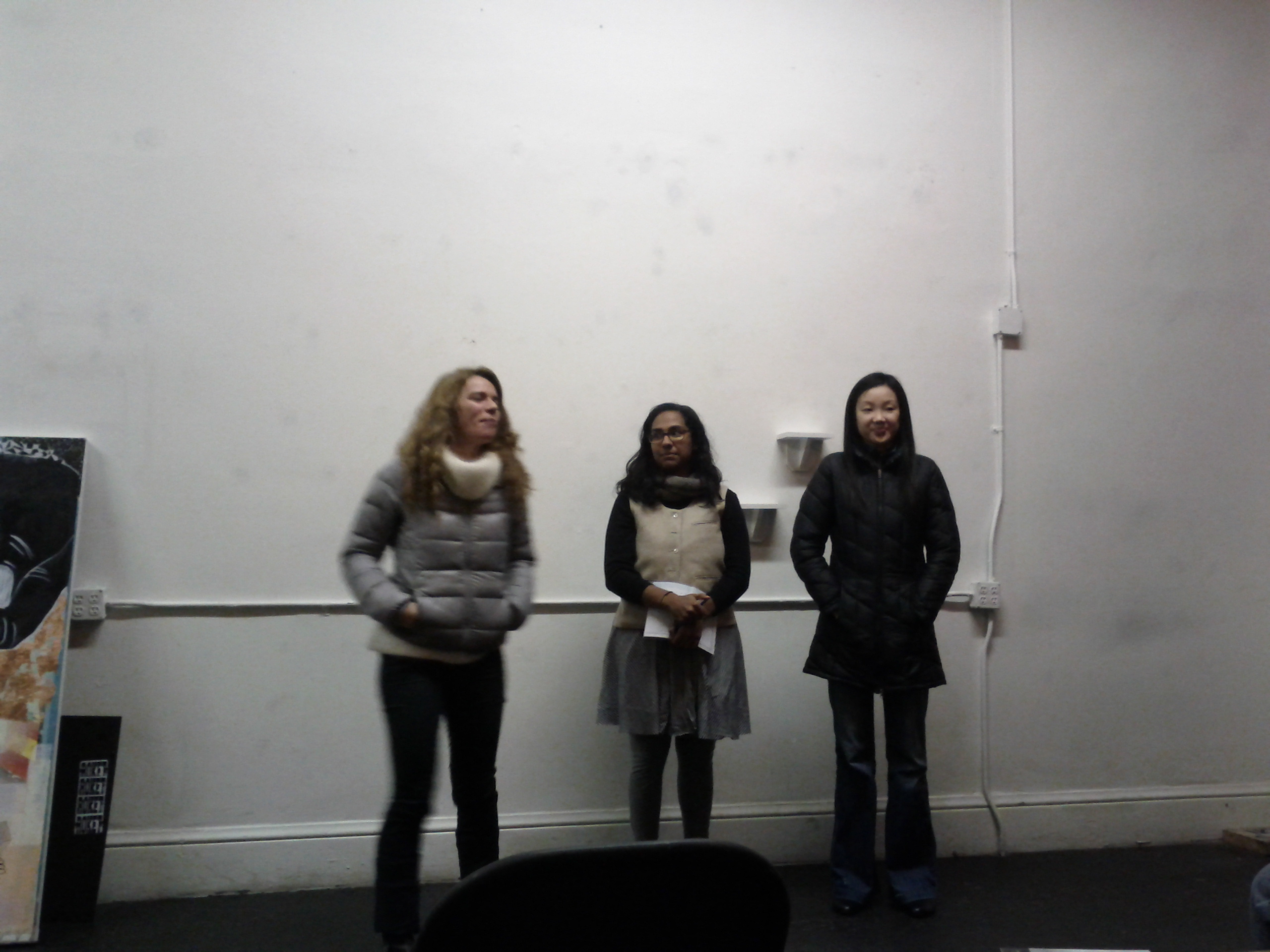
Each of the writers were phenomenal, and as the organizers had introduced at the beginning, organic themes and threads surfaced with each work. The audience was treated to surprising commonalities such as male protagonists and the theme of birth. The next Hazel Reading Series is 5-7pm, Sunday, February 9, 1154 Market. Its a true literary gem in the Bay Area. Many thanks to Erica Eller, Sara Marinelli, Shruti Swamy, and Mei Le Ooi.

The organizers of Hazel Reading Series
letter printing and fashion making at the reading space
the hosting gallery space

All photos courtesy of PJS.

Some (not all) of January’s Reading List

This winter’s schedule might not include teaching classes but that doesn’t mean there’s plenty of homework and reading to do. At the start of 2014, along with the ongoing and maybe some new creative writing projects, the research question rattling this mind is can post-colonial discourse(s) inspire, challenge, and inform the craft of fiction writing? Pictured below are just some of the authors who may or may not light the path with a little Djuna Barnes thrown in for fun.

Previous readings for those interested included John Tomlinson’s Cultural Imperialism (Continuum, 2001), Bill Ashcroft, Gareth Griffiths, Helen Tiffin‘s The Empire Writes Back (Routledge, 2002) and Graeme Harper’s Creative Writing Studies: Practice, Research and Pedagogy (New Writing Viewpoints, 2007). Not pictured but also to be tackled will be Gish Jen’s Tiger Writing: Art, Culture, and the Independent Self (Harvard University Press, 2013).

Maybe more to come on this burning question…

First Reading of 2014 @ Hazel Reading Series: 12 January, 5-7pm in San Francisco

Many thanks to writer and friend Allison Landa for passing on my name to the Hazel Reading Series where I’ve been invited to read this coming Sunday 12 January, 5-7pm, 1564 Market Street, San Francisco. Hope you and yours will be able to join us.

Born two years ago in the living room of founder and graphic designer Erica Eller The Hazel Reading Series as described on their website:

Hazel is a Bay Area reading series in which all of the readers are women writers. Every reader invites another writer whose work they admire to read in the following series. We find that this pattern of organization creates a sense of lineage and a diverse and unpredictable group of readers for each program. In addition to the lineages formed by Hazel invitees, we also invite one notable guest writer to read at each event.

We keep the readings interesting by asking each of the writers to choose to read work in any genre that represents an experimental aspect of their writing. We hope that the writers who take part in Hazel enter into a forum where they feel comfortable taking risks.

Our goal with Hazel is to foster community, support diversity, aid experimentation, and provide an opportunity for women and women-identified writers of the San Francisco Bay Area to network.  We hope to cultivate a space for inclusion and to recognize that women’s voices come in a myriad of forms. Women’s self-representation is a central theme of the series.

Please share widely and consider coming out for some stellar writing!

Screen shot 2014-01-02 at 12.46.31 PM

Final Prep for Panel Talk, Life After The MFA on November 20, 2:35-3:35pm, Hagerty Lounge —

1452501_688082914544440_543522903_n

Life After the MFA: Four authors discuss life after the MFA and cover topics such as agents, teaching, the PhD, a Fulbright, and writing residencies.

Here’s the skinny on what I’ll be covering.

Why a residency or fellowship?

  • In grad school I learned the definition of revision but only after grad school did I really learn what revision felt like, and during each residency I got eyeball deep in revision so I know what it smells and tastes like and what it means to be swimming in it. It takes years of uncertainty. Years of reading great works and years of learning how to read your own so that the project can tell you what it needs.
  • Residencies allow yourself to quiet the mind, settle the body, roll up the sleeves and be immersed in the world of the work.

Background & History of MacDowell 

  • MacDowell is the oldest in the nation, 1901, a composer I met there called it the cultural and artistic matrix of not just US but international artists and creators
  • There are approximately thirty fellows in residency in any given time, including video artists, sculptors, writers, playwrights, etc. Some of the recent notable fellows ach room has a set of boards, called headstones, where past fellows inscribe their name and the date of their stay, some of the greatest, though by no means not all include: ZZ Packer, Michael Chabon, Tillie Olsen, Richard Yates, R. Zamora Linmark (two fellowships at Mansfield!) Jean Valentine, Tayari Jones, Mary Jo Salter, Susan Steinberg, Lysley Tenorio, and Julie Orringer.
  • Each fellow gets a cabin with a fireplace, about a five to fifteen minute walk from the dormitories where most writers stay and you share a bathroom in the dorm.
  • Fellows eat together for breakfast and dinner in the main lodge. Lunch baskets are delivered  to each cabin and the food is obscenely good.
  • Fellows share their work every other night after dinner.
  • There’s always a library and generally limited phone and internet access.
  • January in New Hampshire was like Moscow.

Hawthornden Background & History

  • International Retreat for Writers started by Drue Heinz of the condiment empire, before that the castle was owned by poet and historian Sir John Drummond who was friend’s with Samuel Johnson and even had Dorothy and William Wordsworth stay there.
  • 45 minutes outside of Edinburgh in a very rural and beautiful corner of southern Scotland.
  • Working castle, rooms are varied, shared bathroom, spiral staircase, freezing even in June, runs from September to June one month, six writers, meet for breakfast and dinner with a personal chef who made baked ham and sticky toffee pudding that had us in tears of joy.
  • Library and castle grounds to walk.
  • All sorts of magical animal encounters- kestrels, peregrines, badgers feeding on the lawn at dusk along with bats. Evening sightings of stags, and fawn. A bat flew into the drawing room, where met every evening for pre-cordial, sherry, all the poets wrote about their bat and stag encounters, and the fiction writers were generally chained to the universe of the project, could barely take time out to write about the landscape and experience because you’re taking time out. Had never been so jealous of poets
  • One of the many traditions practiced at the Colony is for fellows to give presentations of their work, whether it be a reading or an open studio, you’re encouraged to share your artistic endeavors. The idea wasn’t that appealing, really, until a fellow explained that its best to present earlier rather than later during residency so that other fellows will have much needed context in terms of why you’re here and what you’re doing. This context cements a substantive foundation to conversations at dinner, breakfast, random encounters on the hallway or on the way to the studio. The whole purpose of the colony is not just for individual, solitary work but to be a part of the community, and being a part of a community means sharing.


APPLYING

  • Maintain contact with professors from graduate school since they are the community who will support you through this creative journey, and be sure to make the recommendation letter process as easy as possible by giving at least two months advance notice with all the supplies already stamped and addressed, ready to post. Keep a short sample, CV, and statement handy if they request it to refresh their memory about you and your work.
  • 344 Questions: The Creative Person's Do-It-Yourself Guide to Insight, Survival, and Artistic FulfillmentKeep refining both your artist statement/letter of intent and the writing sample. These are the two legs you’ll stand on when you face the faceless committee. Keep a list of questions and journal freewrites in response to keep the artist statement/letter of intent urgent and relevant. It should change as you evolve as a writer. I love this little gem of a book 344 Questions?: The Creative Person’s Do-It Yourself Guide to Insight, Survival, and Finding Artistic Fulfillment which I crack open every now and again just to exercise and play with portrayals of self. These musings come handy when piecing together and updating the artist statement.
  • Literature Summary Description (MacDowell Colony)

In two to five words, please describe the work you are proposing to do at the Colony. You will have an opportunity to describe the project in greater detail in the next step of the application. Examples: memoir, historical novel, short fiction, prose poetry.

In the space below, please provide a detailed description of the project you intend to work on at the Colony. If you have already begun the project, tell us where you are in the work process and what you hope to accomplish with your residency. The text field is limited to 2,500 characters including spaces.

  • Intended Project (MacDowell Colony)

Please provide a brief synopsis of the creative work you propose to write if offered a Residential Fellowship at Hawthornden. This may be work already in progress or work still in its infancy. You should be sure to mention any necessary research that you may need to undertake while in residence. Please limit your description to this sheet only.

What to Bring

What to Bring

  • SPACE- All your favorite creature comforts: chai tea, scented candles, warm socks, an eye mask, if you have trouble sleeping in strange places, blank pads of paper and post-its, permanent markers, push pins, chocolate, nice stationary and stamps to write to loved ones, a wall calendar to keep on task, a hard drive to back up regularly, a pocketknife, and gin, lots of gin or your personal choice of poison because you deserve it after a long day’s worth of reading and writing.

Wrapping Up

  • Renewing vows to writing.
  • Relearning what it means to read.