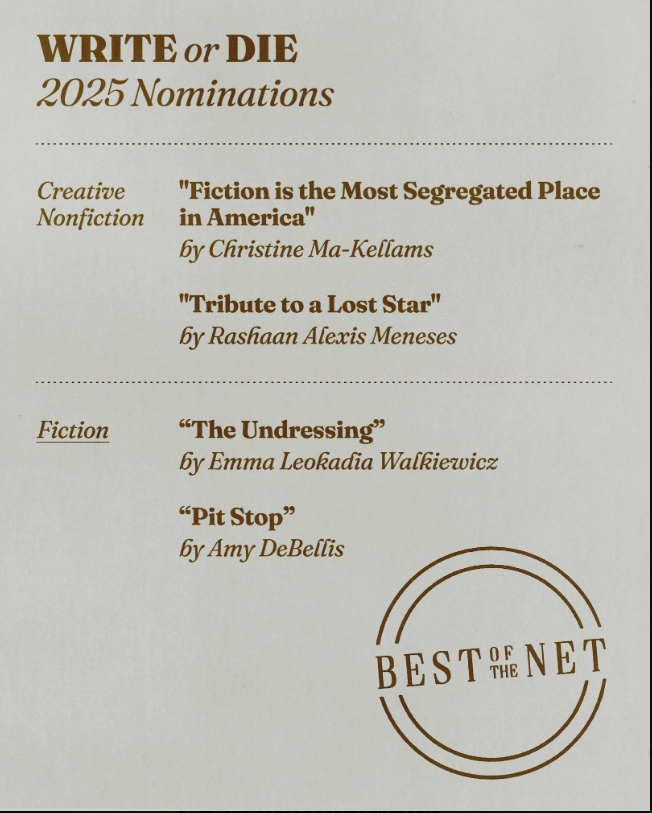
At the beginning of 2023, I wrote a short essay that was so very near and dear to my heart and submitted this little essay to 47 different literary reviews and mags, after which the rejections kept streaming through my inbox. A year later, the piece finally found a home. I’m so very grateful to Write or Die Magazine, not just for believing in these words that became “Tribute to a Lost Star”, but for nominating this work for the Sundress Best of the Net Anthology.
The piece is about literary and cinematic influences that strike us in our adolescence only to shape our sense of self and the world around us as we evolve. I hope to write more pieces like this.
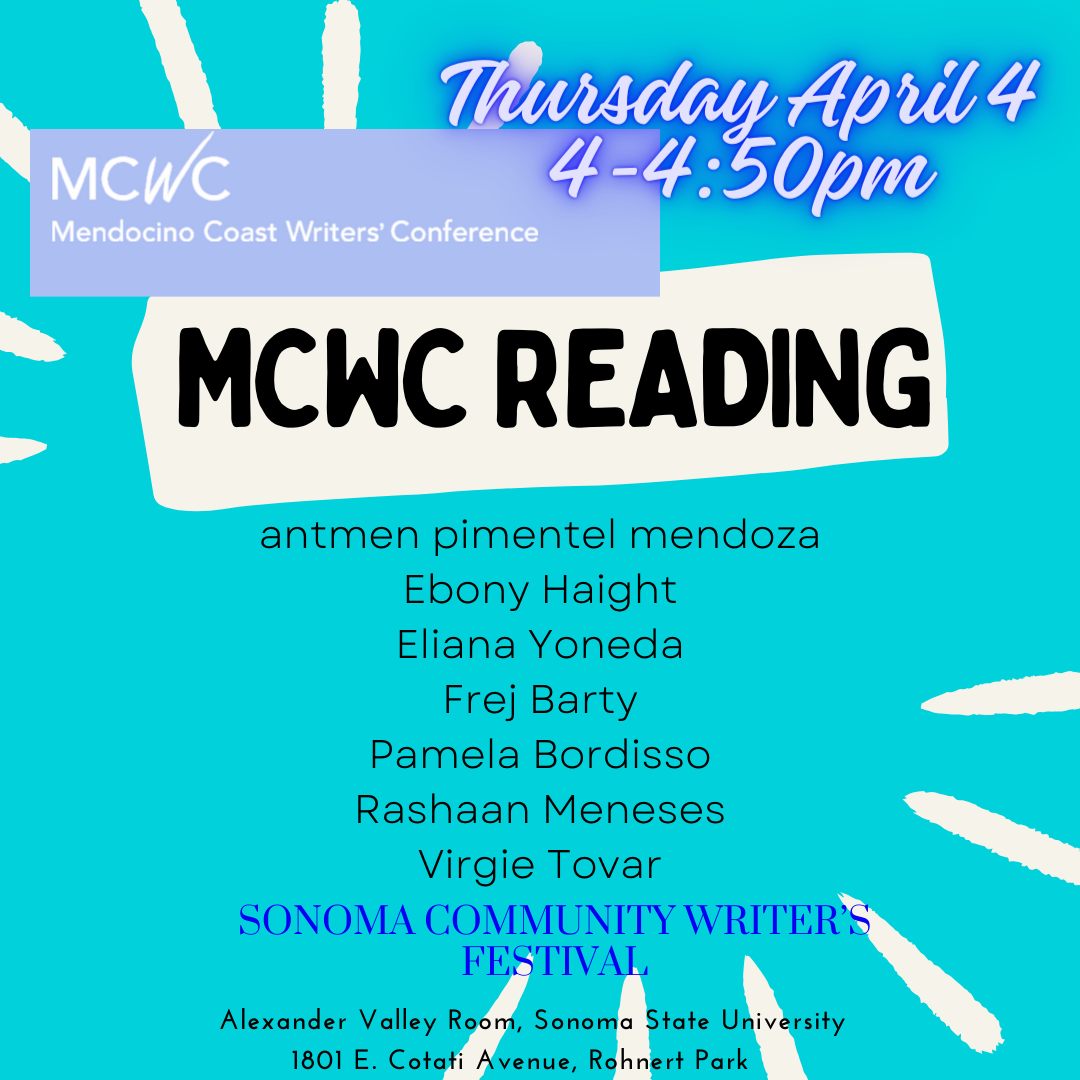
No registration is required. The festival is free and open to the public.
Sonoma State University is located at 1801 E. Cotati Avenue, Rohnert Park. General Parking is $5.00, Reserved Parking in Lot D is $8.00. The passes can be purchased in the lots or at the booth at the entry to campus.
I’m honored to be a part of the return of the Filipino International Book Festival this weekend, October 15-16 at the San Francisco Main Public Library, where I’ll be hosting Ink Storm #3 with luminaries:
Marianne Chan Liza Gino jxtheo Alan Samson Manalo Veronica Montes Vicente Rafael Lara Stapleton Kenneth Tan Host: Rashaan Alexis Meneses Koret Auditorium, Basement
The 6th Filipino American International Book Festival returns to the San Francisco Main Library on Oct 15-16 after a three year hiatus. It is a spectacular lineup of writers and publishers from around the US, the Philippines, and Europe, celebrating the theme of “Hiraya/Emergence.”
The festival will open with a live performance from “Larry the Musical,” a much anticipated production about labor activist Larry Itliong. It will feature headliners Gina Apostol, Erin Entrada Kelly, and Meredith Talusan, panels, author readings, book signings, a free writing workshop, and a books + comics marketplace. We’ll close with a pre-recorded interview with Nobel laureate Maria Ressa and journalist Ben Pimentel.
For the families and teachers, we’re offering a Kids + Teen program. We’ll offer slime-making, a zine workshop, author readings and signings, a puppet show, a giveaway of 80 book bundles, and more for all ages. And if you love YA and MG, catch our authors in discussion with National Book Award finalist Randy Ribay.
Help us by spreading the word, or volunteering with us. Share this email with a teacher, bring a friend, bring your kids, bring yourself! All events are 100% free.
This past April 4, 2018, yours truly had the honor to introduce and chat with the poetic storyteller Shanthi Sekaran about her new novel Lucky Boy. Sekaran is currently the 2018 Distinguished Visiting Writer in Fiction and Creative Nonfiction in the MFA Program in Creative Writing at Saint Mary’s College, and her work includesThe Prayer Room. Lucky Boy is the tale of two women who’s lives are forever linked by love and loss.
The video of her reading and our Q&A is now up as part of SMC MFA Creative Reading Series, so you can see for yourself the brilliance of Sekaran. Please treat yourself and share with other lovers of word and story.
Most days I feel like a mess, other days I know I’m an educator, a wife, a mom, a hiker, a home cook and gardener, but I love the days when I can call myself a “Writer” and thanks to Melissa Sipin, I got a chance to escape the imposter syndrome and discuss some of my greatest loves and life’s passions. Professor Jee Yoon Lee, who teaches at the Georgetown University Writing Program, has created an incredibly comprehensive website featuring Asian/American writers and artists with “Writing Like An Asian.” The scope is astonishingly wide and the interviews are deep, such as Q&A’s with Sipin, Barbara Jane Reyes, Marianne Villaneuva, David Mura, and the list goes on and on.
Here’s a taste:
Every word I write is summoned by my mixed race heritage, and the hundreds if not thousands of miles my grandparents traveled from the Philippines and from Mexico to make a life for them selves and for our family here in the States. I feel in some sense I am re-telling the same story, the origin of our mixed ancestry. How opposing forces from different parts of the world came together to make new.
Joy. Trepidation. Excitement. Yours truly tumulted through a gamut of responses when I opened the email declaring acceptance of a presentation proposal I almost gave up on and didn’t submit. But how could I resist the chance to throw in my hat for The International Creative Writing Conference, UK to be held this coming June at Imperial College, London? And what better topic to tackle than identity and creativity?
I’ve just assigned myself a hefty reading list to hopefully answer questions I’m a little scared to approach. The urgency to these questions is undeniable, not just for myself but for our writing communities. Below is the abstract and following are a list of links and articles that have spurred my mission along with the reading list I’ve assigned myself for the next few months.
Craft is Culture: Writing & Reading A Global Imagination
“In my workshop we never explored our racial identities or how they impacted our writing—at all. Never got any kind of instruction in that area—at all…” Junot Diaz states in his “MFA vs. POC” (New Yorker, 2014) thereby igniting an urgent conversation about diversity in the literary arts. For historically marginalized artists, creative writing begins and ends with perilous tension. If we write and read from this premise, we are primed and prepared for the necessary conflict to fuel our art. How do we engage and interrogate craft to help us explore our understandings of identity and politics, and, conversely, how do we test notions of identity and politics to enrich and deepen our craft? Recognizing that craft is culture and that tension drives all creative writing, this presentation explores reading and writing practices to incite a global cultural imagination that ultimately pinpoints intersections where truth meets art.
“We’ve certainly seen an increased urgency among individual student writers to locate themselves and their work within the evolving culture,” she says. For some, that urgency comes from self-identification with a particular ethnic or racial heritage. Others want to explore race as a means, as Voigt says, “to expand imaginative empathy without encroachment or appropriation.”
Shivani, Anis, Against the Workshop: Provocations, Polemics, Controversies
Anzaldúa, Gloria, Light in the Dark/ Luz en lo Oscuro: Rewriting Identity, Spirituality, Reality
and more to come…
The hope and ultimate aim is to expand these ideas into workshops engaging communities in the flesh. If you have any suggestions or would like to dialogue about craft and culture, please don’t hesitate. I’d love to hear your thoughts.
Since I’ve got a thing for the ekphrastic, I’m really looking forward to participating in this unique literary event. Here’s why:
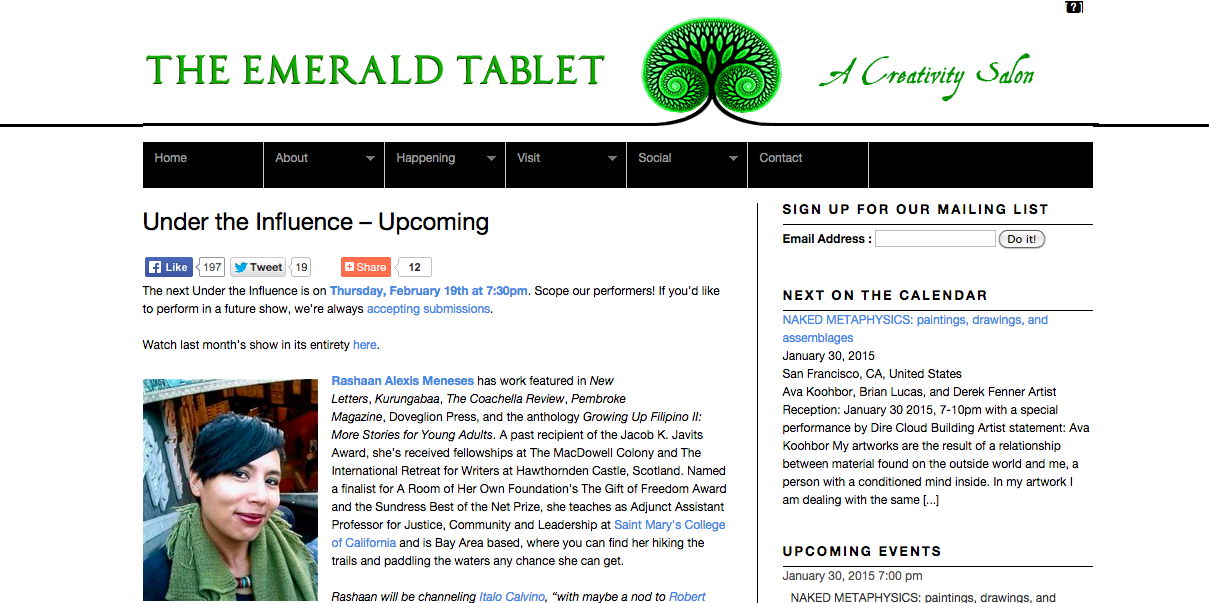
The Emerald Tablet is proud to host the third round of its first homegrown performance series, co-created with and hosted by Quiet Lightning‘s Evan Karp.
Four artists perform work by some of their major influences, followed by original work created for the show that channels that influence. Artists have 15 minutes to perform and will help select the following month’s performers, so that each show is inspired by the one before. In addition, each month an influence will be announced, and we will accept submissions of original work in response; one will be selected to be performed in the next show.
Mark your calendars, please spread the word, and hope to see at what should be an enlightening experience. More to come…
This winter’s schedule might not include teaching classes but that doesn’t mean there’s plenty of homework and reading to do. At the start of 2014, along with the ongoing and maybe some new creative writing projects, the research question rattling this mind is can post-colonial discourse(s) inspire, challenge, and inform the craft of fiction writing? Pictured below are just some of the authors who may or may not light the path with a little Djuna Barnes thrown in for fun.
Previous readings for those interested included John Tomlinson’s Cultural Imperialism (Continuum, 2001), Bill Ashcroft, Gareth Griffiths, Helen Tiffin‘s The Empire Writes Back (Routledge, 2002) and Graeme Harper’s Creative Writing Studies: Practice, Research and Pedagogy (New Writing Viewpoints, 2007). Not pictured but also to be tackled will be Gish Jen’s Tiger Writing: Art, Culture, and the Independent Self (Harvard University Press, 2013).




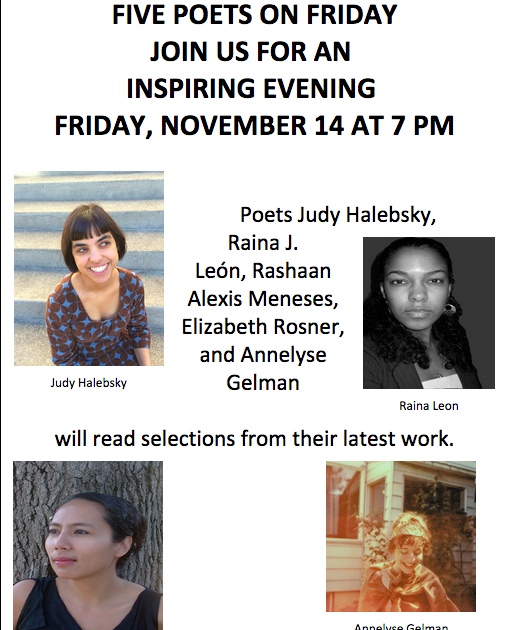

 Rashaan Alexis Meneses